


As hopes faded yesterday of finding any survivors in the destroyed Tunghsing Building (
Civil engineers, meanwhile, said yesterday that damage to the structure -- not liquefaction caused by last Tuesday's quake -- was the likely cause of the building's collapse.
While bulldozers peeled off the upper part of the building that had housed a hotel, a bank and residential apartments on Pateh Road, four more bodies were found in the rubble, bringing the death toll at the site to 32.
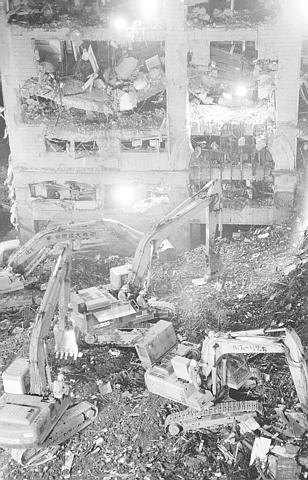
PHOTO: GEORGE TSORNG, TAIPEI TIMES
But over 50 were still trapped in the wreckage, city officials said.
Amid flying dust caused by the demolition work, relatives and friends of those still trapped in the wreckage kept waiting, though with little hope that any survivors could be found in the rubble.
Lee Fa-jen (
Lee then urged the government to find out the real cause of the collapse so as to do justice to those who lost their lives.
At the same time, professionals from Taipei Civil Engineering Technicians' Association -- which was endorsed by the Taipei District Court to help the investigation -- joined city officials and prosecutors in collecting evidence at the site.
Chien Mao-chou (
"So we've ruled out the possibility of liquefaction as the cause of the collapse," Chien said.
Seismologists say one of the greatest risks of earthquake damage occurs when the ground beneath the building liquefies -- a particular danger in some areas of Taipei, which is built on an alluvial basin.
Chang Chung-peng (
"They didn't sink. Instead, it is defects in the building's structure that is related to the collapse," Chien added.
But further investigation is required before the association can come up with a detailed analysis of what they dubbed the "failure of the building's structure," Chien said.
When asked if their investigation had shown that remodeling work at the First Commercial Bank on the ground floor had caused the collapse (as alleged by many residents of the building), Chuang said "such speculation lacks obvious evidence, so it can not serve as the basis of our analysis."
"All of our judgment should have a scientific basis," Chien added.
Lee Horng-ji (
"I can only say that we've ruled out two possibilities: liquefaction engendered by the quake and instability (of the building) caused by soft soil," Lee said.
Chou Chih-jung (
"We need to investigate any people and material evidence related to the case ... But my personal feeling is that we should not make any speculations at the current stage," he said.
"What our society needs is the real answer, and what we need to do is to find out the real cause of the collapse," he said.
Meanwhile, the dangerous building count in the city reached 24, including 449 households, with four more added to the list yesterday, said Taipei City Mayor Ma Ying-jeou (
Ma said residents in these buildings -- now marked as dangerous by red notes posted by the city government -- are requested to evacuate for safety's sake.
A one-off rental subsidy of NT$30,000 will serve as an incentive for these residents to leave their dangerous dwellings, said Ma.
"Of course, it is their own dwellings that have some problems. And if the fault lies in the construction companies which built these places, then people should seek compensation from these firms," he said.
"But it is from the angle of public safety that the city government offers such an incentive to encourage them to leave," he said.

‘NO SECURITY RISK’: The Railway Bureau reassured the public that the technicians’ activities were limited to technical guidance and did not involve sensitive systems The Railway Bureau yesterday said it had invited eight Chinese technicians to assist with an airport MRT construction project. The bureau issued the confirmation after an Internet user said Chinese nationals had entered the construction zone of Taiwan Taoyuan International Airport’s Terminal 3 project. They asked why “individuals from an enemy state” were allowed access to such a major national infrastructure project, which raised serious concerns over Taiwan’s industrial safety, sensitive systems and information security. The bureau’s Northern Region Engineering Branch Office said subcontractor Taiwan Handle Industrial Co (台灣手把工業) of the Taoyuan airport MRT’s “Contract No. CU05 Project A14 Station Civil, MEP &

A US uncrewed surface vessel (USV) encountered multiple Chinese warships during an autonomous transit of the Taiwan Strait, US defense company Seasats said in a statement on Wednesday. Seasats announced that a Lightfish USV had completed the first autonomous transit of the Taiwan Strait. Over five days, the USV traversed the entire length of the Strait while constantly monitoring surface vessel traffic, the company said. The Lightfish encountered multiple Chinese warships, one of which was a Chinese People’s Liberation Army Navy (PLAN) Type 056 corvette, it said. The Chinese vessels were operating “well within Taiwan’s exclusive economic zone without transmitting their identity via the
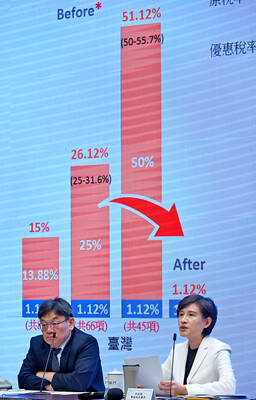
GREATER REACH? Auto parts and wood products would face tariffs of up to 15%, matching those targeting the EU, Japan and South Korea, Vice Premier said The US has announced that preferential tariff treatment for Taiwan’s non-semiconductor Section 232 goods would take effect retroactively from May 1, the Executive Yuan said yesterday. The US government yesterday posted a notice on the Federal Register’s public inspection Web site previewing tariff concessions for Taiwan under a memorandum of understanding (MOU) on Taiwan-US investment after two months of negotiations. The MOU signed on Jan. 15 stipulated three major preferential tariff arrangements: a 15 percent “reciprocal” tariff rate for Taiwan without stacking most-favored nation (MFN) rates; preferential Section 232 treatment for semiconductors and related products; and preferential Section 232 treatment for non-semiconductor

The National Chungshan Institute of Science and Technology yesterday showcased its locally developed variants of the Vision 60 robotic patrol dog, which it plans to deploy on the nation’s outlying territories in the South China Sea. The variants were produced under the Joint Lab project — created by the institute and domestic companies — and assembled with domestically produced motors, lenses and artificial intelligence (AI) systems alongside licensed tech from the US, Missile and Rocket Systems Research Division deputy director Jen Kuo-kang (任國光) told the media event at a military base in Taipei’s Dazhi (大直) area. Taiwan has built up its strengths


 RSS
RSS