


Though the KMT and PFP have been consummate bedfellows since agreeing to cooperate after the Dec. 1 legislative elections, numerous political developments could threaten the relationship, analysts say.
While the two share the same pro-China ideology, the PFP and KMT don't agree on all the issues.
In addition, there's the rising star of KMT member and Taipei Mayor Ma Ying-jeou (馬英九), who may be a contender for the presidency in 2004 against PFP Chairman James Soong (宋楚瑜).
"The opposition and ruling party differ on as many as 90 percent of the issues, which makes it rather natural for the two opposition parties to cooperate," said Emile Sheng (盛治仁), an assistant professor of political science at Soochow University.
Still, that doesn't mean that the KMT and PFP will always see eye to eye.
In addition to reform issues, Sheng said, conflicts could arise over a DPP proposal to investigate the KMT's assets and return to the government property that was stolen by the former ruling party.
"The real test comes only when there are cases concerning partisan interests," Sheng said. "This kind of test hasn't occurred so far."
After the DPP became the largest party in the legislature as a result of the Dec. 1 elections, KMT Chairman Lien Chan (
The first occasion to test out their relationship came last month, when the KMT tapped the PFP for help in passing changes to the Law Governing the Allocation of Government Revenues and Expenditures. The changes -- proposed by Taipei Mayor Ma -- would have given local governments more money from central government coffers and were passed in the previous legislature.
PFP lawmakers threw their support behind the amendments after Ma called Soong personally for support.
The two parties were also successful in obtaining the posts of legislative speaker and vice speaker for KMT members -- despite the KMT's minority status. In this case, the PFP's concession that it wouldn't vie for the posts was instrumental.
And in this week's showdown with the Cabinet over Ma's budget allocation changes, the KMT and PFP managed to muster 109 votes in favor of keeping the amendments in place.
Although that was four votes short of the 113 needed to win the day, the two parties still garnered six more votes than the pan-green camp.
The Cabinet was able to shoot down Ma's amendments because KMT and PFP no-shows failed to cast ballots.
These instances of cooperation between the pan-blue parties has led to optimism about further cooperation in the year-end Taipei and Kaohsiung mayoral elections.
Another area of possible cooperation -- or conflict -- may be the 2004 presidential race. It has been widely speculated that Soong has given his support to the KMT in exchange for a favor from Ma -- namely that he finish the second term as mayor that he seeks instead of running for the presidency.
The Taipei mayor is the KMT's best hope of winning back the nation's highest office, and he has scored higher approval ratings than Soong in some public polls.
But while KMT-PFP cooperation is working fine for now, Sheng doubts whether chummy relations can be maintained until 2004. One factor is that Ma's desire to seek the presidency may increase with his political popularity.
Even if the two parties cooperate in elections later this year, that could be threatened by defections of KMT members who would rather run under the PFP banner for city council posts, Sheng said.
Liao Da-chi (
But Liao said political reality would force the KMT and PFP to get along.
"The reality is that unless they cooperate with each other, the KMT and PFP won't be able to share even a single piece of the pie," Liao said. "Under such pressure, the two parties will still have to work out ways to try to overcome their differences, despite all the difficulties."
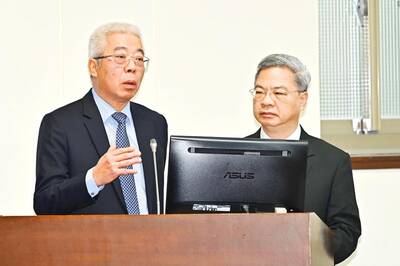
Taiwan has arranged for about 8 million barrels of crude oil, or about one-third of its monthly needs, to be shipped from the Red Sea this month to bypass the Strait of Hormuz and ease domestic supply pressures, CPC Corp, Taiwan (CPC, 台灣中油) said yesterday. The state-run oil company has worked with Middle Eastern suppliers to secure routes other than the Strait of Hormuz, through which about 20 percent of the world’s oil and liquefied natural gas typically passes, CPC chairman Fang Jeng-zen (方振仁) said at a meeting of the legislature’s Economics Committee in Taipei. Suppliers in Saudi Arabia have indicated they
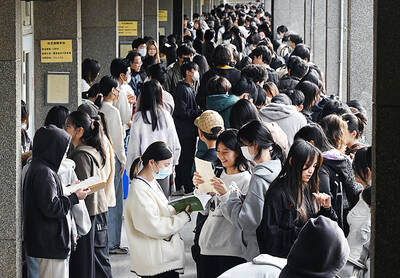
A global survey showed that 60 percent of Taiwanese had attained higher education, second only to Canada, the Ministry of the Interior said. Taiwan easily surpassed the global average of 43 percent and ranked ahead of major economies, including Japan, South Korea and the US, data from the Organisation for Economic Co-operation and Development (OECD) for 2024 showed. Taiwan has a high literacy rate, data released by the ministry showed. As of the end of last year, Taiwan had 20.617 million people aged 15 or older, accounting for 88.5 percent of the total population, with a literacy rate of 99.4 percent, the data
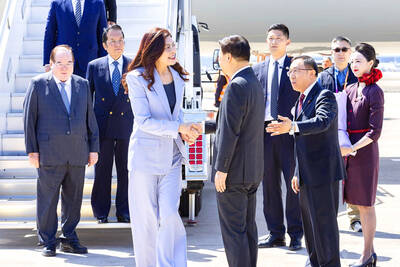
CCP ‘PAWN’? Beijing could use the KMT chairwoman’s visit to signal to the world that many people in Taiwan support the ‘one China’ principle, an academic said Chinese Nationalist Party (KMT) Chairwoman Cheng Li-wun (鄭麗文) yesterday arrived in China for a “peace” mission and potential meeting with Chinese President Xi Jinping (習近平), while a Taiwanese minister detailed the number of Chinese warships currently deployed around the nation. Cheng is visiting at a time of increased Chinese military pressure on Taiwan, as the opposition-dominated Legislative Yuan stalls a government plan for US$40 billion in extra defense spending. Speaking to reporters before going to the airport, Cheng said she was going on a “historic journey for peace,” but added that some people felt uneasy about her trip. “If you truly love Taiwan,

NEW LOW: The council in 2024 based predictions on a pessimistic estimate for the nation’s total fertility rate of 0.84, but last year that rate was 0.69, 17 percent lower An expected National Development Council (NDC) report expects the nation’s population to drop below 12 million by 2065, with the old-age dependency ratio to top 100 percent sooner than 2070, sources said yesterday. The council is slated to release its latest population projections in August, using an ultra-low fertility model, the sources said. The previous report projected that Taiwan’s population would fall to 14.37 million by 2070, but based on a new estimate of the total fertility rate (TFR) — the average number of children born to a woman over her lifetime — the population is expected to reach 12 million by


 RSS
RSS