


The US has played down the Chen Shui-bian (陳水扁) government's decision to add the words "Issued in Taiwan" to the cover of its passports, saying the action will not change things from Washington's perspective.
State Department spokesman Richard Boucher said that the addition of the words to the passport cover "doesn't affect how we deal with travel by or travel documents of the people in Taiwan. That's the bottom line for us."
Boucher refused to comment on Beijing's complaints that the move could be seen as another step toward Taiwanese independence or whether it signifies a change in Taiwan's official name, the Republic of China.
"I don't think I want to speculate any more broadly on what the change might imply," Boucher told reporters.
Boucher also refused to get involved in the meaning of the fact that the change was made during a meeting in Taiwan of the Formosan Association for Public Affairs, a major Taiwan lobbying group based in Washington whose roots are in the Taiwan independence movement.
"Taiwan authorities have said this does not represent any particular change in policy for them," he said.
"We take them at their word, and it won't affect how we deal with the documents or travelers."
The vast majority of people from Taiwan, including the nation's officialdom, have always enjoyed virtually-free access to the US.
The top leaders, including the president and vice president, have been limited to transit visas en route to Latin America and elsewhere.
These stops were tightly controlled, limited generally to overnight airport stopovers until last year, when Chen was allowed to stop off in New York for three days of meetings and sightseeing and another stopover in Houston en route home, although he was barred from making any public pronouncements.
Similar treatment was accorded earlier this month during the New York transit stop of Vice President Annette Lu.
Still, Taiwanese routinely travel back and forth between Taiwan and the US on visas, often finding jobs and gaining permanent residency or citizenship.
Several members of Congress, who met with Chen in New York last year, have pushed for looser rules that would allow the president and other top leaders to make public statements in the US.
The National Press Club has a standing invitation for him to speak at a public club function.
However, the terms and para-meters of the US' "unofficial" relations with Taiwan prohibit that, and there appears to be no serious effort afloat to change those terms in the near future.
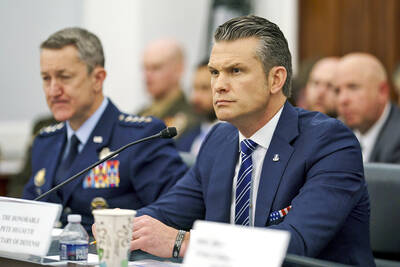
BUILDUP: US General Dan Caine said Chinese military maneuvers are not routine exercises, but instead are ‘rehearsals for a forced unification’ with Taiwan China poses an increasingly aggressive threat to the US and deterring Beijing is the Pentagon’s top regional priority amid its rapid military buildup and invasion drills near Taiwan, US Secretary of Defense Pete Hegseth said on Tuesday. “Our pacing threat is communist China,” Hegseth told the US House of Representatives Appropriations Subcommittee on Defense during an oversight hearing with US General Dan Caine, chairman of the Joint Chiefs of Staff. “Beijing is preparing for war in the Indo-Pacific as part of its broader strategy to dominate that region and then the world,” Hegseth said, adding that if it succeeds, it could derail

CHIP WAR: The new restrictions are expected to cut off China’s access to Taiwan’s technologies, materials and equipment essential to building AI semiconductors Taiwan has blacklisted Huawei Technologies Co (華為) and Semiconductor Manufacturing International Corp (SMIC, 中芯), dealing another major blow to the two companies spearheading China’s efforts to develop cutting-edge artificial intelligence (AI) chip technologies. The Ministry of Economic Affairs’ International Trade Administration has included Huawei, SMIC and several of their subsidiaries in an update of its so-called strategic high-tech commodities entity list, the latest version on its Web site showed on Saturday. It did not publicly announce the change. Other entities on the list include organizations such as the Taliban and al-Qaeda, as well as companies in China, Iran and elsewhere. Local companies need
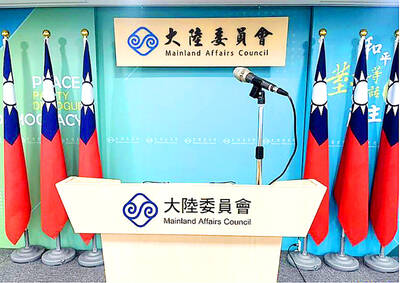
CROSS-STRAIT: The MAC said it barred the Chinese officials from attending an event, because they failed to provide guarantees that Taiwan would be treated with respect The Mainland Affairs Council (MAC) on Friday night defended its decision to bar Chinese officials and tourism representatives from attending a tourism event in Taipei next month, citing the unsafe conditions for Taiwanese in China. The Taipei International Summer Travel Expo, organized by the Taiwan Tourism Exchange Association, is to run from July 18 to 21. China’s Taiwan Affairs Office spokeswoman Zhu Fenglian (朱鳳蓮) on Friday said that representatives from China’s travel industry were excluded from the expo. The Democratic Progressive Party government is obstructing cross-strait tourism exchange in a vain attempt to ignore the mainstream support for peaceful development
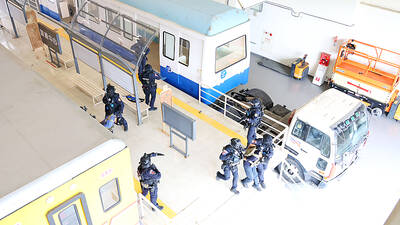
ELITE UNIT: President William Lai yesterday praised the National Police Agency’s Special Operations Group after watching it go through assault training and hostage rescue drills The US Navy regularly conducts global war games to develop deterrence strategies against a potential Chinese invasion of Taiwan, aimed at making the nation “a very difficult target to take,” US Acting Chief of Naval Operations James Kilby said on Wednesday. Testifying before the US House of Representatives Armed Services Committee, Kilby said the navy has studied the issue extensively, including routine simulations at the Naval War College. The navy is focused on five key areas: long-range strike capabilities; countering China’s command, control, communications, computers, cyber, intelligence, surveillance, reconnaissance and targeting; terminal ship defense; contested logistics; and nontraditional maritime denial tactics, Kilby


 RSS
RSS