


The eagerness of the government to burn garbage as a solution to the shortage of landfill sites has left it with an unusual problem: there is not enough garbage to burn.
According to the Environmental Protection Administration (EPA), by the time 36 new incinerators have been completed in 2003, about 90 percent of the garbage generated in Taiwan will be burnt.
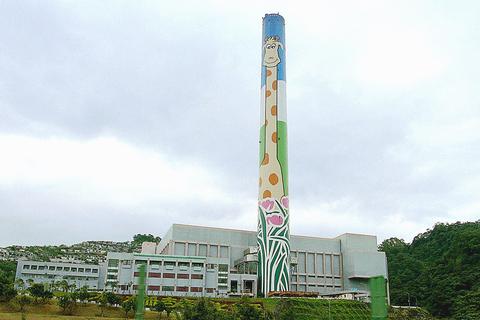
PHOTO: CHIANG YING-YING, TAIPEI TIMES
Anti-incinerator activists, however, say that the proliferation of recycling programs has resulted in a dramatic drop in in the amount of waste generated in recent years, making the policy of building so many incinerators absurd.
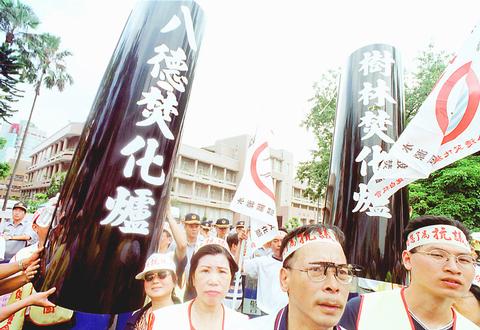
PHOTO: LIAO RAY-SHANG, TAIPEI TIMES
The Green Citizens' Action Alliance says that by 2003, Taiwan will have incinerators capable of burning 30,400 tonnes of household waste per day. However, last year the country generated only 21,000 tonnes of waste per day.
"The amount of waste generated in Taiwan is still in decline due to the promotion of recycling. So, what are we going to burn?" said Chen Jian-zhi (
The success of the EPA's recycling program means that 7.3 percent of household waste was recycled this year, up from 5.1 percent last year.
Until the 1990s, landfills were the usual destination for garbage. By the end of 1993, 90 percent of household waste was dumped in landfills.
Small and densely populated, Taiwan quickly ran out of landfill sites to dump garbage. By the mid-1990s, large waste incinerators in urban areas began operation to take the pressure off landfills.
But by the end of 1998, 75.3 percent of waste was still sent to landfills, while 19.6 percentage was burnt. Another 5.1 percent was disposed of in other ways, such as outdoor burning and dumping.
So the EPA set a target of burning 90 percent of waste by 2003, and started construction of public and private incinerators to meet that goal. If it succeeds, Taiwan will burn proportionately more garbage than any other country.
At a public hearing at the Legislative Yuan last week, Chen said that the country has unnecessarily been building waste incinerators everywhere.
He offered the example of an incinerator which is planned for Linnei township (
Chen argued that the EPA's own statistics imply that the county doesn't need the incinerator. Chen said the entire county generated only 647 tonnes of waste per day last year, down from 762 tonnes per day the previous year.
"In the future, as more and more waste is recycled, the amount of waste will drop dramatically," Chen said.
Chang Tsui-ping (
"In our village, more than 30 percent of the waste can be recycled," Chang said.
The recycling rate in Wutu is much higher than the national average, where the recycling rate rose to 4.8 percent last year from 0.6 percent in 1998.
Many residents of Linnei township believe that the planned incinerator will pollute their water supply because the proposed incinerator is just 1.8km from an area earmarked for a new water-treatment plant.
Changhua County faces the same problem. Residents near the site of the planned Changpei waste incinerator, which would have the capacity to treat 800 tonnes of household waste a day, fear it will pollute cattle and dairy farms 1.5km away and say the waste produced in the area does not justify an incinerator.
According to the county's environmental protection bureau, residents produce an about 1,280 tonnes of waste a day, which is handled mostly by the county's landfill and an incinerator with 900 tonnes of daily capacity.
According to the bureau's statistics, the 900-tonne incinerator treats an average of 720 tonnes of garbage a day, about 80 percent of its capacity.
Similar cases highlighting the potential shortage of garbage to burn have emerged around the country and legislators are starting to question the EPA's waste-burning policy.
"We all remember the garbage wars that resulted from the shortage of landfill sites a decade ago, when garbage that no one wanted to take responsibility for was dumped on counties' borders," said DPP legislator Lai Chin-lin (
According to the build-operate-transfer agreements for some of the incinerators, local governments have to provide guarantees to the incinerator operators on the amount of garbage they will burn.
Hualien County has been criticized by environmentalists after it promised to supply 320 tonnes of waste a day to a planned incinerator with a capacity of 400 tonnes.
During each incinerator's first 20 years of operation, the builder has the right to charge the local government if it fails to supply the agreed amount of garbage.
This kind of agreement has led to squabbling between local authorities.
One notable case occurred in Kaohsiung County, where two incinerators with a combined capacity of 2,700 tonnes fought over the 1,200 tons of waste generated each day by the residents.
Kaohsiung City faces the same problem. Two public incinerators in the city with a combined capacity of 2,700 tonnes share the 1,800 tonnes of waste generated each day.
As a result, environmentalist suspect that industrial waste is being treated at public waste incinerators, which are designed to burn household waste.
In January this year, the EPA revised the Waste Disposal Act, allowing non-hazardous industrial waste and non-infectious medical waste to be treated by existing waste incinerators. The EPA said the law needed to be revised to prevent illegal dumping and provide a way for dealing with non-hazardous waste.
The change in the law has allowed some incinerators to sign deals with industrial companies to make up for the lack of household waste. And demand from industry seems to be enough that the incinerators can even raise their prices.
The Peitou waste incinerator in Taipei City recently announced that the charge for treating non-hazardous industrial waste next year would rise to NT$2,000 per tonne from NT$1,600.
"We suspect that incinerators now under construction are designed to burn toxic industrial waste because it's more economical for the industry," said George Cheng (鄭益明), the executive general of the Taiwan Watch Institute, an environmental group.
Activists said that the handling fee for treating toxic solvents in Taiwan was about NT$10,000 per tonne.
Environmentalists criticize the new policy because they fear that incinerator operators lack the professional skills needed to inspect the waste sent to incinerators.
Chen, of the Green Citizens' Action Alliance, says the EPA should be investigate rumors that the Peitou waste incinerator has been treating hazardous industrial waste.
EPA officials said, however, that special operation guidelines for treating non-hazardous industrial waste have been followed by operators at the incinerator, which can burn 1,800 tonnes of waste a day.
"We have a comprehensive mechanism to inspect all waste sent to the plant because we previously discovered some toxic solvents which were mixed up with non-hazardous industrial waste," said Tsai Huei-min (
Tsai said that details about the waste treated at every incinerator would be released to the public on the Internet to allay people's fears.
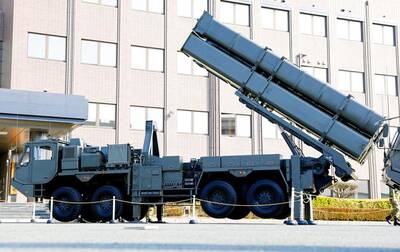
Japan has deployed long-range missiles in a southwestern region near China, the Japanese defense minister said yesterday, at a time when ties with Beijing are at their lowest in recent years. The missiles were installed in Kumamoto in the southern region of Kyushu, as Japan is attempting to shore up its military capacity as China steps up naval activity in the East China Sea. “Standoff defense capabilities enable us to counter the threat of enemy forces attempting to invade our country ... while ensuring the safety of our personnel,” Japanese Minister of Defense Shinjiro Koizumi said. “This is an extremely important initiative for
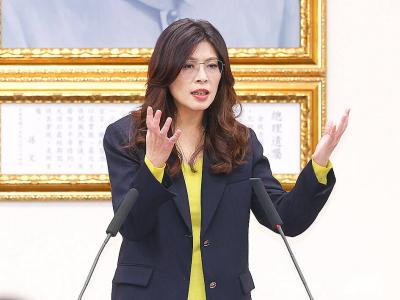
Chinese Nationalist Party (KMT) Chairwoman Cheng Li-wun (鄭麗文) today accepted an invitation from Chinese President Xi Jinping (習近平) to lead a delegation to China next month, saying she hopes to promote the peaceful development of cross-strait relations and bring stability to the Taiwan Strait. “I am grateful and happy to accept this invitation,” Cheng said in a statement from the KMT chairperson’s office. Cheng said she hopes both sides can work together to promote the peaceful development of cross-strait relations, enhance exchange and cooperation, bring stability to the Taiwan Strait and improve people’s livelihoods. At today's news conference, Cheng said any efforts to

MORE POPULAR: Taiwan Pass sales increased by 59 percent during the first quarter compared with the same period last year, the Tourism Administration said The Tourism Administration yesterday said that it has streamlined the Taiwan Pass, with two versions available for purchase beginning today. The tourism agency has made the pass available to international tourists since 2024, allowing them to access the high-speed rail, Taiwan Railway Corp services, four MRT systems and four Taiwan Tourist Shuttles. Previously, five types of Taiwan Pass were available, but some tourists have said that the offerings were too complicated. The agency said only two types of Taiwan Pass would be available, starting from a three-day pass with the high-speed rail and a three-day pass with Taiwan Railway Corp. The former costs NT$2,800

The nation’s fastest supercomputer, Nano 4 (晶創26), is scheduled to be launched in the third quarter, and would be used to train large language models in finance and national defense sectors, the National Center for High-Performance Computing (NCHC) said. The supercomputer, which would operate at about 86.05 petaflops, is being tested at a new cloud computing center in the Southern Taiwan Science Park in Tainan. The exterior of the server cabinet features chip circuitry patterns overlaid with a map of Taiwan, highlighting the nation’s central position in the semiconductor industry. The center also houses Taiwania 2, Taiwania 3, Forerunner 1 and


 RSS
RSS