


An illegally released VCD may be about to reveal the full vulgarity of Taiwanese culture, and how it infringes peoples' privacy. This time, one of the victims is suspected of being a well-known former New Party politician apparently having sex in an apartment.
Hidden cameras have become a disturbingly commonplace phe-nomenon in Taiwan, and can be found not only in public toilets and hotel rooms, but also in private bedrooms.
Rumors in political circles have for some time suggested that several copies of a VCD featuring former New Party Taipei city councilor Chu Mai-feng (璩美鳳) having sex with a man in her bedroom have been sent to a large number of tabloids and magazines in Hong Kong and Taiwan.
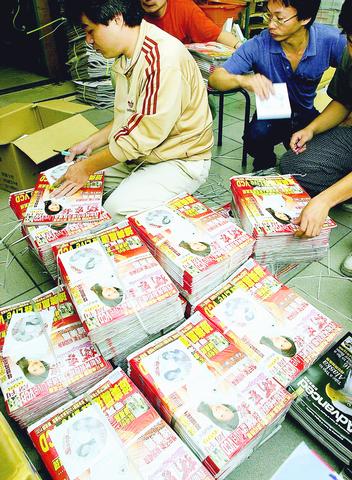
PHOTO: CHANG CHUNG-YI, TAIPEI TIMES
Chu, born in 1966, was once a shining star of the New Party who first rose to prominence in 1997 after becoming the first to denounce Sung Chi-li (
She later regained the media spotlight by having a love affair with the sitting mayor of Hsinchu City Tsai Jen-chien (蔡仁堅), though she ended the relationship with Tsai last year.
Many Taiwanese reporters had heard the gossip but no one printed a story about it. Sex scandals infringing on people's privacy and legal rights do not attract the same kind of attention they used to.
Lo Tien-bin (羅添斌), head of the Cabinet news section of the Liberty Times, the Chinese-language sister newspaper of the Taipei times, said that the Liberty Times did not report the story last week because the newspaper could not confirm whether the woman on the VCD was Chu.
"First, we regarded it as a private matter with no bearing on the public interest. Second, we were not sure whether the woman really was Chu, especially given the fact that computer technology can easily be used to fake images of people," Lo said.
It became a public issue only after copies of the VCD were illegally distributed in political and media circles last week after reporters and legislative assistants screened it in the press room of the Legislative Yuan. By the weekend, feverish debate was underway on the Internet, on which parts of the VCD were released.
On pornographic Web sites, Web users inquired where they could get a copy, or discussed the behavior and physical attributes of the woman in the movie. On some discussion sites, there was serious debate about the human rights, privacy and public interest implications.
According to some of the weekend's cyber-gossip, copies of the VCD are selling in Taipei's Kuanghwa Market (光華商場) for NT$800.
The frenzy reached a crescendo on Monday when this weeks' edition of Scoop Weekly magazine (獨家報導) hit the stores with a free copy of the VCD attached.
All copies of the magazine sold out within hours and shopkeepers ordered additional copies. The extra copies never arrived as the Government Information Office and prosecutors took action against the weekly, searching its headquarters and confiscating all remaining copies yesterday.
An evening paper said yesterday that copies of Scoop Weekly magazine with the VCD attached were fetching up to NT$1,300 on the black market.
Web users appear to have divided into two diametrically opposed camps over the issue. On the site of a media-watching group called "Against the Media" (
"Don't forget that when Next first appeared in Taiwan, Shen Yeh (
But Scoop Weekly is not short of supporters. Another Web user applauded the weekly's action, arguing that nothing less than the truth itself was at issue.
"It is what a paparazzi magazine thrives on. If it [the VCD] is fake, then she [Chu] should sue the magazine for every penny she can get; if it's true, then I'm afraid she won't dare sue anyone," he said. "The weekly is simply doing its job."
But as Shen and his daughter, Shen Jung (
A visitor to Chinatimes Interactive wrote, "Readers' right to know? Well, I would prefer to see VCDs of Shen Yeh and Shen Jung having sex."
Another visitor said, "If it's all about the readers' right to know, the next issue of the weekly should distribute a VCD demonstrating a rape."
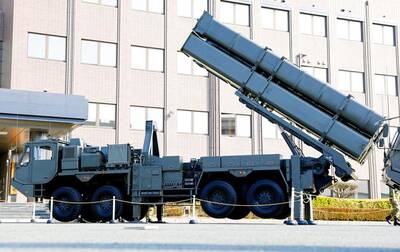
Japan has deployed long-range missiles in a southwestern region near China, the Japanese defense minister said yesterday, at a time when ties with Beijing are at their lowest in recent years. The missiles were installed in Kumamoto in the southern region of Kyushu, as Japan is attempting to shore up its military capacity as China steps up naval activity in the East China Sea. “Standoff defense capabilities enable us to counter the threat of enemy forces attempting to invade our country ... while ensuring the safety of our personnel,” Japanese Minister of Defense Shinjiro Koizumi said. “This is an extremely important initiative for

Chinese Nationalist Party (KMT) Chairwoman Cheng Li-wun (鄭麗文) today accepted an invitation from Chinese President Xi Jinping (習近平) to lead a delegation to China next month, saying she hopes to promote the peaceful development of cross-strait relations and bring stability to the Taiwan Strait. “I am grateful and happy to accept this invitation,” Cheng said in a statement from the KMT chairperson’s office. Cheng said she hopes both sides can work together to promote the peaceful development of cross-strait relations, enhance exchange and cooperation, bring stability to the Taiwan Strait and improve people’s livelihoods. At today's news conference, Cheng said any efforts to

MORE POPULAR: Taiwan Pass sales increased by 59 percent during the first quarter compared with the same period last year, the Tourism Administration said The Tourism Administration yesterday said that it has streamlined the Taiwan Pass, with two versions available for purchase beginning today. The tourism agency has made the pass available to international tourists since 2024, allowing them to access the high-speed rail, Taiwan Railway Corp services, four MRT systems and four Taiwan Tourist Shuttles. Previously, five types of Taiwan Pass were available, but some tourists have said that the offerings were too complicated. The agency said only two types of Taiwan Pass would be available, starting from a three-day pass with the high-speed rail and a three-day pass with Taiwan Railway Corp. The former costs NT$2,800

The nation’s fastest supercomputer, Nano 4 (晶創26), is scheduled to be launched in the third quarter, and would be used to train large language models in finance and national defense sectors, the National Center for High-Performance Computing (NCHC) said. The supercomputer, which would operate at about 86.05 petaflops, is being tested at a new cloud computing center in the Southern Taiwan Science Park in Tainan. The exterior of the server cabinet features chip circuitry patterns overlaid with a map of Taiwan, highlighting the nation’s central position in the semiconductor industry. The center also houses Taiwania 2, Taiwania 3, Forerunner 1 and


 RSS
RSS