


Environmental protection-related government bodies conducted a drill yesterday morning to practice helping each other in the event Taipei Harbor is polluted by oil leaked from a ship.
"We need more practice at this," said Chang Juu-en (
"We have enough manpower, enough equipment, but communications between different units has been poor in the past. We do not have enough experience for an accident like this. If a ship does leak oil along our shoreline, it will definitely be a disaster."
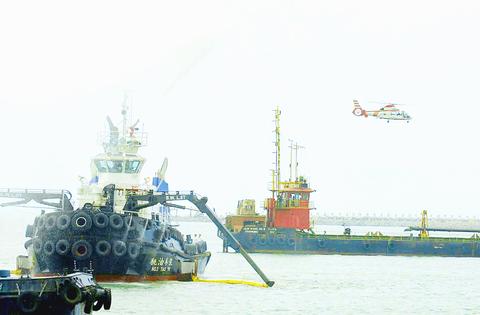
PHOTO: GEORGE TSORNG, TAIPEI TIMES
The EPA scenario simulated a 30,000-tonne ship planning to return to Taipei Harbor when the captain realizes there is a malfunction aboard the ship.
The vessel ran aground on its way back to the port and the accident also cracked the side of the ship. Approximately 200 tonnes of oil leaked from the cracked ship and kept leaking at the speed of five to 10 tonnes an hour.
Since the location of the accident was close to the port, rescue crews from the Coast Guard Administration and Keelung Harbor Bureau Taipei Harbor Branch arrived at the scene in minutes.
They used cables to trap the leaking oil within a limited area and then began to suck it up with pumps. In addition, the Taiwan National Police Administration's Airborne Police joined the rescue with a helicopter to update the size of the polluted area from the air.
"Prompt reaction and instant communications are what we need," said Chang. "We will keep training our rescue crews of different units so they can be more familiar with their job and work with each other more smoothly."
The Taipei Harbor is located in Pali township, Taipei County, and was recently designated as an international harbor in support of the overloaded Keelung Harbor.
It is invested in and run by private enterprises instead of the government.
Currently, three ports are finished and in use. Two of them are for gravel ships. The Formosa Petrochemical Oil Corp owns and runs the other one for shipping oil from its Mailiao oil storage complex in YunlinCounty.
The Harbor Bureau says that another seven ports will be finished before 2011.

‘NO SECURITY RISK’: The Railway Bureau reassured the public that the technicians’ activities were limited to technical guidance and did not involve sensitive systems The Railway Bureau yesterday said it had invited eight Chinese technicians to assist with an airport MRT construction project. The bureau issued the confirmation after an Internet user said Chinese nationals had entered the construction zone of Taiwan Taoyuan International Airport’s Terminal 3 project. They asked why “individuals from an enemy state” were allowed access to such a major national infrastructure project, which raised serious concerns over Taiwan’s industrial safety, sensitive systems and information security. The bureau’s Northern Region Engineering Branch Office said subcontractor Taiwan Handle Industrial Co (台灣手把工業) of the Taoyuan airport MRT’s “Contract No. CU05 Project A14 Station Civil, MEP &

The National Chungshan Institute of Science and Technology yesterday showcased its locally developed variants of the Vision 60 robotic patrol dog, which it plans to deploy on the nation’s outlying territories in the South China Sea. The variants were produced under the Joint Lab project — created by the institute and domestic companies — and assembled with domestically produced motors, lenses and artificial intelligence (AI) systems alongside licensed tech from the US, Missile and Rocket Systems Research Division deputy director Jen Kuo-kang (任國光) told the media event at a military base in Taipei’s Dazhi (大直) area. Taiwan has built up its strengths

NOT IMMEDIATE: Taiwan has a chance to appeal the proposed 10 percent tariff before it starts, while other countries face a 12.5 percent tariff from the trade office Taiwan is among 60 economies determined by the US to have failed to impose or enforce a ban on the importation of goods produced with forced labor, according to a notice released on Tuesday by the Office of the US Trade Representative (USTR), which proposed imposing an additional 10 percent or more tariff on them. The USTR in a statement said that following an investigation, it had determined under Section 301 of the Trade Act of 1974 that the failure of the 60 economies to impose and effectively enforce a prohibition on the importation of goods produced with forced labor is

RIGHT DIRECTION: Taiwan’s efforts to prevent forced labor include a proposal to ‘fully prohibit’ employers from withholding workers’ documents, an official said Taiwan is to establish a mechanism to restrict imports of goods linked to forced labor, the Executive Yuan said yesterday, after the US proposed imposing additional tariffs on Taiwanese goods over labor concerns. “The Ministry of Labor and the Ministry of Economic Affairs are to establish an interministerial review procedure,” Executive Yuan spokesperson Michelle Lee (李慧芝) said at a news briefing in Taipei. “The government is to use the Foreign Trade Act [貿易法] as the legal basis to restrict imports of goods produced with forced labor” and bring its supply chain governance more in line with international standards on human rights, resilience


 RSS
RSS