


Walking down Kueite Street in Taipei City's Tatong District, Chen Chun-hui (
"I remember a lot of tea shops sun dried their tea along the street during the winter. And my father loved to take us to the Bolero down on Minsheng West Road," she said.
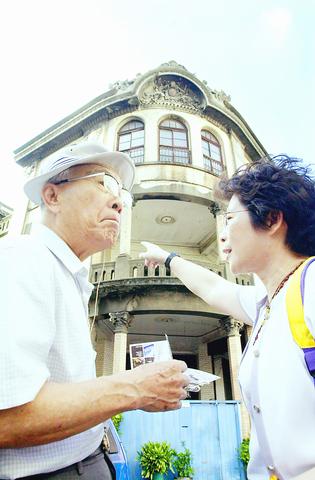
PHOTO: GEORGE TSORNG, TAIPEI TIMES
Bolero was the city's first Western restaurant and a favorite hang-out for young people, especially lovers, during the 1950s and 1960s.
Chen said that she even had a blind date at the restaurant.
"I remember I couldn't wait for the date to be over because the guy I was dating was damn ugly," she said, chuckling.
Chen was one of about 300 city residents attending a one-hour tour of the 10 historic architectural sites located in Tatong District yesterday afternoon. The event was organized by the city's cultural affairs bureau in a bid to educate the public about the rich culture and history of the area.
"The Tatong District, or better known as Tataocheng in the past, is the second-oldest area of Taipei City, following the Wan-hua District, or Mangka," said Lu Chun-che (
The tour of the 10 selected historic sites are the result of last Sunday's evaluation meeting organized by the bureau and attended by academics, historians and architects. It was part of the city's efforts to survey potential historic architectural sites located in the city's 12 districts.
The 10 selections include churches, temples, schools, houses and stores which are rich in history and culture and have well-preserved facades.
The bureau plans to spend NT$3 million on the survey and evaluation project and complete it by the end of next year.
Chuang Yung-ming (莊永明), the tour guide for yesterday's activity and vice chairman of the municipal Historical Research Commission, said that most people hesitate to have their buildings designated as a cultural architectural site because they believe the designation might mean no alteration to the building is allowed.
"We're sometimes shooed away or have fruit nuts thrown at us while guiding the tour of the buildings," Chuang said, adding that a historic relic and historic architectural site are two different things.
The legislature passed an amendment to the Cultural Heritage Preservation Law last year to protect historic architecture. No specific procedures or criteria, however, are stipulated in the measure for local governments to follow.
In short, no one can touch any part of a historic relic, while the alteration of historic architecture is allowed.
In addition, the owner of a designated historic architectural site is responsible for house and property taxes, while that of a designated historic relic is eligible for the exemption of the two taxes.
Lu said that the bureau would like to see the owners of potential historic architectural sites more keen on having their buildings designated as such, because they want to preserve the legacy of their ancestors.
"I'm personally against any monetary or other kinds of incentives," Lu said.
Watching the three-story building of the family house of a late tea merchant, Chen Tien-lai (
"I just want to see what it's like 53 years later," said Chen, who is a native of the area. "I remember I used to go to the church over there to get free milk every Sunday. It smelled so good and tasted so rich."
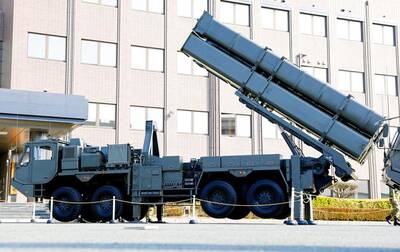
Japan has deployed long-range missiles in a southwestern region near China, the Japanese defense minister said yesterday, at a time when ties with Beijing are at their lowest in recent years. The missiles were installed in Kumamoto in the southern region of Kyushu, as Japan is attempting to shore up its military capacity as China steps up naval activity in the East China Sea. “Standoff defense capabilities enable us to counter the threat of enemy forces attempting to invade our country ... while ensuring the safety of our personnel,” Japanese Minister of Defense Shinjiro Koizumi said. “This is an extremely important initiative for

Chinese Nationalist Party (KMT) Chairwoman Cheng Li-wun (鄭麗文) today accepted an invitation from Chinese President Xi Jinping (習近平) to lead a delegation to China next month, saying she hopes to promote the peaceful development of cross-strait relations and bring stability to the Taiwan Strait. “I am grateful and happy to accept this invitation,” Cheng said in a statement from the KMT chairperson’s office. Cheng said she hopes both sides can work together to promote the peaceful development of cross-strait relations, enhance exchange and cooperation, bring stability to the Taiwan Strait and improve people’s livelihoods. At today's news conference, Cheng said any efforts to
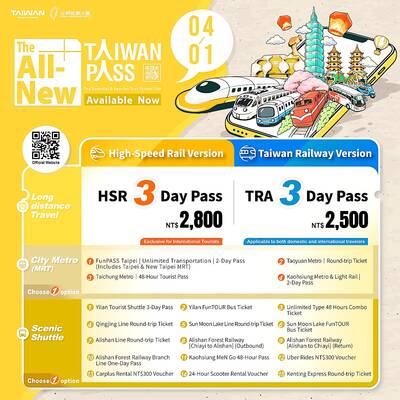
MORE POPULAR: Taiwan Pass sales increased by 59 percent during the first quarter compared with the same period last year, the Tourism Administration said The Tourism Administration yesterday said that it has streamlined the Taiwan Pass, with two versions available for purchase beginning today. The tourism agency has made the pass available to international tourists since 2024, allowing them to access the high-speed rail, Taiwan Railway Corp services, four MRT systems and four Taiwan Tourist Shuttles. Previously, five types of Taiwan Pass were available, but some tourists have said that the offerings were too complicated. The agency said only two types of Taiwan Pass would be available, starting from a three-day pass with the high-speed rail and a three-day pass with Taiwan Railway Corp. The former costs NT$2,800

The nation’s fastest supercomputer, Nano 4 (晶創26), is scheduled to be launched in the third quarter, and would be used to train large language models in finance and national defense sectors, the National Center for High-Performance Computing (NCHC) said. The supercomputer, which would operate at about 86.05 petaflops, is being tested at a new cloud computing center in the Southern Taiwan Science Park in Tainan. The exterior of the server cabinet features chip circuitry patterns overlaid with a map of Taiwan, highlighting the nation’s central position in the semiconductor industry. The center also houses Taiwania 2, Taiwania 3, Forerunner 1 and


 RSS
RSS