


President Chen Shui-bian's (
According to tradition, the couple should return to the bride's home the day after the wedding to tell the bride's parents that they are happy.
Chen Chih-chung (
In keeping with tradition, he invited his elder sister and her groom to return to the bride's family's home.
President Chen also returned to the presidential residence for a family lunch.
The president displayed no signs of fatigue as he inspected the Furniture Design Exhibition in Taipei County in the morning, despite telling reporters that he had worked on official papers until approximately 2am after the wedding banquet, which ended at about 11pm on Thursday.
"I am busy with my family's affairs, which bring me joy," Chen said. "But affairs of state must not be affected."
Chen energetically toured the exhibition, showing a particular interest in locally made bamboo products. He exhorted the bamboo craftsmen, who gave demonstrations of their skills, to teach and help further develop the traditional Taiwanese industry.
When the president, with broad smile on his face, took a moment to play with a baby's crib and stroller, Taipei County Commissioner Su Chen-chang (
Meanwhile, the presidential son-in-law's family busied itself with arrangements for a banquet for relatives and friends in Tainan County, where Chao Chien-ming's parents were born and still live.
The son-in-law's father, Chao Yu-chu (趙玉柱), is principal of the Ta Chiou Elementary School and members of the school were yesterday preparing a series of performances to celebrate the marriage.
"The theme of the performances will focus on floriculture, with children displaying various flowers," a teacher at the school said.
The groom's banquet is the final activity in traditional Taiwanese weddings.
Chao Chien-ming, an orthopedic surgeon at National Taiwan University Hospital, and Chen Hsin-yu, a dentist at Chang Gung Memorial Hospital, will live in the Chen family's Min Sheng E Road home, where President Chen and first lady Wu Shu-chen (

‘NO SECURITY RISK’: The Railway Bureau reassured the public that the technicians’ activities were limited to technical guidance and did not involve sensitive systems The Railway Bureau yesterday said it had invited eight Chinese technicians to assist with an airport MRT construction project. The bureau issued the confirmation after an Internet user said Chinese nationals had entered the construction zone of Taiwan Taoyuan International Airport’s Terminal 3 project. They asked why “individuals from an enemy state” were allowed access to such a major national infrastructure project, which raised serious concerns over Taiwan’s industrial safety, sensitive systems and information security. The bureau’s Northern Region Engineering Branch Office said subcontractor Taiwan Handle Industrial Co (台灣手把工業) of the Taoyuan airport MRT’s “Contract No. CU05 Project A14 Station Civil, MEP &

The National Chungshan Institute of Science and Technology yesterday showcased its locally developed variants of the Vision 60 robotic patrol dog, which it plans to deploy on the nation’s outlying territories in the South China Sea. The variants were produced under the Joint Lab project — created by the institute and domestic companies — and assembled with domestically produced motors, lenses and artificial intelligence (AI) systems alongside licensed tech from the US, Missile and Rocket Systems Research Division deputy director Jen Kuo-kang (任國光) told the media event at a military base in Taipei’s Dazhi (大直) area. Taiwan has built up its strengths
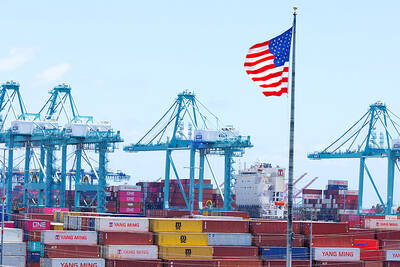
NOT IMMEDIATE: Taiwan has a chance to appeal the proposed 10 percent tariff before it starts, while other countries face a 12.5 percent tariff from the trade office Taiwan is among 60 economies determined by the US to have failed to impose or enforce a ban on the importation of goods produced with forced labor, according to a notice released on Tuesday by the Office of the US Trade Representative (USTR), which proposed imposing an additional 10 percent or more tariff on them. The USTR in a statement said that following an investigation, it had determined under Section 301 of the Trade Act of 1974 that the failure of the 60 economies to impose and effectively enforce a prohibition on the importation of goods produced with forced labor is
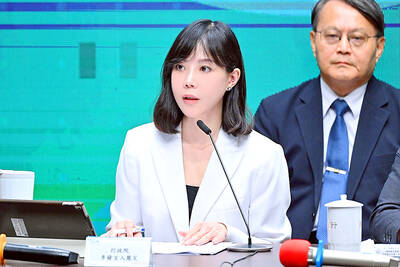
RIGHT DIRECTION: Taiwan’s efforts to prevent forced labor include a proposal to ‘fully prohibit’ employers from withholding workers’ documents, an official said Taiwan is to establish a mechanism to restrict imports of goods linked to forced labor, the Executive Yuan said yesterday, after the US proposed imposing additional tariffs on Taiwanese goods over labor concerns. “The Ministry of Labor and the Ministry of Economic Affairs are to establish an interministerial review procedure,” Executive Yuan spokesperson Michelle Lee (李慧芝) said at a news briefing in Taipei. “The government is to use the Foreign Trade Act [貿易法] as the legal basis to restrict imports of goods produced with forced labor” and bring its supply chain governance more in line with international standards on human rights, resilience


 RSS
RSS