


Taiwan's Chinese Petroleum Co (CPC) has been assured of stable crude oil supplies from the Saudi Arabia Oil Co in the event of war, said CPC President Pan Wen-yen (
The head of the Saudi oil company said in a letter to Pan that the company will fully honor the terms of the contract between the two companies by continuing to supply the CPC with crude oil even if war breaks out in the Middle East.
The international price for crude oil spiked earlier this month to US$31.5 per barrel soon after the Sept. 11 terrorist attacks in the US -- a rise of US$4 per barrel. Prices fell back and were at US$22.1 per barrel on Monday.
Pan said that he expects international oil prices to fluctuate between US$20 and US$30 a barrel.
The CPC is a state-run company which monopolized Taiwan's oil market before the Formosa Oil Co, an affiliate of the Formosa Group, entered the market last year.
The CPC still enjoys a majority share of the local market.
The US is poised to launch an all-out war against terrorism in Afghanistan, which allegedly provides shelter for Osama bin Laden, the prime suspect in the terrorist attacks by hijacked airplanes that left close to 7,000 people dead or missing in New York, the Pentagon and Pennsylvania.
Local consumers are worried that Taiwan may face oil supply shortages should war break out.
Pan said that the CPC has a sufficient stock of crude oil to ensure sales for 110 days.
Fifty-eight percent of the CPC's oil comes from countries in the Middle East, including Saudi Arabia and Kuwait, 25 percent comes from African countries and 10 percent comes from Indonesia, Australia and other oil producing nations.
The Formosa Oil Co is also fully dependent on foreign crude oil supplies.
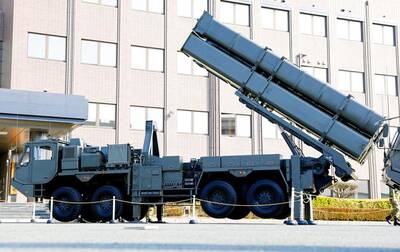
Japan has deployed long-range missiles in a southwestern region near China, the Japanese defense minister said yesterday, at a time when ties with Beijing are at their lowest in recent years. The missiles were installed in Kumamoto in the southern region of Kyushu, as Japan is attempting to shore up its military capacity as China steps up naval activity in the East China Sea. “Standoff defense capabilities enable us to counter the threat of enemy forces attempting to invade our country ... while ensuring the safety of our personnel,” Japanese Minister of Defense Shinjiro Koizumi said. “This is an extremely important initiative for

Chinese Nationalist Party (KMT) Chairwoman Cheng Li-wun (鄭麗文) today accepted an invitation from Chinese President Xi Jinping (習近平) to lead a delegation to China next month, saying she hopes to promote the peaceful development of cross-strait relations and bring stability to the Taiwan Strait. “I am grateful and happy to accept this invitation,” Cheng said in a statement from the KMT chairperson’s office. Cheng said she hopes both sides can work together to promote the peaceful development of cross-strait relations, enhance exchange and cooperation, bring stability to the Taiwan Strait and improve people’s livelihoods. At today's news conference, Cheng said any efforts to

The nation’s fastest supercomputer, Nano 4 (晶創26), is scheduled to be launched in the third quarter, and would be used to train large language models in finance and national defense sectors, the National Center for High-Performance Computing (NCHC) said. The supercomputer, which would operate at about 86.05 petaflops, is being tested at a new cloud computing center in the Southern Taiwan Science Park in Tainan. The exterior of the server cabinet features chip circuitry patterns overlaid with a map of Taiwan, highlighting the nation’s central position in the semiconductor industry. The center also houses Taiwania 2, Taiwania 3, Forerunner 1 and
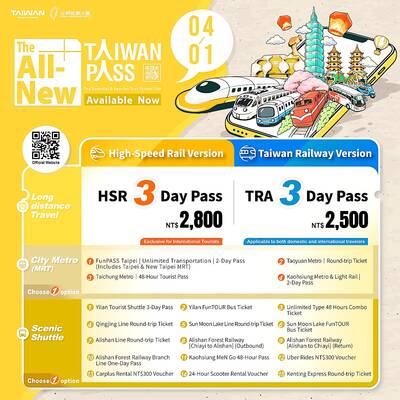
MORE POPULAR: Taiwan Pass sales increased by 59 percent during the first quarter compared with the same period last year, the Tourism Administration said The Tourism Administration yesterday said that it has streamlined the Taiwan Pass, with two versions available for purchase beginning today. The tourism agency has made the pass available to international tourists since 2024, allowing them to access the high-speed rail, Taiwan Railway Corp services, four MRT systems and four Taiwan Tourist Shuttles. Previously, five types of Taiwan Pass were available, but some tourists have said that the offerings were too complicated. The agency said only two types of Taiwan Pass would be available, starting from a three-day pass with the high-speed rail and a three-day pass with Taiwan Railway Corp. The former costs NT$2,800


 RSS
RSS