


The KMT will support the New Party's Wang Chien-shien in the race for Taipei County commissioner, the party said yesterday.
Wang beat the KMT's candidate Lin Jih-jia (林志嘉) in an opinion poll by a margin of just 0.28 percent.
Though Wang won by a hairsbreadth, the New Party and KMT had agreed earlier to accept the results of the poll and ignore any margin of error.
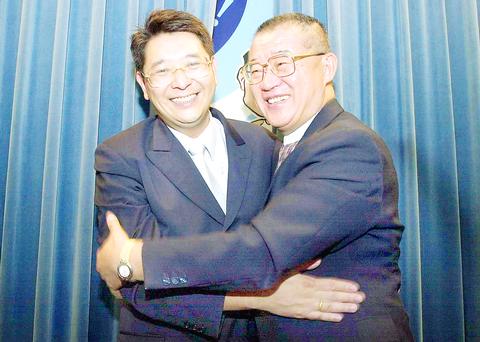
PHOTO: CHIANG YING-YING, TAIPEI TIMES
Lin said he would throw his support behind Wang and would not seek any other public office. The four-term lawmaker also said he would not rule out the possibility of quitting politics for good.
"As soon as the poll results were out today, Wang, demonstrating his good intentions, proposed redoing the polls in light of the narrow margin," Lin said. "But I think this is it since we've already made a deal."
This was Lin's second failed attempt to become Taipei County commissioner. In 1997, Lin ran for the seat without the KMT's blessing after the party had nominated former Council of Labor Affairs chairman Hsieh Shen-shan (謝深山).
Lin's candidacy in that race drew votes from Hsieh. The split-ticket cost both the election, and Lin was blamed after the seat went to the DPP's Su Tseng-chang (蘇貞昌).
This year, the KMT had originally planned to cooperate with the People First Party (PFP) by backing a PFP candidate to compete with Su. The plan started to fall apart after former minister of justice Liao Cheng-hao (廖正豪) turned down the offer in July.
Later that month, the KMT nominated Lin, who still had a keen interest in the position.
The PFP, meanwhile, nominated its deputy secretary-general, Chin Chin-sheng (
Chin quit the race two weeks ago, with the PFP criticizing the KMT as being insincere in its pledges of cooperation.
After Chin's withdrawal, the KMT and the New Party agreed to conduct opinion polls in order to jointly select a candidate to run for Taipei County commissioner.
Having obtained the KMT's backing yesterday, Wang said he would visit both PFP Chairman James Soong (
"I still need to work hard and show my sincerity if the three parties -- including their leadership, campaign officials and supporters -- are to identify with me as the candidate representing the opposition alliance," Wang said.
PFP spokesman Liao Tsang-song (
But as to whether the PFP would take concrete actions to show their support, such as campaigning for Wang, Liao said that would depend on the development of his campaign and on public opinion.
"The votes are in the hands of the voters. The PFP should consider the opinions of our supporters too," Liao said.
The Taipei County commissioner race is expected to be an uphill battle for Su's challenger.
In opinion polls released so far, Su's approval rating has been the highest among all potential contestants.
As shown in the polls released by the KMT and New Party yesterday, which were conducted by two different polling companies, Su's approval rating ranged from 36.49 percent to 39.69 percent, leading Wang by 11.7 to 13.74 percentage points.
Wang's polls showed his support ratings ranging between 24.79 percent and 25.95 percent.
Su yesterday said the outcome of the polls showed that the so-called "opposition alliance" does not exist at all, especially in light of the fact that the PFP had refused to join the polling.
Su said Wang's participation in the race will not affect his campaign strategy.
"The party affiliation of candidates isn't important in a county commissioner's election.
"The candidate who is the most enthusiastic about serving the people, most experienced and most familiar with county administration will gain the public's support," Su said.

A signaling system malfunction disrupted high-speed rail (HSR) services beginning at 8am today, with trains temporarily reduced to three northbound and three southbound trains per hour as authorities conduct inspections. The malfunction occurred on a section of track in Miaoli County during pre-operation checks early this morning, forcing northbound and southbound trains to use a single track, the HSR operator said. The regular schedule has been replaced with three hourly trains offering only nonreserved seating in each direction, stopping at every station, it said, adding that business class cars would still have reserved seating. Departures from terminal stations are scheduled at the top

Taiwan is still in the process of assessing the possibility of recruiting workers from Eswatini, the Ministry of Foreign Affairs said yesterday, adding that its goal is to help Eswatini upgrade its vocational training centers. If there are plans to recruit workers from Eswatini, safeguarding national security, protecting public health and ensuring the employment rights of Taiwanese would be prerequisites, Department of West Asian and African Affairs Director-General Yen Chia-liang (顏嘉良) told a news conference. Key considerations would also include filling labor shortages in specific industries, and fostering bilateral professional and technical exchanges, he said. Yen was asked about the progress of labor

VERBOSE VESSELS: A CGA cutter and a China Coast Guard exchanged verbal barbs for more than a day in Taiwanese-controlled waters before the Chinese vessel left The Taiwanese and Chinese coast guards had a standoff near the strategically located Pratas Islands (Dongsha Islands, 東沙群島) in the north of the South China Sea, the Coast Guard Administration (CGA) said yesterday. The two sides engaged in intense radio exchanges over sovereignty claims during the 33-hour standoff. China Coast Guard vessel 3501 eventually left the restricted waters, 26.6 nautical miles (49.2km) west of the Pratas Islands, at 5pm yesterday, the CGA said. Lying approximately between southern Taiwan and Hong Kong, the Taiwan-controlled Pratas are seen by some security experts as vulnerable to Chinese attack due to their distance — more than
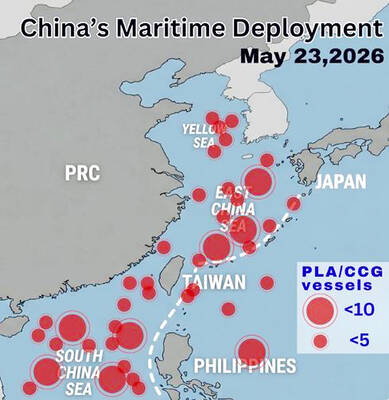
WARNING: China should stop engaging in actions that undermine regional peace and stability, as it would only build resentment among people across the Strait, the CGA said China has deployed more than 100 navy, coast guard and other vessels in waters from the Yellow Sea to the South China Sea and the western Pacific since US President Donald Trump and Chinese President Xi Jinping (習近平) met in Beijing, National Security Council Secretary-General Joseph Wu (吳釗燮) said yesterday. “In this part of the world, #China is the one & only PROBLEM wrecking the #StatusQuo & threatening regional peace & stability,” Wu wrote on X. In a separate post, he said Beijing was coercing Taiwan’s maritime domain, calling it illegal and provocative, after the Coast Guard Administration (CGA) expelled a


 RSS
RSS