


A 90-member delegation of international peace advocates led by Vice President Annette Lu (
Accompanied by local government officials, the group of peace advocates, including heads of international non-governmental organizations and legislators from Holland, Japan, South Korea, Thailand and the Philippines, toured underground combat tunnels and the cavernous Atlas Dome, which was entirely carved out of granite by 1,000 soldiers in 1963 and can serve as an emergency medical center in times of conflict.
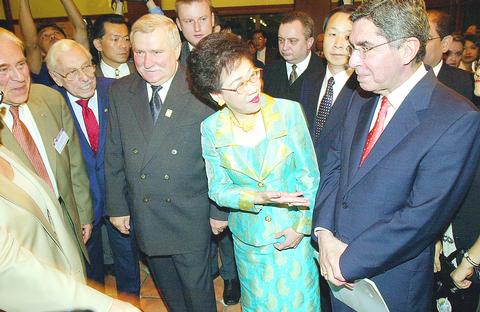
PHOTO: CHEN CHENG-CHANG, TAIPEI TIMES
Lu said at a lunch banquet welcoming her and the foreign guests that her present visit -- her third to Kinmen since she became vice president last May -- is the most significant so far because of the peace advocates accompanying her to the heavily garrisoned island.
She added her hope that her guests would exchange views on how to bring peace to the Taiwan Strait when they take up the series of activities involved with the 2001 Global Peace Assembly.
Thanking the soldiers and local military commanders for protecting the nation, she said that peace for many people is just a slogan, but for the servicemen and women in Kinmen, it is a matter of life and death and a sacred mission.
Noting that she is confident that the "bell of peace" will in the near future be heard around the world, including Kinmen, she said that she hopes Kinmen will -- under government leadership and with the contribution Kinmen's people -- become a "bridge of peace" between Taiwan and China.
Arias, president of Costa Rica from 1986-1990 and who received the Nobel Peace Prize in 1987, said at the banquet that "peace is necessary," and that in a civilized world, no one should resort to the use of military force to settle conflicts.
He said that in a rational world, conflicts would be resolved at the negotiating table, adding that the same is true for the situation in the Taiwan Strait, so that Taiwan's youth can live in a "new century of peace."
"Dialogue produces miracles," Arias said, explaining that "you need to look in the face and the eyes of the other party and for that, you need to sit around a negotiating table. And if the other party doesn't want to take part in dialogue, be humble, invite it to dialogue, and if it refuses, invite it again."
The essence of dialogue is compromise, he added.
He called for a closer look at the real dangers to world peace -- poverty, illiteracy and environmental degradation -- instead of starting a new arms race.
"How can we live in peace in the future if half of the world population lives in poverty, if people don't have access to potable water, if most of the people in the world are illiterate?" he asked.
A two-day "World Peace Forum" is scheduled to kick off today, with the theme of "Creating Eternal Peace in the Taiwan Strait." Former Taiwan president Lee Teng-hui is slated to speak at the forum's opening ceremony.
An outdoor concert titled "A Night of World Peace" will be held tonight at Taipei's Chiang Kai-shek Memorial Hall, where Lu and the Nobel laureates who were invited to participate in the series of events will jointly inaugurate a "Terrestrial Globe of Peace" in commemoration of the end of World War II some 56 years ago.
The Nobel Peace Prize winners invited to attend the event include Arias; former Polish president Lech Walesa; former South African president Frederick W. de Klerk; Jody Williams, a US anti-land mine activist; and Joseph Rotblat, a British nuclear scientist who advocates the elimination of nuclear arms around the world.
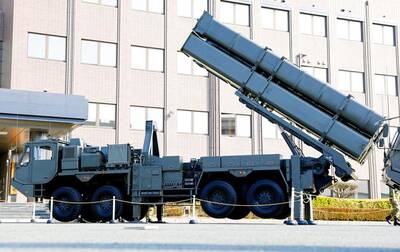
Japan has deployed long-range missiles in a southwestern region near China, the Japanese defense minister said yesterday, at a time when ties with Beijing are at their lowest in recent years. The missiles were installed in Kumamoto in the southern region of Kyushu, as Japan is attempting to shore up its military capacity as China steps up naval activity in the East China Sea. “Standoff defense capabilities enable us to counter the threat of enemy forces attempting to invade our country ... while ensuring the safety of our personnel,” Japanese Minister of Defense Shinjiro Koizumi said. “This is an extremely important initiative for
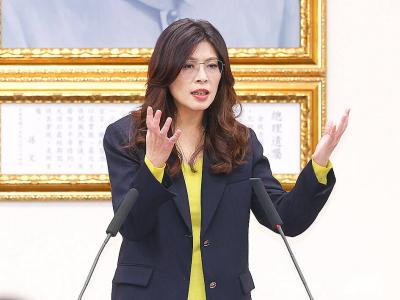
Chinese Nationalist Party (KMT) Chairwoman Cheng Li-wun (鄭麗文) today accepted an invitation from Chinese President Xi Jinping (習近平) to lead a delegation to China next month, saying she hopes to promote the peaceful development of cross-strait relations and bring stability to the Taiwan Strait. “I am grateful and happy to accept this invitation,” Cheng said in a statement from the KMT chairperson’s office. Cheng said she hopes both sides can work together to promote the peaceful development of cross-strait relations, enhance exchange and cooperation, bring stability to the Taiwan Strait and improve people’s livelihoods. At today's news conference, Cheng said any efforts to
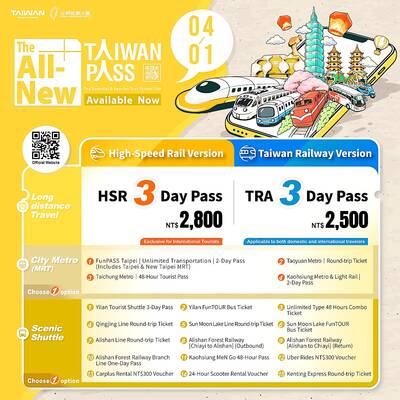
MORE POPULAR: Taiwan Pass sales increased by 59 percent during the first quarter compared with the same period last year, the Tourism Administration said The Tourism Administration yesterday said that it has streamlined the Taiwan Pass, with two versions available for purchase beginning today. The tourism agency has made the pass available to international tourists since 2024, allowing them to access the high-speed rail, Taiwan Railway Corp services, four MRT systems and four Taiwan Tourist Shuttles. Previously, five types of Taiwan Pass were available, but some tourists have said that the offerings were too complicated. The agency said only two types of Taiwan Pass would be available, starting from a three-day pass with the high-speed rail and a three-day pass with Taiwan Railway Corp. The former costs NT$2,800

The nation’s fastest supercomputer, Nano 4 (晶創26), is scheduled to be launched in the third quarter, and would be used to train large language models in finance and national defense sectors, the National Center for High-Performance Computing (NCHC) said. The supercomputer, which would operate at about 86.05 petaflops, is being tested at a new cloud computing center in the Southern Taiwan Science Park in Tainan. The exterior of the server cabinet features chip circuitry patterns overlaid with a map of Taiwan, highlighting the nation’s central position in the semiconductor industry. The center also houses Taiwania 2, Taiwania 3, Forerunner 1 and


 RSS
RSS