


Regulations concerning the care and use of animals in laboratory research in Taiwan are becoming stricter as the enforcement of measures establishing institutional animal care and use committees take effect today.
Officials at the National Science Council (NSC) said yesterday that institutions falling under the authority of the Animal Protection Law (
Officials of the National Laboratory Animal Breeding and Research Center under the science council said yesterday that a committee installed at every research institution would supervise animal-research-related affairs.
One of the requirements for establishing a committee includes the hiring of a veterinarian or an equivalent expert with a certificate issued by training centers recognized by the central government.
"Key committee personnel will be in charge of supervising procedures for self monitoring in obtaining, breeding, managing and using animals in laboratory research," said Liang San-chi (
Other important duties of committee members, Liang added, include ensuring appropriate maintenance of facilities where animals are used in laboratory research and adequate veterinary care.
"We believe that proper management of animals in laboratory research will minimize the negative consequences of animal testing," Liang said.
A workshop to train such professionals will be held by the center for the very first time today. Some 150 experts from different research institutions are expectedly to receive the certification. The center will hold another workshop in November this year. Liang said that more than 300 experts will be qualified to serve as committee members within a year.
According to the Council of Agriculture, however, there are more than 500 institutions in need of such experts, such as research centers, hospitals, universities, biotech firms, pharmaceutical companies.
After next July, any institution lacking a committee will be fined between NT$20,000 and NT$100,000.
Animal welfare activists told the Taipei Times yesterday that they welcomed new measures which ensure the rights of animals.
"But we have reservations about the integrity of appointed committee members because they will be on the payroll of the institutions they supervise," said Chen Yu-min (陳玉敏) of the Environment & Animal Society of Taiwan.
"Waiving unnecessary animal experiments should have become the researchers' main concern," Chen said. She added that animal welfare activists can look forward to seeing committee members with diverse backgrounds, such as animal behavior, animal protection and psychology.
The budget for biotech research in Taiwan next fiscal year has been increased to NT$17 billion from NT$11.7 billion. Biotech is a priority of the government's business promotion activities.
"It [the increased budget] doesn't necessarily mean that Taiwan will need more animals for scientific research," NSC Chairman Wei Che-ho (魏哲和) said yesterday.
Wei said that the measures taking effect today would improve the image of Taiwan in the international community.
According to the NSC, Taiwan will do its best to become a leader in biotech research next year by spending NT$4 billion on planned national projects.
Science council chairman Wei and Academia Sinica President Lee Yuan-tseh (李遠哲) will head for Japan today to visit several biotech research centers including Tokyo University and the Tsukuba Science Park.

CREDIT-GRABBER: China said its coast guard rescued the crew of a fishing vessel that caught fire, who were actually rescued by a nearby Taiwanese boat and the CGA Maritime search and rescue operations do not have borders, and China should not use a shipwreck to infringe upon Taiwanese sovereignty, the Coast Guard Administration (CGA) said yesterday. The coast guard made the statement in response to the China Coast Guard (CCG) saying it saved a Taiwanese fishing boat. The Chuan Yu No. 6 (全漁6號), a fishing vessel registered in Keelung, on Thursday caught fire and sank in waters northeast of Diaoyutai Islands (釣魚台). The vessel left Keelung’s Badouzih Fishing Harbor (八斗子漁港) at 3:35pm on Sunday last week, with seven people on board — a 62-year-old Taiwanese captain surnamed Chang (張) and six

LEVERAGE: China did not ‘need to fire a shot’ to deny Taiwan airspace over Africa when it owns ‘half the continent’s debt,’ a US official said, calling it economic warfare The EU has raised concerns about overflight rights following the delay of President William Lai’s (賴清德) planned state visit to the Kingdom of Eswatini after three African nations denied overflight clearance for his charter at the last minute. Taiwanese allies Paraguay and Saint Kitts and Nevis, as well as several US lawmakers and the Inter-Parliamentary Alliance on China (IPAC) condemned China for allegedly pressuring the countries. Lai was scheduled to fly directly to Taiwan’s only African ally from yesterday to Sunday to celebrate the 40th anniversary of King Mswati III’s accession and his 58th birthday, but Seychelles, Mauritius and Madagascar suddenly revoked

RISKY BUSINESS: The ‘incentives’ include initiatives that get suspended for no reason, creating uncertainty and resulting in considerable losses for Taiwanese, the MAC said China’s “incentives” failed to sway sentiment in Taiwan, as willingness to work in China hit a record low of 1.6 percent, a Ministry of Labor survey showed. The Directorate-General of Budget, Accounting and Statistics (DGBAS) also reported that the number of Taiwanese workers in China has nearly halved from a peak of 430,000 in 2012 to an estimated 231,000 in 2024. That marked a new low in the proportion of Taiwanese going abroad to work. The ministry’s annual survey on “Labor Life and Employment Status” includes questions respondents’ willingness to seek employment overseas. Willingness to work in China has steadily declined from
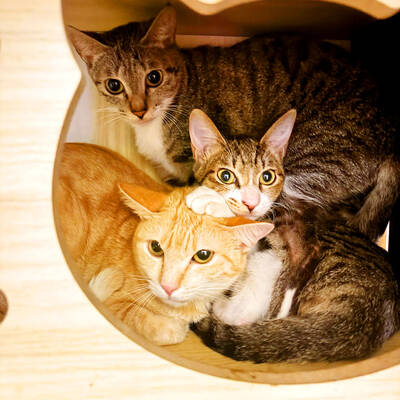
The number of pet cats in Taiwan surpassed that of pet dogs for the first time last year, reaching 1,742,033, a 32.8 percent increase from 2023, the Ministry of Agriculture said yesterday, citing a survey. By contrast, the number of pet dogs declined slightly by 1.2 percent over the same period to 1,462,528, the ministry said. Despite the shift, households with dogs still slightly outnumber those with cats by 1.2 percent. However, while the number of households with multiple dogs has remained relatively stable, households keeping more than two cats have increased, contributing to the overall rise in the feline population. The trend


 RSS
RSS