


In the 1970s, Amnesty International -- a London-based human rights group with a high international profile -- kicked off its work in Taiwan with tireless campaigns to help political prisoners of the KMT regime -- a cause which few international organizations had before then drawn attention to.
In the most hopeless moments of their lives, these "prisoners of conscience" were encouraged with the knowledge that members of the international organization were continually sending them petition letters.
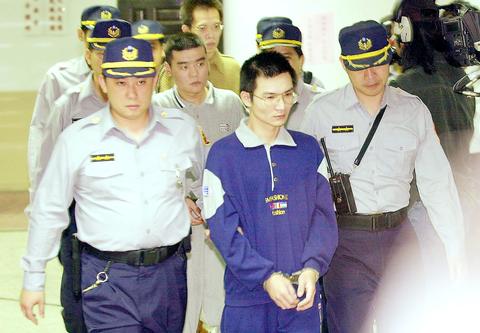
PHOTO: CHIANG YING-YING, TAIPEI TIMES
Because of Amnesty International's efforts, many political prisoners in Taiwan had their sentences reduced or at least had their conditions improved.
In the late 1980s, several local groups were formed in Taiwan and began to join in Amnesty International's global campaigns for prisoners of conscience outside the country.
In 1994 Amnesty International Taiwan was formed, but it was only three years later that the London headquarters of the organization approved the Taiwan body as a valid branch.
Over two decades, the political environment of Taiwan has changed enormously and many of the former political prisoners have made their mark in politics and academics.
However, developments at Amnesty International Taiwan have not quite kept up with the changes. Instead, the Taiwanese section, long-plagued with infighting and administrative problems, has not been able to function as well as its prestigious and influential 40-year-old parent body.
"In general, I think the problems with the [Taiwan] section is a reflection of Taiwanese politics. What you see in the legislature -- petty personal politics, laziness, cowardice -- is also what you see in this and many other NGOs here," said Brian Kennedy, a US attorney who worked for Amnesty International Taiwan between 1994 and 1999.
"In my years with the organization, I rarely heard discussions on issues. All the attention was given to personality politics. And the prestige of Amnesty International has been unwisely used for personal gains."
Haunted by infighting
During the darkest period of his life, former political prisoner Bo Yang (柏楊), now a writer, was told one day that Amnesty Interna-tional had continually written to pressure the Chiang Ching-kuo (蔣經國) government to release him.
"In the knowledge of the campaigns outside, I realized my imprisonment had caught international attention. My feeling was that I was not alone and I had to carry on to survive," the 81-year-old said as he recalled his initial contact with the human rights organization.
In 1977, a year after he learned of Amnesty International's campaigns on his behalf, Bo Yang was released after nine years of imprisonment. The internationally known writer subsequently devoted himself to human rights activities and became the first-term chairperson of Amnesty International Taiwan in 1994.
Bo Yang said Amnesty International's early activities in Taiwan and the formation of the organization's Taiwan branch marked a defining period in Taiwan's human rights development. However, the author of The Ugly Chinaman (醜陋的中國人) recounted with shame that infighting -- which he said was characteristic of Chinese culture -- has also placed Amnesty International Taiwan in a difficult situation.
Split on independence
In an early stage, Amnesty International Taiwan was faced with a split over independence issues. And in the years following Amnesty International Taiwan's acquisition of branch status, personal politics and maneuvering for power have dominated the agenda. Thus, despite its roughly 700 members, the organization achieved little in terms of human rights activities.
"We did try to do something but at the end of the day the personal politics made it so difficult to carry out any activities. And almost all the local groups have halted their work," said Yvonne Lin (林美瑢), coordinator of Taiwan Grassroots Women Workers' Center and a long-time member of Group 1 of Amnesty International Taiwan.
Like many other non-governmental organizations, lots of members of Amnesty International Taiwan manipulated NGO membership as a publicity stunt, while knowing little about what the organization was about.
"Being connected with an international organization such as Amnesty International definitely has business value. And sometimes politicians would also manipulate these kind of connections," says Brian Kennedy.
Although Amnesty International is a very influential and highly active human rights network among Western cultures, several regional sections of Amnesty International are by comparison weak and plagued with allegations of corruption.
Amnesty International Taiwan might not be the worst kind, but the organization's London headquarters has been aware of conditions at Amnesty International Taiwan and has, in an unusual fashion, stepped in a few times in the past to press for reform.
Warning from headquarters
In early June, two members of Amnesty International's Interna-tional Executive Committee, Pierre Robert and Morton Winston, visited Taiwan and carried out an inspection of Amnesty International Taiwan.
The worst-case scenario, according to the London headquarters, would have been to revoke the branch status of Amnesty International Taiwan.
It escaped with its status intact in the end, but the two inspectors made it clear that headquarters would continue to monitor the Taiwan section and asked it to file regular reports with Amnesty International's secretariat.
They also recommended that the branch's national section -- with only two part-time workers -- must apply for funds from the headquarters. They also asked the Taiwan section to improve the human rights issues-training of its management and members.
Improvements promised
Despite the notoriety of the organization, local human rights workers generally feel it would be bad for Taiwan if Amnesty International Taiwan is ever scrapped.
"Given the country's isolation from the international human rights system, I think it'll be a big loss for Taiwan to lose its link with the prominent international organization," said Peter Huang (
Zeng Wei-kai (曾威凱), secretary-general of Amnesty International Taiwan, said the June inspection was a catalyst for change as quite a few members of local groups have felt the pressure and have undertaken to work more effectively.
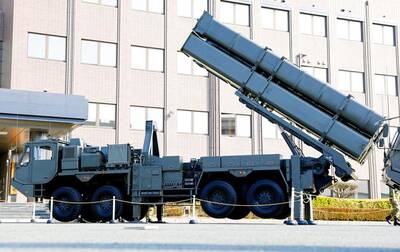
Japan has deployed long-range missiles in a southwestern region near China, the Japanese defense minister said yesterday, at a time when ties with Beijing are at their lowest in recent years. The missiles were installed in Kumamoto in the southern region of Kyushu, as Japan is attempting to shore up its military capacity as China steps up naval activity in the East China Sea. “Standoff defense capabilities enable us to counter the threat of enemy forces attempting to invade our country ... while ensuring the safety of our personnel,” Japanese Minister of Defense Shinjiro Koizumi said. “This is an extremely important initiative for
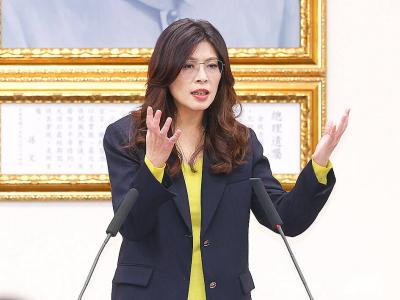
Chinese Nationalist Party (KMT) Chairwoman Cheng Li-wun (鄭麗文) today accepted an invitation from Chinese President Xi Jinping (習近平) to lead a delegation to China next month, saying she hopes to promote the peaceful development of cross-strait relations and bring stability to the Taiwan Strait. “I am grateful and happy to accept this invitation,” Cheng said in a statement from the KMT chairperson’s office. Cheng said she hopes both sides can work together to promote the peaceful development of cross-strait relations, enhance exchange and cooperation, bring stability to the Taiwan Strait and improve people’s livelihoods. At today's news conference, Cheng said any efforts to
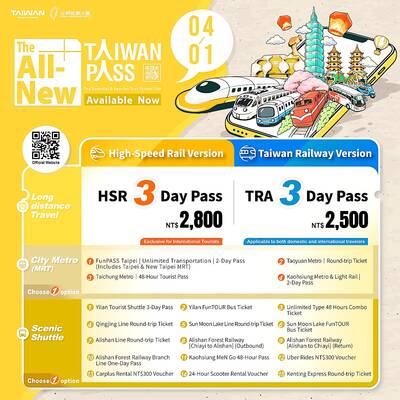
MORE POPULAR: Taiwan Pass sales increased by 59 percent during the first quarter compared with the same period last year, the Tourism Administration said The Tourism Administration yesterday said that it has streamlined the Taiwan Pass, with two versions available for purchase beginning today. The tourism agency has made the pass available to international tourists since 2024, allowing them to access the high-speed rail, Taiwan Railway Corp services, four MRT systems and four Taiwan Tourist Shuttles. Previously, five types of Taiwan Pass were available, but some tourists have said that the offerings were too complicated. The agency said only two types of Taiwan Pass would be available, starting from a three-day pass with the high-speed rail and a three-day pass with Taiwan Railway Corp. The former costs NT$2,800

The nation’s fastest supercomputer, Nano 4 (晶創26), is scheduled to be launched in the third quarter, and would be used to train large language models in finance and national defense sectors, the National Center for High-Performance Computing (NCHC) said. The supercomputer, which would operate at about 86.05 petaflops, is being tested at a new cloud computing center in the Southern Taiwan Science Park in Tainan. The exterior of the server cabinet features chip circuitry patterns overlaid with a map of Taiwan, highlighting the nation’s central position in the semiconductor industry. The center also houses Taiwania 2, Taiwania 3, Forerunner 1 and


 RSS
RSS