


A rare site in southern Taiwan -- which hosts a broad diversity of ecological systems -- needs continued careful attention and care, say ecologists from the National Science Council.
"Only in Taiwan and Mexico can you see both tropical forest and sub-tropical forest coexisting between a 300m altitude drop in a region between 20 and 30 degrees north," said Hsieh Chang-fu (謝長富), a botany professor at National Taiwan University (NTU).
Last week ecologists revealed the results of their long-term research project on Nanjen Mountain (
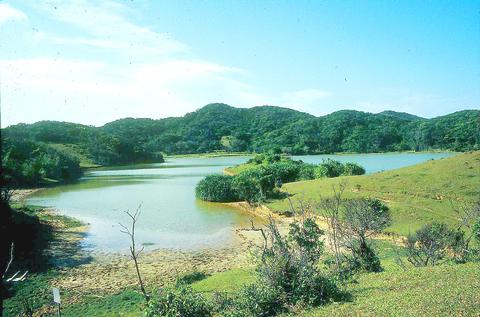
PHOTO COURTESY OF TAIWAN LONG-TERM ECOLOGICAL RESEARCH NETWORK
Hsieh, one of the pioneers of the ecological project, has spent 11 years working on the mountain investigating its diverse range of plants. Nanjen Mountain is home to Taiwan's only low-altitude forest.
"What excites ecologists is that temperate zone forest ecological systems can also be found here, which makes the mountain a unique place in the world," Hsieh said.
Because of monsoon winds and the particular land forms of the Hengchun Peninsula, diverse ecological systems have formed on the sides of the mountain, Hsieh said.
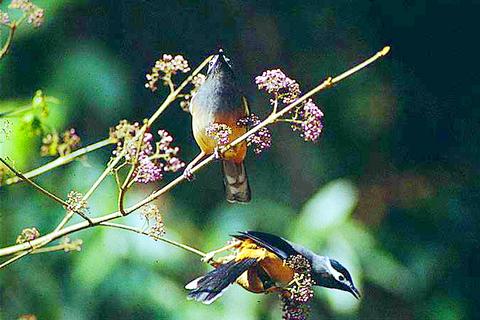
PHOTO COURTESY OF TAIWAN LONG-TERM ECOLOGICAL RESEARCH NETWORK
Decades ago, the 5,600-hectare mountain was a popular sightseeing spot for residents of southern Taiwan.
But since the establishment of Kenting National Park (墾丁國家公園) in 1982, the mountain became an officially protected area and a daily limit of 400 visitors was set.
Residents, who planted rice on the mountain, were encouraged to abandon their fields and homes and to relocate. Currently, only one man, in his 70s, has refused to leave, and lives there without tap water or electricity.
The abandoned fields on the mountain formed Nanjen Lake (
In 1989, Hsieh created a 5.25-hectare sampling site, which is the largest in Taiwan, to carry out the largest botanic investigation ever undertaken in Taiwan. The project initiated a new era of long-term ecological research in Taiwan.
Expanding research
In 1992, the Taiwan Long-term Ecological Research Network (TERN) was established. Most of its funding came from the science council. The network includes council scientists who cooperate with universities and the Taiwan Forestry Research Institute (TFRI). It has also established four research sites in northern and central Taiwan: Fushan (福山), Yuanyang Lake (鴛鴦湖), Guandaushi (關刀溪) and Tatachia (塔塔加).
In 1995, the network incorporated the research site in Nanjen Mountain, making it TERN's sixth research site.
The Nanjen Mountain site is the first official site for studying sub-tropical forest and rainforest in Taiwan.
Deep in the forest of Nanjen, scientists at TERN have established four sampling sites, three weather stations and three observation towers.
Shuttling between subtropical monsoon forest and Lauraceae forest, researchers study diverse topics, such as evolution in the plant community, herbivore-plant interaction, organic matter accumulation and decomposition in surface soils, the effect of monsoon and typhoons on forest structure and functions, food web and nutrient cycles in freshwater wetlands, ecological modeling and data management.
In the past six years, Hsieh said, scientists from universities, research institutes and national parks, have cataloged more than 60,000 trees and discovered 35 endemic species of plants. Scientists said that such a high density of endemic species exists nowhere else in Taiwan.
For example, Hsieh said, in one hectare of the mountain there are about 11,200 trees, with trunk cross-sections of an average of 6.5cm in diameter.
Ecological systems in the mountain suffered as a result of the importation of foreign species in the 1970s, which was due to an ill-considered project approved by the government.
Hsia Yue-joe (
"Foresters then considered the management of forest zones on the basis of promoting economic development," Hsia said, adding that trees were once regarded as material for burning and for making furniture.
“Unfortunately, the experience the UN gained in changing types of trees in
temperate zone was inappropriate for tropical Taiwan,” Hsia said.
Scientists said that the UN project has had a substantial negative impact on ecological systems in the mountain, and that it was time for the mountain to recover.
Last week, Hou Ping-chun (
Forest acquaintance
Scientists in Taiwan previously knew little about forests, which cover three fifths of the island, because of the difficulties in integrating the different disciplines necessary comprehensively to conduct forestry research.
Hou, a biological science professor at National Cheng Kung University (成功大學), said that the research project has successfully united experts from diverse backgrounds and that 72 sub-projects within the main project had been completed between 1995 and 2001.
A database of the heterogeneity at the site has already been established, containing information about air temperature, soil temperature, precipitation, solar radiation, wind speed and direction, chemical composition of precipitation, soil solution, and other data, she said.
Walking deep into the forest on Nanjen Mountain, visitors see crabs moving nimbly along little creeks, palm-sized spiders hanging on their nets, and sometimes snakes crawling across muddy paths.
In addition to diverse plant life, scientists said, invertebrates and amphibians made Nanjen Mountain a repository of varied life forms.
Hou and her teammates have observed the behavior of diverse amphibians at the site for two years in a bid to figure out their distribution and impact on the ecological system.
There are more than 30 species of amphibians in Taiwan and Hou's teammates have found 17 at the site. Scientists have even researched what amphibians native to the mountain, such as toads and frogs, eat.
Chen Zueng-sang (
Kuo Yau-lun (郭耀綸), a professor of forest resource management and technology at National Pingtung University of Science and Technology (國立屏東科技大學), has explored the ecophysiological mechanisms for tree species adapting to different elevations in Nanjen.
Chen Chaur-tzuhn (陳朝圳), a forestry professor at National Pingtung University of Science and Technology, said that he plans to integrate baseline data collected by TERN scientists, translate it into more easily understood Chinese, and make it available to the public.
King Hen-biau (
"The need for data, particularly long-term data, is crucial," King said.
King said knowledge of patterns of population, development, biodiversity, and other aspects in Asia, was very important in dealing with the global effects of pollution, climate change, deforestation and land use.
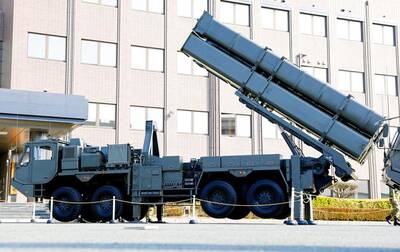
Japan has deployed long-range missiles in a southwestern region near China, the Japanese defense minister said yesterday, at a time when ties with Beijing are at their lowest in recent years. The missiles were installed in Kumamoto in the southern region of Kyushu, as Japan is attempting to shore up its military capacity as China steps up naval activity in the East China Sea. “Standoff defense capabilities enable us to counter the threat of enemy forces attempting to invade our country ... while ensuring the safety of our personnel,” Japanese Minister of Defense Shinjiro Koizumi said. “This is an extremely important initiative for

Chinese Nationalist Party (KMT) Chairwoman Cheng Li-wun (鄭麗文) today accepted an invitation from Chinese President Xi Jinping (習近平) to lead a delegation to China next month, saying she hopes to promote the peaceful development of cross-strait relations and bring stability to the Taiwan Strait. “I am grateful and happy to accept this invitation,” Cheng said in a statement from the KMT chairperson’s office. Cheng said she hopes both sides can work together to promote the peaceful development of cross-strait relations, enhance exchange and cooperation, bring stability to the Taiwan Strait and improve people’s livelihoods. At today's news conference, Cheng said any efforts to

MORE POPULAR: Taiwan Pass sales increased by 59 percent during the first quarter compared with the same period last year, the Tourism Administration said The Tourism Administration yesterday said that it has streamlined the Taiwan Pass, with two versions available for purchase beginning today. The tourism agency has made the pass available to international tourists since 2024, allowing them to access the high-speed rail, Taiwan Railway Corp services, four MRT systems and four Taiwan Tourist Shuttles. Previously, five types of Taiwan Pass were available, but some tourists have said that the offerings were too complicated. The agency said only two types of Taiwan Pass would be available, starting from a three-day pass with the high-speed rail and a three-day pass with Taiwan Railway Corp. The former costs NT$2,800

The nation’s fastest supercomputer, Nano 4 (晶創26), is scheduled to be launched in the third quarter, and would be used to train large language models in finance and national defense sectors, the National Center for High-Performance Computing (NCHC) said. The supercomputer, which would operate at about 86.05 petaflops, is being tested at a new cloud computing center in the Southern Taiwan Science Park in Tainan. The exterior of the server cabinet features chip circuitry patterns overlaid with a map of Taiwan, highlighting the nation’s central position in the semiconductor industry. The center also houses Taiwania 2, Taiwania 3, Forerunner 1 and


 RSS
RSS