


What a difference a year makes.
In the 365 days since President Chen Shui-bian's (陳水扁) multi-party administration took office, the nation's stock market has tumbled some 4,000 points -- and at 5,111 sits far below the 10,000 level Chen promised the index would rise to if elected. Export growth has contracted, economic growth has slowed to a snail's pace (by Taiwan standards, at least) and the jobless rate is at a record high. Consumers, reacting to the steady flow of poor economic numbers, are keeping their money under the mattress, refusing to spend.
The new Cabinet undoubtedly envisioned spending its first term on campaign promises such as dismantling government ties to KMT enterprises, cutting taxes for small and medium-sized businesses and constructing a technological dreamland called the "Green Silicon Island" (
And as the US economy began to slow, the Cabinet was spinning its wheels in legislative gridlock with the KMT, unable to push through its policy initiatives.
Still steaming over their election loss, opposition lawmakers punished Cabinet ministers by holding them hostage with endless questioning in the legislature.
Besides distracting officials from more pressing economic issues, the ensuing political uncertainty soured business confidence and share prices slumped even further.
The blatant lack of cooperation only complicated the inexperienced Cabinet's ability to devise a common thread of economic policymaking.
Seeing dark economic clouds forming on the horizon, the president repeatedly attempted to "re-double efforts" to bolster the nation's economy. While his intentions may have been sincere, the regular creation of task forces and stimulus packages did little but confuse the direction of the nation's economic policy.
Even Chen admitted on Friday, speaking on the one year anniversary of his taking office, that stemming the downward slide was more than his Cabinet could do alone. "Only by stopping this internal [political] war of attrition can we win the battle for economic development."
A bad hand
When Chen and his team took office on May 20 last year, the cards were already stacked against them. Many of the economic and financial policies that would demand his attention first -- ballooning bad debt at banks, corporations teetering on the edge of bankruptcy, traditional industries that long ago lost their competitive edge and an export sector far too dependent on the US information technology boom -- were the leftover problems of decades of KMT rule.
John Peet, business affairs editor at the Economist in London, placed blame for Taiwan's poor financial practices clearly on the KMT. "The problems have their roots in cronyism which clearly predated the present government."
Even former Premier Vincent Siew (蕭萬長), speaking just days before Chen was elected, knew the next Cabinet would have its work cut out for it. "It is the time to wrap up the past and hand over the heavy administrative burden to the next Cabinet."
As Taiwan's export-based economy slowed -- hindered by the steady drop in US markets -- local stock investors ran for the exits as the bourse rode its daily roller coaster course.
Acting to prop-up stocks, the Ministry of Finance began sporadic market intervention with the government's NT$500 billion National Stabilization Fund (
Officials instead opted to write the rules themselves and use the fund to boost the confidence of investors worried about economic policy direction.
The amateur dabbling in the market drew harsh criticism from pundits and cost the nation nearly NT$50 billion in paper losses. Strong armed by the Cabinet to intervene, the four government-related pension and labor insurance funds also lost nearly NT$100 billion on paper in the risky gamble.
In mid-April the government watchdog Control Yuan censured the stabilization fund's management for its lack of "real-world, professional market experience," saying in a statement, "The Executive Yuan should review deficiencies regarding the Stabilization Fund's operations."
With egg on their faces and the economic numbers looking poor, the Cabinet came up with a new strategy: What you don't know can't hurt you.
Various agencies began withholding "frightening" economic data all together, including the disclosure of bad bank loan updates, consumer confidence figures and profit reports at state-run firms. But under pressure from local and international media, the government was forced to reverse this policy.
A November 2000 report in the Economist warning of a possible liquidity crisis in the banking sector triggered a landslide of media criticism that eventually forced the finance ministry to revise bad loan statistics.
But the ministry does deserve some credit for making headway on reforming the financial sector, including sparking consolidation in the nation's ailing banking industry. In addition officials pushed through legislation to begin the enormous task of disposing of more than NT$1 trillion in non-performing loans.
Yet plans to merge many healthy banks with sickly ones have left the finance ministry charged with the absurd task of saying the mergers won't cost anyone their job. While the government may believe the prospect of more job losses may be hard for the public to take, ignoring the reality only perpetuated the notion that officials are trying to hide bad economic news.
Nuclear meltdown
By late summer last year, the Cabinet was preoccupied with the debate over the Ministry of Economic Affairs' review of the Fourth Nuclear Power Plant (
The final announcement by Premier Chang Chun-hsiung (
A review of that decision early in January this year by the government's top judicial court would force Premier Chang to overturn the policy under threat of the president's dismissal. The plant's termination and subsequent restart some 110 days later cost the state-run power company charged with constructing the nuclear plant -- Taiwan Power Co (台電) -- over NT$3.4 billion.
Wanted: jobs
They hit the streets by the thousands, united in their call for more jobs and demanding a policy fix to cure the economic woes. But most analysts agree there is little the government can do in the short term to stimulate the US appetite for Taiwan-made computers, phones and other electronics, which make up about half of Taiwan's export-dependent economy. According to officials the math is simple: Less trade means fewer jobs.
Taiwanese, long accustomed to job stability, have panicked in recent months at the thought of joining the ranks of some 380,000 on the unemployment line -- or worse yet -- looking for work in a construction or manufacturing position usually reserved for imported laborers. The news, while a bitter pill few will want to swallow, may be the only choice in the near future according to the economic's chief.
"There is no magic cure for Taiwan's economic ills," Minister of Economic Affairs Lin Hsin-yi (林信義) said just last month, adding that the public "should expect between two and three more years of pain before things improve."

‘NO SECURITY RISK’: The Railway Bureau reassured the public that the technicians’ activities were limited to technical guidance and did not involve sensitive systems The Railway Bureau yesterday said it had invited eight Chinese technicians to assist with an airport MRT construction project. The bureau issued the confirmation after an Internet user said Chinese nationals had entered the construction zone of Taiwan Taoyuan International Airport’s Terminal 3 project. They asked why “individuals from an enemy state” were allowed access to such a major national infrastructure project, which raised serious concerns over Taiwan’s industrial safety, sensitive systems and information security. The bureau’s Northern Region Engineering Branch Office said subcontractor Taiwan Handle Industrial Co (台灣手把工業) of the Taoyuan airport MRT’s “Contract No. CU05 Project A14 Station Civil, MEP &

A US uncrewed surface vessel (USV) encountered multiple Chinese warships during an autonomous transit of the Taiwan Strait, US defense company Seasats said in a statement on Wednesday. Seasats announced that a Lightfish USV had completed the first autonomous transit of the Taiwan Strait. Over five days, the USV traversed the entire length of the Strait while constantly monitoring surface vessel traffic, the company said. The Lightfish encountered multiple Chinese warships, one of which was a Chinese People’s Liberation Army Navy (PLAN) Type 056 corvette, it said. The Chinese vessels were operating “well within Taiwan’s exclusive economic zone without transmitting their identity via the
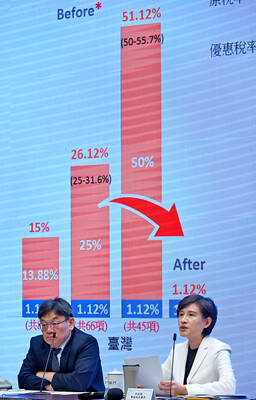
GREATER REACH? Auto parts and wood products would face tariffs of up to 15%, matching those targeting the EU, Japan and South Korea, Vice Premier said The US has announced that preferential tariff treatment for Taiwan’s non-semiconductor Section 232 goods would take effect retroactively from May 1, the Executive Yuan said yesterday. The US government yesterday posted a notice on the Federal Register’s public inspection Web site previewing tariff concessions for Taiwan under a memorandum of understanding (MOU) on Taiwan-US investment after two months of negotiations. The MOU signed on Jan. 15 stipulated three major preferential tariff arrangements: a 15 percent “reciprocal” tariff rate for Taiwan without stacking most-favored nation (MFN) rates; preferential Section 232 treatment for semiconductors and related products; and preferential Section 232 treatment for non-semiconductor
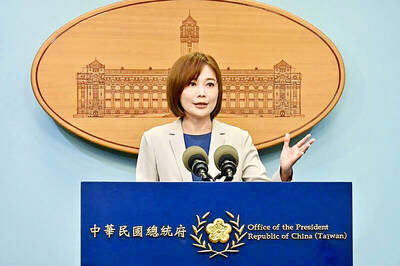
TIT-FOR-TAT: The US allegedly revoked the visa of a Chinese national working at Xinhua News Agency in the US in response to Beijing’s expulsion of Vivian Wang The Presidential Office yesterday condemned China for expelling a New York Times correspondent from Beijing following the newspaper’s interview with President William Lai (賴清德), saying the move highlighted Beijing’s suppression of press freedom and its threat to international news media. Taiwan has noted a series of recent incidents in which Beijing used similar tactics to “threaten and pressure international media outlets and journalists,” Presidential Office spokeswoman Karen Kuo (郭雅慧) said in a statement. “This concerns not only press freedom and freedom of expression, but also the safety of journalists, and Taiwan and relevant partners are paying close attention to the situation,” she


 RSS
RSS