


Taipei Times: What inspired you to film Taiwan's treatment of animals?
Chu Hsien-jer (
TT: Do you agree that treatment of animals has improved since 1996?
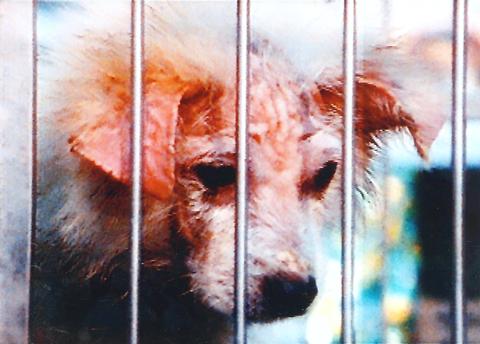
PHOTO: CHU HSIEN-JER
Chu: Yes. But there is still much to do. We have animal protection laws, but Taiwan's law enforcement is far from satisfactory.
TT: Tell us about some current problems impairing animal rights.
Chu: The problem of stray dogs results from the abandonment of pet dogs. People here lack respect for life and see animals as merely lifeless objects. I have found that many shoppers in night markets buy puppies as gifts for their loved ones, but the recipients are simply not prepared for keeping a dog. They dump the pet after it grows up to become less beautiful or because it is confirmed not to be a pedigree.
The father of a very good friend of mine has abandoned several pet dogs. One of them suffered from a skin disease and was repeatedly dumped after finding its way home. The family drove a long way to dump it in the end to make sure that it would never return.
Many vets have had to accept requests to cut the vocal chords of pet dogs whose owners can't stand their barking for fear that otherwise the dogs will be abandoned. People who live in apartment buildings and those who are not ready to have pets should never keep dogs in the first place.
TT: Give us some personal analysis of why people in Taiwan treat animals like this.
Chu: Taiwan is an extremely utilitarian society. Consider conversations with your friends and relatives. They are always about real estate prices and the stock market. Because people don't care about anything but economic development, they overlook animal rights. But how animals are treated is a reflection of the maturity, sophistication and harmony of a society.
TT: In what sense?
Chu: Animals do not reason like humans and cannot vote. But they have all sorts of feelings just like humans. The way people treat animals here shows that people lack respect and tolerance of others, especially the underprivileged. People here are preoccupied with money and resigned to the pressure to compete for their daily bread. It is rare that they consider the people at the bottom of society, let alone animal rights.
Sometimes abusing animals is a way for people to release their stress.
The army is a microcosm of society. When we were in the army and under great pressure, animal abuse was one way to relieve the stress. We tossed puppies into the air. My fellow recruits even put a dog into a spin dryer. I myself ate dog meat. As I shot the film, I sometimes felt like repenting.
I remember, on the other hand, a time when I was relaxed and I lived in the mountains and slept on the floor, a poisonous toad was licking my face. I simply got it out of the room without hurting it. I think that was because I was at ease.
The sympathy of people in Taiwan people has been suppressed during their socialization process. That human warmth, suffocated by greed needs to be dug out for a more harmonious society to emerge.
People in Taiwan treat others the way they treat animals. The violent verbal attack that cuts like an invisible knife in the legislature or on a call-in program is an example. They can't even respect the freedom of speech of others. Most legislators' faces are ugly because of their offensive minds.
People who lack tolerance for one another can hardly be expected to have respect for other species.
I hope my and other directors' documentaries can help with that problem by spreading a little kindness around. But sometimes I think that the audience may feel touched for an hour but the next day they still have to face the pressures of society. We need more media coverage of matters that touch human feelings.

‘NO SECURITY RISK’: The Railway Bureau reassured the public that the technicians’ activities were limited to technical guidance and did not involve sensitive systems The Railway Bureau yesterday said it had invited eight Chinese technicians to assist with an airport MRT construction project. The bureau issued the confirmation after an Internet user said Chinese nationals had entered the construction zone of Taiwan Taoyuan International Airport’s Terminal 3 project. They asked why “individuals from an enemy state” were allowed access to such a major national infrastructure project, which raised serious concerns over Taiwan’s industrial safety, sensitive systems and information security. The bureau’s Northern Region Engineering Branch Office said subcontractor Taiwan Handle Industrial Co (台灣手把工業) of the Taoyuan airport MRT’s “Contract No. CU05 Project A14 Station Civil, MEP &

A US uncrewed surface vessel (USV) encountered multiple Chinese warships during an autonomous transit of the Taiwan Strait, US defense company Seasats said in a statement on Wednesday. Seasats announced that a Lightfish USV had completed the first autonomous transit of the Taiwan Strait. Over five days, the USV traversed the entire length of the Strait while constantly monitoring surface vessel traffic, the company said. The Lightfish encountered multiple Chinese warships, one of which was a Chinese People’s Liberation Army Navy (PLAN) Type 056 corvette, it said. The Chinese vessels were operating “well within Taiwan’s exclusive economic zone without transmitting their identity via the
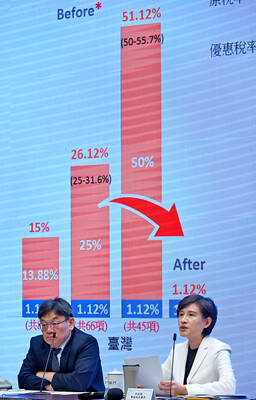
GREATER REACH? Auto parts and wood products would face tariffs of up to 15%, matching those targeting the EU, Japan and South Korea, Vice Premier said The US has announced that preferential tariff treatment for Taiwan’s non-semiconductor Section 232 goods would take effect retroactively from May 1, the Executive Yuan said yesterday. The US government yesterday posted a notice on the Federal Register’s public inspection Web site previewing tariff concessions for Taiwan under a memorandum of understanding (MOU) on Taiwan-US investment after two months of negotiations. The MOU signed on Jan. 15 stipulated three major preferential tariff arrangements: a 15 percent “reciprocal” tariff rate for Taiwan without stacking most-favored nation (MFN) rates; preferential Section 232 treatment for semiconductors and related products; and preferential Section 232 treatment for non-semiconductor

The National Chungshan Institute of Science and Technology yesterday showcased its locally developed variants of the Vision 60 robotic patrol dog, which it plans to deploy on the nation’s outlying territories in the South China Sea. The variants were produced under the Joint Lab project — created by the institute and domestic companies — and assembled with domestically produced motors, lenses and artificial intelligence (AI) systems alongside licensed tech from the US, Missile and Rocket Systems Research Division deputy director Jen Kuo-kang (任國光) told the media event at a military base in Taipei’s Dazhi (大直) area. Taiwan has built up its strengths


 RSS
RSS