


Recent efforts to introduce Taiwan's hotspring resources to the world by joining an international hotspring organization have been overshadowed by resistance from China.
Enjoying a relaxing soak in a hotspring, especially on a cold day, has become a popular pastime among people in Taiwan. However, officials say that despite Taiwan's abundant hotspring resorts, international tourism to the springs has been limited due to Taiwan's lack of political standing in the international arena.
In order to bring Taiwan's hotsprings to the world stage, the Taiwan Hotspring Association (台灣溫泉協會) has submitted its application to enter the International Federation of Hydrotherapy and Climatotherapy (IFHAC), an organization based in France that promotes the healing benefits of thermal spas and climatic resorts and has a nearly 50 country membership.
Invited by the Taiwan Hot-spring Association, Dr Guy Ebrard, honorary president of the French organization, began his 10-day trip in Taiwan yesterday afternoon to appraise Taiwan's application. Ebrard is scheduled to meet President Chen Shui-bian (
With more than two-thirds of its participants being medical experts, the 63-year-old IFHAC is the most influential organization on hotsprings in the world, sources at the Taiwan Hotspring Association said.
The French organization's goal is to research and exchange knowledge about the technical and scientific problems relating to hydrotherapy and climatotherapy and to promote the medical benefits of hotsprings while facilitating their development for tourism.
Sources said that the present Russian chairman of the IFHAC has recommended both China and Mongolia for membership.
Because of its status as a provisional member in the organization, China has tried to block Taiwan's entry, involving the research organization in politics.
Despite China's attempt to interfere, the Taiwan Hotspring Association has actively promoted Taiwan's hotspring resources to the organization.
If Taiwan gains membership in the body, local officials said it will be undoubtedly a giant step for developing local tourism.
According to a brochure published by the Tourism Bureau (交通部觀光局) to promote local hotspring hotels, there are more than 130 hotsprings in Taiwan.
In spite of abundant resources, hotsprings have not as successfully penetrated daily life here as they have in Japan. An official said the crux of the problem lies in Taiwan's poor management.
"Some of the bad habits include entering the pool without taking a shower first, wearing swimming suits while taking a soak, and washing hair or even their buttocks in the pool," said Chen Chun-ting (陳俊廷), secretary-general of the Taiwan Hotspring Association.
Chen pointed out that the habits could transmit some diseases, making it more difficult to promote the hotsprings.
Some hotels fail to keep hot water flowing to maintain their pools' freshness. Such poor circulation and repeated use of the same water cannot provide healing effects, and instead the pools become a hotbed for bacteria, Chen said.
Famous resorts in Taiwan include Nantou County's Lushan (
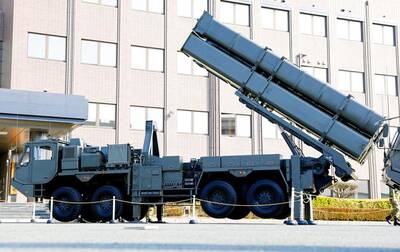
Japan has deployed long-range missiles in a southwestern region near China, the Japanese defense minister said yesterday, at a time when ties with Beijing are at their lowest in recent years. The missiles were installed in Kumamoto in the southern region of Kyushu, as Japan is attempting to shore up its military capacity as China steps up naval activity in the East China Sea. “Standoff defense capabilities enable us to counter the threat of enemy forces attempting to invade our country ... while ensuring the safety of our personnel,” Japanese Minister of Defense Shinjiro Koizumi said. “This is an extremely important initiative for
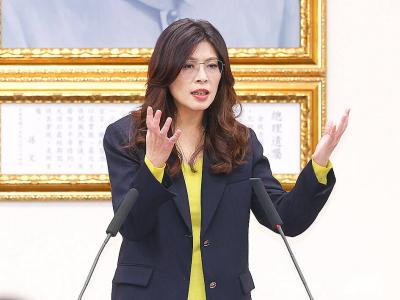
Chinese Nationalist Party (KMT) Chairwoman Cheng Li-wun (鄭麗文) today accepted an invitation from Chinese President Xi Jinping (習近平) to lead a delegation to China next month, saying she hopes to promote the peaceful development of cross-strait relations and bring stability to the Taiwan Strait. “I am grateful and happy to accept this invitation,” Cheng said in a statement from the KMT chairperson’s office. Cheng said she hopes both sides can work together to promote the peaceful development of cross-strait relations, enhance exchange and cooperation, bring stability to the Taiwan Strait and improve people’s livelihoods. At today's news conference, Cheng said any efforts to

MORE POPULAR: Taiwan Pass sales increased by 59 percent during the first quarter compared with the same period last year, the Tourism Administration said The Tourism Administration yesterday said that it has streamlined the Taiwan Pass, with two versions available for purchase beginning today. The tourism agency has made the pass available to international tourists since 2024, allowing them to access the high-speed rail, Taiwan Railway Corp services, four MRT systems and four Taiwan Tourist Shuttles. Previously, five types of Taiwan Pass were available, but some tourists have said that the offerings were too complicated. The agency said only two types of Taiwan Pass would be available, starting from a three-day pass with the high-speed rail and a three-day pass with Taiwan Railway Corp. The former costs NT$2,800

The nation’s fastest supercomputer, Nano 4 (晶創26), is scheduled to be launched in the third quarter, and would be used to train large language models in finance and national defense sectors, the National Center for High-Performance Computing (NCHC) said. The supercomputer, which would operate at about 86.05 petaflops, is being tested at a new cloud computing center in the Southern Taiwan Science Park in Tainan. The exterior of the server cabinet features chip circuitry patterns overlaid with a map of Taiwan, highlighting the nation’s central position in the semiconductor industry. The center also houses Taiwania 2, Taiwania 3, Forerunner 1 and


 RSS
RSS