


Taipei Times: Many DPP legislators have alleged that you are a gangster. The DPP on Wednesday even made public a name list of the party's legislators whom they said had been attacked by you before, to show that you behave like a gangster. Why is that so?
Lo Fu-chu (
Almost all legislators have some voters who are from the underworld, and it is very common for people standing for public office to know people from all walks of life.
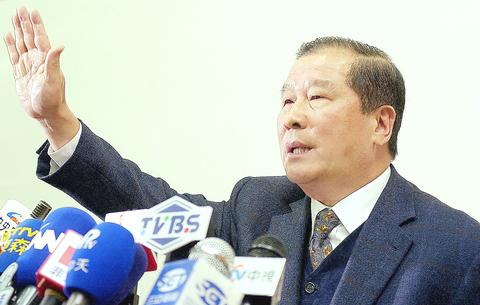
PHOTO: HUANG JUI-PO, TAIPEI TIMES
The DPP is well aware of my stature, because I have so many friends from different corners of society. The DPP looked to me for cooperation at first, but that plan did not work out because we did not see eye-to-eye ideologically. The DPP then started to accuse me of being a gangster, which caused confrontation between myself and the party. But in fact in private, I am good friends with many members of the DPP.
At the beginning of my first term in the legislature, there were never any fights. This was probably because the DPP had heard that I have many important friends and dared not do anything reckless.
I'm different from other legislators. I joined the legislature because I saw a crisis in the country and wished to do something about it.
Before I became a legislator, many foreign friends of mine laughed at the fact that Taiwan's legislators were so happy to hit each other. I felt ashamed about this too. But after I joined the legislature, I myself was also involved in this kind of behavior. I admit that this was wrong.
TT: It has been reported that you admitted to being a "spiritual leader" of the Tian Tau Meng (
Lo: This is totally untrue. I personally have never said, on any occasion, that I was a member of the Tian Tau Meng.
I never joined any gang. In 1992, the Taipei Prosecutors' Office concluded an investigation on a case in which I was charged with being involved in organized crime, and no indictment was brought against me.
Everybody who called me a gangster has been sued and convicted, including independent Legislator Liao Hsueh-kuang (廖學廣) and DPP Legislator Tsai Ming-shian (蔡明憲). Prosecutors have also brought an indictment in another case against DPP Legislator Lee Wen-chung (李文忠). They have to have evidence if they are to accuse me of being a gangster, and they have never been able to present any evidence of my involvement in organized crime.
I was jailed for three years [from November 1984 to July 1988] for "alleged sedition" for financing opposition activists during the martial law era. But the prosecutors eventually dropped the case, because their investigation turned up no evidence of my involvement. Now I'm applying for compensation from the government for unjust imprisonment. I originally planned to let bygones be bygones, but now that so many false allegations are being made against me, I have to do something to clear my name.
TT: What made you decide to stop participating in the legislature's activities? Does it mean that you feel guilty about Wednesday's incident?
Lo: In the past five years of my political career, I have felt deeply that many legislators are Janus- faced. They say one thing, and do another.
In the past, many of the fights that took place in the legislature were referred to the Discipline Co-mmittee for punishment. But I don't think this is the solution.
To really reform the legislature, I am willing to sacrifice myself.
I wish to take this opportunity to make this case the last of its kind in the legislature. Physical conflict is a very bad thing, and I personally think that verbal violence is even worse than physical violence.
If all the legislators are sincere about doing a good job, I'm willing to set a model today to let peace prevail in the Legislative Yuan and to let the country claim back its good name.
I hereby announce, in all seriousness, that I will stop participating in the activities of the legislature for three months. I also won't rule out the possibility of quitting politics altogether.

‘NO SECURITY RISK’: The Railway Bureau reassured the public that the technicians’ activities were limited to technical guidance and did not involve sensitive systems The Railway Bureau yesterday said it had invited eight Chinese technicians to assist with an airport MRT construction project. The bureau issued the confirmation after an Internet user said Chinese nationals had entered the construction zone of Taiwan Taoyuan International Airport’s Terminal 3 project. They asked why “individuals from an enemy state” were allowed access to such a major national infrastructure project, which raised serious concerns over Taiwan’s industrial safety, sensitive systems and information security. The bureau’s Northern Region Engineering Branch Office said subcontractor Taiwan Handle Industrial Co (台灣手把工業) of the Taoyuan airport MRT’s “Contract No. CU05 Project A14 Station Civil, MEP &

The National Chungshan Institute of Science and Technology yesterday showcased its locally developed variants of the Vision 60 robotic patrol dog, which it plans to deploy on the nation’s outlying territories in the South China Sea. The variants were produced under the Joint Lab project — created by the institute and domestic companies — and assembled with domestically produced motors, lenses and artificial intelligence (AI) systems alongside licensed tech from the US, Missile and Rocket Systems Research Division deputy director Jen Kuo-kang (任國光) told the media event at a military base in Taipei’s Dazhi (大直) area. Taiwan has built up its strengths

RIGHT DIRECTION: Taiwan’s efforts to prevent forced labor include a proposal to ‘fully prohibit’ employers from withholding workers’ documents, an official said Taiwan is to establish a mechanism to restrict imports of goods linked to forced labor, the Executive Yuan said yesterday, after the US proposed imposing additional tariffs on Taiwanese goods over labor concerns. “The Ministry of Labor and the Ministry of Economic Affairs are to establish an interministerial review procedure,” Executive Yuan spokesperson Michelle Lee (李慧芝) said at a news briefing in Taipei. “The government is to use the Foreign Trade Act [貿易法] as the legal basis to restrict imports of goods produced with forced labor” and bring its supply chain governance more in line with international standards on human rights, resilience

NOT IMMEDIATE: Taiwan has a chance to appeal the proposed 10 percent tariff before it starts, while other countries face a 12.5 percent tariff from the trade office Taiwan is among 60 economies determined by the US to have failed to impose or enforce a ban on the importation of goods produced with forced labor, according to a notice released on Tuesday by the Office of the US Trade Representative (USTR), which proposed imposing an additional 10 percent or more tariff on them. The USTR in a statement said that following an investigation, it had determined under Section 301 of the Trade Act of 1974 that the failure of the 60 economies to impose and effectively enforce a prohibition on the importation of goods produced with forced labor is


 RSS
RSS