


A Taipei city councilor has called on the central government to regulate tattoo parlors, which are all illegal.
Taipei City Councilor Lee Hsin (
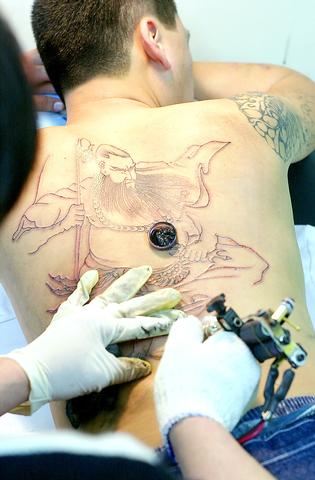
PHOTO: CHEN CHENG-CHANG, TAIPEI TIMES
By failing to regulate the industry, the government is putting "consumers' rights and safety in jeopardy," Lee said at a press conference held at the Taipei City Council yesterday.
Lee asked the city government to pay more attention to the booming business and legalize and regulate it. "It should consider formulating regulatory measures regarding the qualifications of those who perform the service, [and it should make] uniform standards for fee structures, facilities and hygiene," he said.
In recent years, tattoos have become increasingly popular, especially among women. But not every-one is aware of the pitfalls associated with getting a tattoo and advocates say regulation would lead to better informed consumers.
Amy Lee has tried almost everything to get rid of the tattoo on the back of her left palm. She has tried salt and chemicals including hydrochloric acid, but the cartoon image of Calvin and Hobbes won't fade away.
"I got really sick and tired of it five years after I got it," said Lee, 21.
Lee got a tattoo at the age of 16 out of curiosity, but said that the older she gets, the more eager she is to get rid of the tattoo.
"I was too young to realize that although it's cool to get a tattoo, it's still looked down on by society," she said.
While she paid nothing for the tattoo, which was done by one of her friends free of charge, she will now have to pay a whopping NT$30,000 and make at least three trips to a clinic to have it removed.
Tseng Chih-jen (
"You may not know what risks you're taking because you can easily get infected by poorly sterilized equipment or have to pay an outrageous amount of money for a poor service," he said.
Lee's case, however, highlights only one of the problems faced by the tattoo industry.
Although the tattoo business keeps booming and has become very popular and fashionable for young people, few people realize that it is not a recognized industry.
According to the Ministry of Economic Affairs (經濟部), tattoo shop owners are banned from applying for operating licenses because the service they provide "violates accepted social practices" and "does harm to human health."
The Cabinet's Department of Health (
In other words, all of the tattoo parlors currently operating are doing so without any legal framework.
Chang Hui-hsiung (
"If it becomes legal, we will have rules to follow, and regulation usually brings quality," said Chang, who was tattooed on the back, chest and both arms while serving a prison sentence at the age of 19.
Although legalization would also mean paying taxes, Chang said that it would not make much difference to his shop, where gross monthly revenues reach between NT$100,000 and NT$200,000.
"We are, after all, not making big profits out of it," he said.
Charges at his shop vary a great deal, ranging between NT$1,000 and NT$60,000, depending on the size and complexity of the tattoo. While one simple icon may take about 20 minutes to finish, a tattoo covering one's back may take at least 10 hours or three trips, he said.
Comparing the clientele of today with that of six years ago when he opened his shop, Chang said that he has seen a dramatic change in terms of gender and age.
"I see more young people coming in, and while about 60 percent of them are women nowadays, only 10 percent were six years ago," he said.
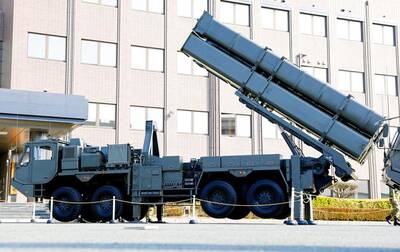
Japan has deployed long-range missiles in a southwestern region near China, the Japanese defense minister said yesterday, at a time when ties with Beijing are at their lowest in recent years. The missiles were installed in Kumamoto in the southern region of Kyushu, as Japan is attempting to shore up its military capacity as China steps up naval activity in the East China Sea. “Standoff defense capabilities enable us to counter the threat of enemy forces attempting to invade our country ... while ensuring the safety of our personnel,” Japanese Minister of Defense Shinjiro Koizumi said. “This is an extremely important initiative for
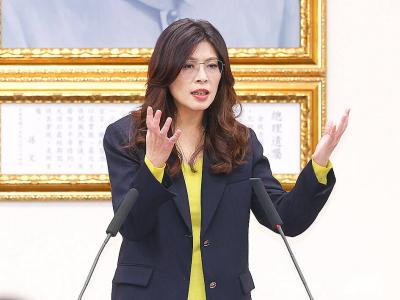
Chinese Nationalist Party (KMT) Chairwoman Cheng Li-wun (鄭麗文) today accepted an invitation from Chinese President Xi Jinping (習近平) to lead a delegation to China next month, saying she hopes to promote the peaceful development of cross-strait relations and bring stability to the Taiwan Strait. “I am grateful and happy to accept this invitation,” Cheng said in a statement from the KMT chairperson’s office. Cheng said she hopes both sides can work together to promote the peaceful development of cross-strait relations, enhance exchange and cooperation, bring stability to the Taiwan Strait and improve people’s livelihoods. At today's news conference, Cheng said any efforts to
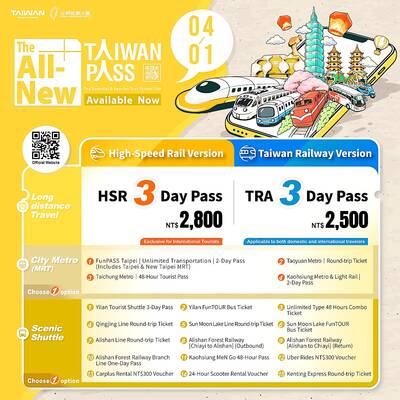
MORE POPULAR: Taiwan Pass sales increased by 59 percent during the first quarter compared with the same period last year, the Tourism Administration said The Tourism Administration yesterday said that it has streamlined the Taiwan Pass, with two versions available for purchase beginning today. The tourism agency has made the pass available to international tourists since 2024, allowing them to access the high-speed rail, Taiwan Railway Corp services, four MRT systems and four Taiwan Tourist Shuttles. Previously, five types of Taiwan Pass were available, but some tourists have said that the offerings were too complicated. The agency said only two types of Taiwan Pass would be available, starting from a three-day pass with the high-speed rail and a three-day pass with Taiwan Railway Corp. The former costs NT$2,800

The nation’s fastest supercomputer, Nano 4 (晶創26), is scheduled to be launched in the third quarter, and would be used to train large language models in finance and national defense sectors, the National Center for High-Performance Computing (NCHC) said. The supercomputer, which would operate at about 86.05 petaflops, is being tested at a new cloud computing center in the Southern Taiwan Science Park in Tainan. The exterior of the server cabinet features chip circuitry patterns overlaid with a map of Taiwan, highlighting the nation’s central position in the semiconductor industry. The center also houses Taiwania 2, Taiwania 3, Forerunner 1 and


 RSS
RSS