


A visiting Russian parliamentarian and Russian experts voiced mixed views yesterday on whether Russia should become the destination for Taiwan's nuclear waste once the State Duma passes a bill to allow Russia to import highly radioactive waste from foreign countries.
While some said economic interest was what drove a majority of Duma deputies to support the bill, others opposed the import of Taiwan's nuclear waste for the sake of environmental protection.
"The main purpose [for the amendment of the law] is to attract foreign currency which Russia badly needs," Alexandr Alexandrovich Karelin, a member of the State Duma, said after emerging from a briefing on Taiwan's development at the Government Information Office yesterday afternoon.
Russian Nuclear Power Minister Yevgeny Adamov has claimed that Russia would earn up to US$20 billion over the next 10 to 15 years by importing foreign waste.
Karelin, who won medals for wrestling at the 1988, 1992 and 1996 Olympics, said that projects would involve transnational cooperation.
"There is an international aspect to the project. Not only Russia, but other countries will have shared responsibilities," Karelin added.
Although polls in Russia have shown that the Russian public is unequivocally opposed to such imports, Duma deputies last December passed the first reading of a government-backed bill with a vote of 319-38 that would allow the country to import highly radioactive waste from foreign countries. The second reading of the bill is scheduled to take place tomorrow.
The London-based Guardian newspaper reported from Moscow on Monday that a leaked document showed that the US had backed plans to turn Russia into an international nuclear dump to accommodate waste from Taiwan, South Korea and Japan.
The US Department of Energy denied on Monday that it had played a role in pushing for the shipment of nuclear waste from Taiwan to Russia for permanent disposal.
However, a spokesperson for Taipower (
One Russian analyst based in Taipei voiced his opposition to the proposal, saying that imports of high-level radioactive nuclear waste could only jeopardize what they described the already "serious environmental problems" in Russia.
"If the authorities decide to do this, I will be against it because it's contrary to the interests of our country ... it is a problem of environmental security," Michael Kryukov, a professor at the Institute of Russian Studies at Tamkang University, said.
Noted US journalist Colin McMahon has said that it's estimated that 60 million out of 145 million Russians live in "environmentally dangerous" conditions.
Russian officials such as Adamov have argued that spent nuclear fuels are valuable commodities which can be reprocessed and recycled.
Meanwhile, some Moscow-based analysts such as Pavel Felgenhauer have argued that it was "defense considerations" that drove the Russian political elite to support the passage of the bill -- which would allow Russia to develop a new generation of weapons by reprocessing nuclear waste from other countries.
It was immediately after Russian President Vladimir Putin -- in his capacity as then-secretary of the Security Council -- ordered the nuclear power ministry in April 1999 to speed up the development of a new generation of nuclear weapons that Adamov started to clamor for foreign nuclear waste and the bill was introduced in the Duma, Felgenhauer wrote in the Moscow Times on Jan. 4.
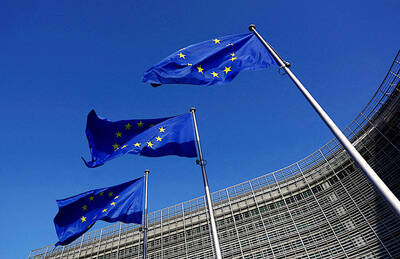
LEVERAGE: China did not ‘need to fire a shot’ to deny Taiwan airspace over Africa when it owns ‘half the continent’s debt,’ a US official said, calling it economic warfare The EU has raised concerns about overflight rights following the delay of President William Lai’s (賴清德) planned state visit to the Kingdom of Eswatini after three African nations denied overflight clearance for his charter at the last minute. Taiwanese allies Paraguay and Saint Kitts and Nevis, as well as several US lawmakers and the Inter-Parliamentary Alliance on China (IPAC) condemned China for allegedly pressuring the countries. Lai was scheduled to fly directly to Taiwan’s only African ally from yesterday to Sunday to celebrate the 40th anniversary of King Mswati III’s accession and his 58th birthday, but Seychelles, Mauritius and Madagascar suddenly revoked
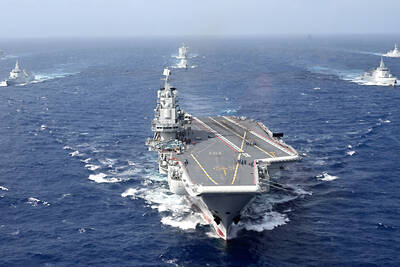
PROVOCATIVE: Chinese Deputy Ambassador to the UN Sun Lei accused Japan of sending military vessels to deliberately provoke tensions in the Taiwan Strait China denounced remarks by Japan and the EU about the South China Sea at a UN Security Council meeting on Monday, and accused Tokyo of provocative behavior in the Taiwan Strait and planning military expansion. Ayano Kunimitsu, a Japanese vice foreign minister, told the Council meeting on maritime security that Tokyo was seriously concerned about the situation in the East China and South China seas, and reiterated Japan’s opposition to any attempt to change the “status quo” by force, and obstruction of freedom of navigation and overflight. Stavros Lambrinidis, head of the EU delegation to the UN, also highlighted South China Sea
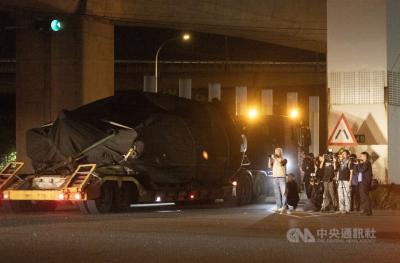
The final batch of 28 M1A2T Abrams tanks purchased from the US arrived at Taipei Port last night and were transported to the Armor Training Command in Hsinchu County’s Hukou Township (湖口), completing the military’s multi-year procurement of 108 of the tanks. Starting at 12:10am today, reporters observed more than a dozen civilian flatbed trailers departing from Taipei Port, each carrying an M1A2T tank covered with black waterproof tarps. Escorted by military vehicles, the convoy traveled via the West Coast Expressway to the Armor Training Command, with police implementing traffic control. The army operates about 1,000 tanks, including CM-11 Brave Tiger
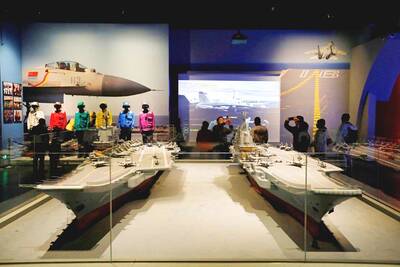
China on Wednesday teased in a video an aircraft carrier that could be its fourth, and the first using nuclear power, while making an allusion to Taiwan and vowing to further build up its islands, as it looks to boost maritime power, secure resources and bolster territorial claims. The video, issued on the eve of the 77th founding anniversary of the Chinese People’s Liberation Army Navy, featured fictional officers with names that are homophones of three commissioned aircraft carriers, the Liaoning (遼寧), Shandong (山東) and Fujian (福建). Titled Into the Deep, it showed a 19-year-old named “Hejian” (何劍) joining the group, sparking


 RSS
RSS