


President Chen Shui-bian (
Chen cautioned at the same time against a potential outbreak of war in the Taiwan Strait because of miscalculations by the Chinese leadership.
"We can not ignore the fact that we are feeling greater pressure from China because of its growing ballistic missile forces, state-of-the-art weapons and overall arms build-up. They are still likely to miscalculate the situation and launch a war in the Strait," Chen said. "We must therefore constantly be ready for war so as to deter China."
Chen made the statements in a speech to 200 senior officers from all the services, who gathered at a military site in Yangmingshan yesterday for the start of an annual four-day advanced studies session. It is the first time that Chen has spoken to the military leadership on such an occasion.
The advanced studies sessions are held for generals or those likely to be promoted to general, to enrich their knowledge of various fields. A total of 600 officers will have attended this year's sessions by the time the program ends in a month's time.
In his speech, Chen reemphasized his advocacy of conditional economic and political integration with China, which he first brought up in a televised address to the nation at the end of last year.
"I called upon the Beijing leadership in my speech on Dec. 31, last year, to respect the ROC's right to exist in international society. I urged them to publicly renounce the use of force against Taiwan," Chen said.
"[Under these conditions], the two sides of the Strait can best use their wisdom to solve the current stalemate. We can start with economic and cultural integration. We can build mutual trust during the process," he said.
"The ultimate goal is to seek a lasting peace in the Taiwan Strait and construct a framework for the political integration of the two sides. This will be to the greatest interests of people on both sides of the Strait. If we can join hand-in-hand, there will be immense possibilities for both sides," he said.
Chen did not forget, however, to remind officers of the military threat from China despite the bright future he envisioned for them together.
"China's threat to use force against Taiwan is still the biggest danger to the existence and development of Taiwan. It is estimated that by 2005, China will pose a real threat to Taiwan in military satellites, advanced weapons, C4ISR (command, control, communication, computer, intelligence, surveillance, reconnaissance) systems, as well as naval and air power," he said.
In a break following Chen's speech, none of the generals in the audience were willing to talk with the press about what they thought of the speech.
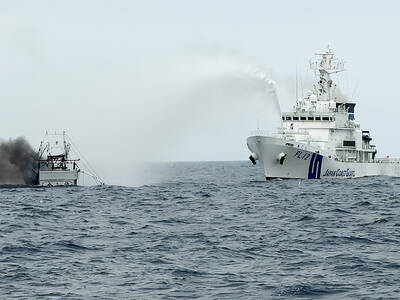
CREDIT-GRABBER: China said its coast guard rescued the crew of a fishing vessel that caught fire, who were actually rescued by a nearby Taiwanese boat and the CGA Maritime search and rescue operations do not have borders, and China should not use a shipwreck to infringe upon Taiwanese sovereignty, the Coast Guard Administration (CGA) said yesterday. The coast guard made the statement in response to the China Coast Guard (CCG) saying it saved a Taiwanese fishing boat. The Chuan Yu No. 6 (全漁6號), a fishing vessel registered in Keelung, on Thursday caught fire and sank in waters northeast of Diaoyutai Islands (釣魚台). The vessel left Keelung’s Badouzih Fishing Harbor (八斗子漁港) at 3:35pm on Sunday last week, with seven people on board — a 62-year-old Taiwanese captain surnamed Chang (張) and six
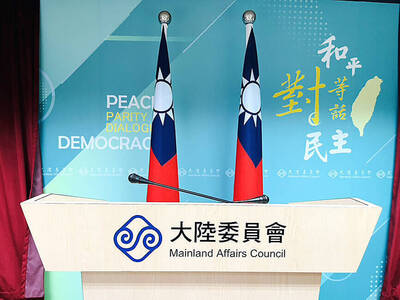
RISKY BUSINESS: The ‘incentives’ include initiatives that get suspended for no reason, creating uncertainty and resulting in considerable losses for Taiwanese, the MAC said China’s “incentives” failed to sway sentiment in Taiwan, as willingness to work in China hit a record low of 1.6 percent, a Ministry of Labor survey showed. The Directorate-General of Budget, Accounting and Statistics (DGBAS) also reported that the number of Taiwanese workers in China has nearly halved from a peak of 430,000 in 2012 to an estimated 231,000 in 2024. That marked a new low in the proportion of Taiwanese going abroad to work. The ministry’s annual survey on “Labor Life and Employment Status” includes questions respondents’ willingness to seek employment overseas. Willingness to work in China has steadily declined from

LEVERAGE: China did not ‘need to fire a shot’ to deny Taiwan airspace over Africa when it owns ‘half the continent’s debt,’ a US official said, calling it economic warfare The EU has raised concerns about overflight rights following the delay of President William Lai’s (賴清德) planned state visit to the Kingdom of Eswatini after three African nations denied overflight clearance for his charter at the last minute. Taiwanese allies Paraguay and Saint Kitts and Nevis, as well as several US lawmakers and the Inter-Parliamentary Alliance on China (IPAC) condemned China for allegedly pressuring the countries. Lai was scheduled to fly directly to Taiwan’s only African ally from yesterday to Sunday to celebrate the 40th anniversary of King Mswati III’s accession and his 58th birthday, but Seychelles, Mauritius and Madagascar suddenly revoked
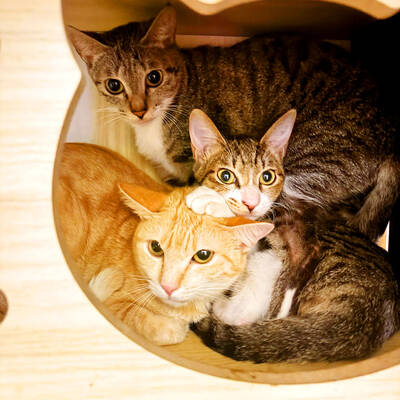
The number of pet cats in Taiwan surpassed that of pet dogs for the first time last year, reaching 1,742,033, a 32.8 percent increase from 2023, the Ministry of Agriculture said yesterday, citing a survey. By contrast, the number of pet dogs declined slightly by 1.2 percent over the same period to 1,462,528, the ministry said. Despite the shift, households with dogs still slightly outnumber those with cats by 1.2 percent. However, while the number of households with multiple dogs has remained relatively stable, households keeping more than two cats have increased, contributing to the overall rise in the feline population. The trend


 RSS
RSS