


The military plans to test-fire the domestically developed Hsiung Feng-III
The test-firing is to take place off the east coast to coincide with the Hankuang No. 17 joint-force exercise, which will be launched around the same time in southern Taiwan.
It is expected to cause spy ships and submarines from various countries to converge off the east coast to collect information on the new high-tech weapon.
Several years ago, a US navy Los Angeles-class submarine was spotted off an island near the east coast where the air force was testing Mica air-to-air missiles bought from France.
The result of the test-firing of the Hsiung Feng-III will affect the scheduled time for the new missile to enter mass production and become operational.
The missiles are set to go into production at the end of the year.
In June, the military leadership will make a decision on the matter according to the performance of the new missile during its pre-service trials.
In this year's defense budget, there is an unidentified sum of money for preparations for the missile to become operational.
The Hsiung Feng-III missile will become the latest and highest-specification locally built anti-ship missile in the armed services, if it passes muster.
It is the third generation of Hsiung Feng-series anti-ship missiles. Its developer is the military-run Chung Shan Institute of Science and Technology (CSIST).
CSIST staff say that the new missile surpasses the lethal Russian-made Sunburn anti-ship missile in range. The Chinese navy has acquired dozens of Sunburns for use on its two Sovremenny-class destroyers.
The Hsiung Feng-III is said to have a range of around 600km and a speed of over Mach 2, while the Sunburn, which also travels at twice the speed of sound, is reportedly limited in range to 240km.
Powered by a ramjet engine, the missile can attack not only surface targets but also targets in harbors, a defense official said.
"It is equivalent to the newest version of the US Harpoon anti-ship missile, which can either engage moving ships or static targets in harbors," the official said.
"There is only a minor distinction between an anti-ship missile of this kind and a cruise missile. The Hsiung Feng-III missile is to have a cruise missile variant in the future. CSIST is working on it," he said.
Unlike its two previous versions, the Hsiung Feng-III is a vertically launched missile like the US Harpoon missile. This marks a breakthrough in CSIST missile launch development technology.
A vertical launch can greatly widen the angle of attack of the missile while at the same time reducing the radar cross section of the weapon.
It is not known what type of ships will be equipped with the Hsiung Feng-III missile, but it could end up on either Lafayette-class or Chengkung-class frigates.
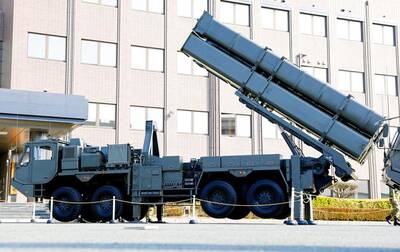
Japan has deployed long-range missiles in a southwestern region near China, the Japanese defense minister said yesterday, at a time when ties with Beijing are at their lowest in recent years. The missiles were installed in Kumamoto in the southern region of Kyushu, as Japan is attempting to shore up its military capacity as China steps up naval activity in the East China Sea. “Standoff defense capabilities enable us to counter the threat of enemy forces attempting to invade our country ... while ensuring the safety of our personnel,” Japanese Minister of Defense Shinjiro Koizumi said. “This is an extremely important initiative for
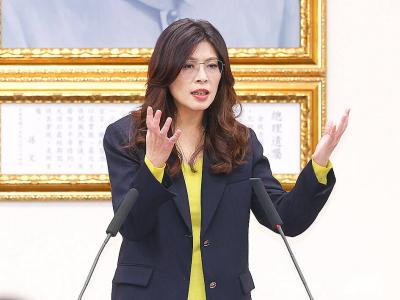
Chinese Nationalist Party (KMT) Chairwoman Cheng Li-wun (鄭麗文) today accepted an invitation from Chinese President Xi Jinping (習近平) to lead a delegation to China next month, saying she hopes to promote the peaceful development of cross-strait relations and bring stability to the Taiwan Strait. “I am grateful and happy to accept this invitation,” Cheng said in a statement from the KMT chairperson’s office. Cheng said she hopes both sides can work together to promote the peaceful development of cross-strait relations, enhance exchange and cooperation, bring stability to the Taiwan Strait and improve people’s livelihoods. At today's news conference, Cheng said any efforts to
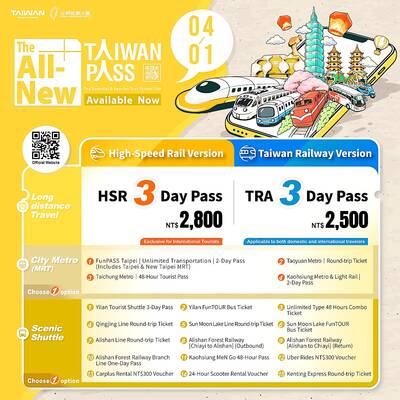
MORE POPULAR: Taiwan Pass sales increased by 59 percent during the first quarter compared with the same period last year, the Tourism Administration said The Tourism Administration yesterday said that it has streamlined the Taiwan Pass, with two versions available for purchase beginning today. The tourism agency has made the pass available to international tourists since 2024, allowing them to access the high-speed rail, Taiwan Railway Corp services, four MRT systems and four Taiwan Tourist Shuttles. Previously, five types of Taiwan Pass were available, but some tourists have said that the offerings were too complicated. The agency said only two types of Taiwan Pass would be available, starting from a three-day pass with the high-speed rail and a three-day pass with Taiwan Railway Corp. The former costs NT$2,800
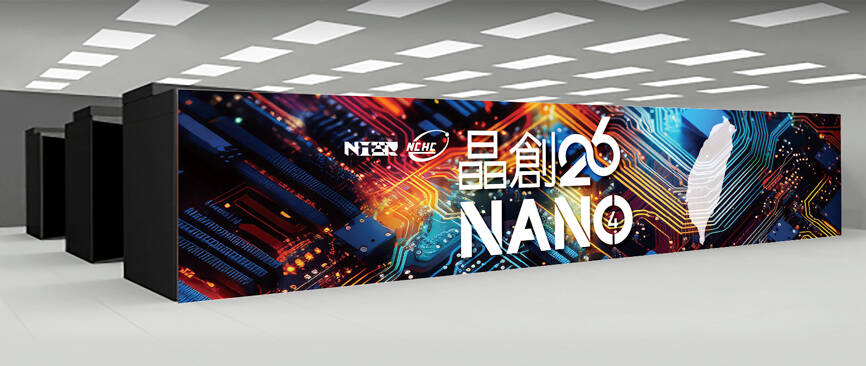
The nation’s fastest supercomputer, Nano 4 (晶創26), is scheduled to be launched in the third quarter, and would be used to train large language models in finance and national defense sectors, the National Center for High-Performance Computing (NCHC) said. The supercomputer, which would operate at about 86.05 petaflops, is being tested at a new cloud computing center in the Southern Taiwan Science Park in Tainan. The exterior of the server cabinet features chip circuitry patterns overlaid with a map of Taiwan, highlighting the nation’s central position in the semiconductor industry. The center also houses Taiwania 2, Taiwania 3, Forerunner 1 and


 RSS
RSS