


Chen Li-an (陳履安), a former Control Yuan president kicked out of the KMT for his unificationist stance, officially returned to the party yesterday.
At a press conference yesterday morning, Chen encouraged the people of Taiwan to take part in party politics in an effort to save the country from "ruin."
Chen registered his membership at the KMT's division in the Ta-an district of Taipei, accompanied by Chao Shou-po (
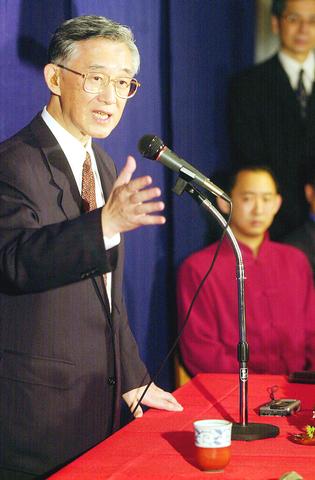
PHOTO: CHEN CHENG-CHANG, TAIPEI TIMES
When asked whether his return to the KMT was motivated by the diminishing influence of former president Lee Teng-hui (李登輝) and the "localization" ideals he advocated, Chen shied away from answering the question directly.
"All the bad old days are gone already. If we recall them, we will be engaged in endless political bickering again" Chen was quoted by local media as saying. "Is it necessary for us to get fully involved in this?"
Asked why he decided to return to the party now, Chen remained evasive.
"People keep asking this question. When I made a call to KMT Chairman Lien Chan (連戰) on Jan. 1, he said, `Pretty good!' And he told me the KMT headquarters would arrange for me to return [to the party]."
Chen lashed out at the media for focusing on the politics of his return and what it means for the KMT.
Reporters repeatedly asked Chen whether he would run for the party's chairmanship, while Chen professed to not even know when the election was scheduled to take place.
"The main reasons behind my return to the KMT are: first, to set a decent example for everybody in Taiwan. I expect each person to join a political party as I do now," Chen said.
"Second, I am rejoining the KMT in a bid to restore `freedom, equality and charity' -- the spiritual guidelines that were once promoted by the KMT's founder, Sun Yat-sen (孫中山)."
In addition, Chen encouraged political participation at the grass roots level, particularly among youngsters.
DPP Chairman Frank Hsieh (
But Hsieh added that former president Lee was probably in a foul mood.
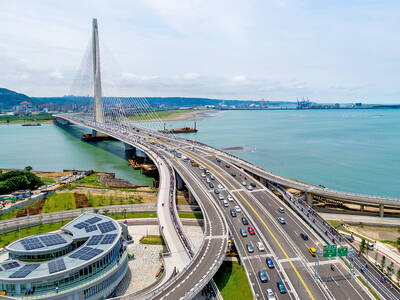
The Ministry of Transportation and Communications yesterday inaugurated the Danjiang Bridge across the Tamsui River in New Taipei City, saying that the structure would be an architectural icon and traffic artery for Taiwan. Feted as a major engineering achievement, the Danjiang Bridge is 920m long, 211m tall at the top of its pylon, and is the longest single-pylon asymmetric cable-stayed bridge in the world, the government’s Web site for the structure said. It was designed by late Iraqi-British architect Zaha Hadid. The structure, with a maximum deck of 70m, accommodates road and light rail traffic, and affords a 200m navigation channel for boats,
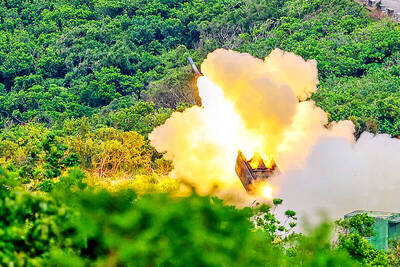
PRECISION STRIKES: The most significant reason to deploy HIMARS to outlying islands is to establish a ‘dead zone’ that the PLA would not dare enter, a source said A High Mobility Artillery Rocket System (HIMARS) would be deployed to Penghu County and Dongyin Island (東引) in Lienchiang County (Matsu) to force the Chinese military to retreat at least 100km from the coastline, a military source said yesterday. Taiwan has been procuring HIMARS and Army Tactical Missile Systems (ATACMS) from the US in batches. Once all batches have been delivered, Taiwan would possess 111 HIMARS units and 504 ATACMS, which have a range of 300km. Considering that “offense is the best defense,” the military plans to forward-deploy the systems to outlying islands such as Penghu and Dongyin so that
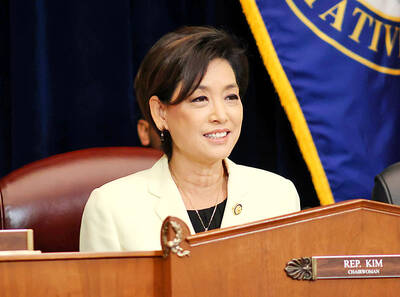
‘CLEAR MESSAGE’: The bill would set up an interagency ‘tiger team’ to review sanctions tools and other economic options to help deter any Chinese aggression toward Taiwan US Representative Young Kim has introduced a bill to deter Chinese aggression against Taiwan, calling for an interagency “tiger team” to preplan coordinated sanctions and economic measures in response to possible Chinese military or political action against Taiwan. “[Chinese President] Xi Jinping [習近平] has directed the People’s Liberation Army to be ready to invade Taiwan by 2027. China has a plan. America should have one too,” Kim said in a news release on Thursday last week. She introduced the “Deter PRC [People’s Republic of China] aggression against Taiwan act” to “ensure the US has a coordinated sanctions strategy ready should

TAIWAN ISSUE: US treasury secretary Scott Bessent said on the first day of meetings that ‘it wouldn’t be a US-China summit without the Taiwan issue coming up’ There were no surprises on the first day of the summit between US President Donald Trump and Chinese President Xi Jinping (習近平), the Mainland Affairs Council (MAC) said yesterday, as the government reiterated that cross-strait stability is crucial to the Asia-Pacific region, as well as the world. As the two presidents met for a highly anticipated summit yesterday, Chinese state media reported that Xi warned Trump that missteps regarding Taiwan could push their two countries into “conflict.” Trump arrived in China with accolades for his host, calling Xi a “great leader” and “friend,” and extending an invitation to visit the White House


 RSS
RSS