


The Malaysian pilot of Singapore Airlines flight SQ006 said yesterday that he saw something on the runway immediately before the plane crashed and exploded upon takeoff at Chang Kai-shek International Airport.
The airline's spokesman, Rick Clements, confirmed the pilot's statement saying: "He saw something there. It might have been a vehicle, it might have been a tire, I don't know."
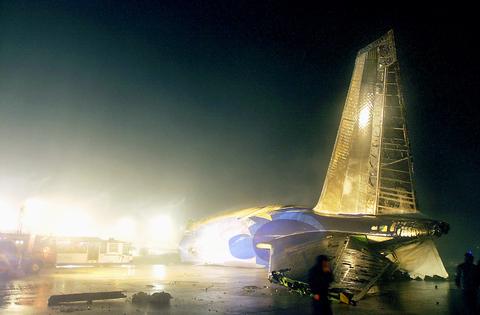
PHOTO: CHEN CHENG-CHANG, TAIPEI TIMES
Taiwan aviation officials initially suspected that storm-force winds from Typhoon Xangsane could have contributed to the crash, but later said that conditions were within acceptable limits for takeoff.
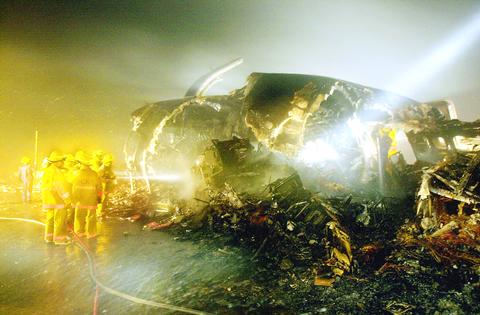
PHOTO: CHEN CHENG-CHANG, TAIPEI TIMES
Local TV station TVBS said that the plane may have tried to take off from an adjacent runway under repair and hit equipment that was parked there.
The station showed footage of the closed runway littered with a hydraulic backhoe, which appeared to have been damaged, cement blocks and the wreckage of the plane.
Airline officials said that the pilot did not take the wrong runway.
"I understand there is no evidence of that so far," Clements said. "The runway that the aircraft was cleared to depart from was actually a well-lit runway, whereas the other runway was not lit, so an experienced pilot should not have made the mistake of using the wrong runway."
Aviation officials in Taiwan, however, are not ruling out human error. Chang Kuo-cheng (張國政), deputy director-general of the Civil Aeronautics Administration (CAA, 民航局), said yesterday it was possible that the pilot was unfamiliar with the airport and may have taxied onto the wrong runway.
The Aviation Safety Council (ASC, 飛安委員會), which is responsible for investigating such accidents, said the aircraft had crashed near the site of construction on the runway.
The pilot, however, had flown to Taipei several times during October and was familiar with the airport, Clements said.
Preliminary investigations have not ruled out the possibility of poor weather as a factor in the crash.
Jim McKenna Czysc, from the US Aviation Safety Alliance, said that a sudden and violent change in wind direction, or "microburst" -- a form of windshear -- could have occurred during takeoff.
The aircraft's two flight data recorders have been recovered and the ASC has made a cursory examination but has yet to release their findings.
Further analysis of the recordings is to be conducted with information from the Boeing company and Singapore Airlines.
In Washington, the National Transportation Safety Board said it was sending a team of investigators to help Taiwan authorities investigate the disaster. The eight-member team was expected to arrive in Taiwan this evening.
Singapore Airlines, the city-state's flagship carrier, is one of the world's most profitable airlines and has one of the industry's best safety records. It has been flying for 28 years and had never lost a plane in a crash.
The plane that burst into flames Tuesday was bought new in January 1997, airline spokesman James Boyd said in Los Angeles.
He said there had been no problems with the aircraft, which underwent its last maintenance check on Sept. 16.
The pilot of the plane, Foong Chee Kong of Malaysia, had 11,235 hours of flying experience, according to airline officials.
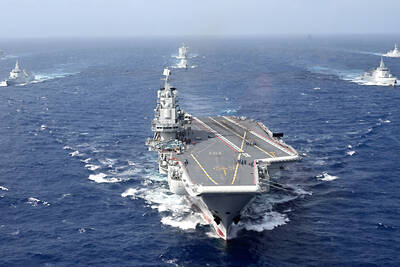
PROVOCATIVE: Chinese Deputy Ambassador to the UN Sun Lei accused Japan of sending military vessels to deliberately provoke tensions in the Taiwan Strait China denounced remarks by Japan and the EU about the South China Sea at a UN Security Council meeting on Monday, and accused Tokyo of provocative behavior in the Taiwan Strait and planning military expansion. Ayano Kunimitsu, a Japanese vice foreign minister, told the Council meeting on maritime security that Tokyo was seriously concerned about the situation in the East China and South China seas, and reiterated Japan’s opposition to any attempt to change the “status quo” by force, and obstruction of freedom of navigation and overflight. Stavros Lambrinidis, head of the EU delegation to the UN, also highlighted South China Sea
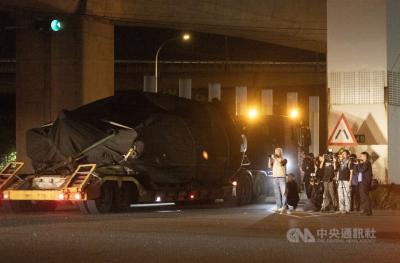
The final batch of 28 M1A2T Abrams tanks purchased from the US arrived at Taipei Port last night and were transported to the Armor Training Command in Hsinchu County’s Hukou Township (湖口), completing the military’s multi-year procurement of 108 of the tanks. Starting at 12:10am today, reporters observed more than a dozen civilian flatbed trailers departing from Taipei Port, each carrying an M1A2T tank covered with black waterproof tarps. Escorted by military vehicles, the convoy traveled via the West Coast Expressway to the Armor Training Command, with police implementing traffic control. The army operates about 1,000 tanks, including CM-11 Brave Tiger
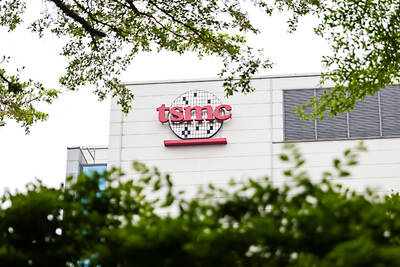
Taiwan Semiconductor Manufacturing Co (TSMC, 台積電), the world’s largest contract chipmaker, said it expects its 2-nanometer (2nm) chip capacity to grow at a compound annual rate of 70 percent from this year to 2028. The projection comes as five fabs begin volume production of 2-nanometer chips this year — two in Hsinchu and three in Kaohsiung — TSMC senior vice president and deputy cochief operating officer Cliff Hou (侯永清) said at the company’s annual technology symposium in Silicon Valley, California, last week. Output in the first year of 2-nanometer production, which began in the fourth quarter of last year, is expected to
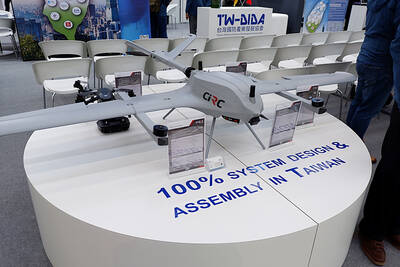
Taiwan’s drone exports surged past US$100 million in the first quarter, exceeding last year’s full-year total, with the Czech Republic emerging as the largest buyer, the Ministry of Economic Affairs said. Exports of complete drones reached US$115.85 million in the period, about 1.2 times the total recorded for all of last year, the ministry said in a report. Exports to the Czech Republic accounted for about US$100 million, far outpacing other markets. Poland, last year’s top destination, recorded about US$11.75 million in the first quarter. Taiwan’s drone exports have expanded rapidly in the past few years, with last year’s total


 RSS
RSS