


Vice President Annette Lu (
She has been at the scene of almost all the important events of Taiwan's recent history. During martial law, when independent political parties were outlawed, she was active in the tang wai (
She was the deputy publisher of Formosa (
In 1979 Lu delivered a 20-minute speech criticizing the government at a peaceful rally to commemorate International Human Rights Day that later became known as the Kaohsiung Incident (
After breaking up the demonstration and inciting violence, the KMT imprisoned virtually the entire leadership of Taiwan's budding democracy movement, including Lu.
She was found guilty of violent sedition by a military court, and for her 20-minute speech was sentenced to 12 years in prison. She was jailed for a total of 1,933 days.
Lu has also long been a prominent and outspoken advocate of women's rights. She was well ahead of her time when, 30 years ago, she introduced feminist ideas to Taiwan and initiated the country's women's movement. Today, Taiwan's women, whether in education, business, society, or politics, have achieved remarkable progress, equaling their sisters in many advanced industrialized countries.
Her life "from prison to power" is not only a democratic anomaly of "oriental despotism" but also a victory for women in Taiwan.
And in 1993 she began a campaign to press for Taiwan's entrance into the UN, pitting herself in a diplomatic struggle against the Chinese authorities. In 1994 she chaired the Global Summit for Women, held in Taipei that year.
Her strong actions resulted in a denial of permission to transit via New York when she visited Central America this autumn.
Her outspoken personality led China to call her "the scum of the nation."
Even in Taiwan, she also lashed out at the new government's reaction to the Pachang Creek (
"President Chen can't keep a public image of being ill-tempered or of blaming other officials," Lu said on July 27, shortly after Chen's inauguration on May 20.
"I think that tendency is the reason why recent opinion polls show President Chen's popularity rate is declining."
She said that "This incident reveals a serious problem in Taiwan's constitutional system. The premier is not elected directly ... but has great power. And therefore, both the president and premier are shamed when facing such an incident."
Her suggestion was that the president should hold a national affairs conference to clarify the rights and responsibilities of the president and vice president.
She even said that "If everybody thinks that the vice president is not important, the Constitution should abolish the post."
The speech disturbed many observers at the time, but also predicted the short political life of former premier Tang Fei's (

‘NO SECURITY RISK’: The Railway Bureau reassured the public that the technicians’ activities were limited to technical guidance and did not involve sensitive systems The Railway Bureau yesterday said it had invited eight Chinese technicians to assist with an airport MRT construction project. The bureau issued the confirmation after an Internet user said Chinese nationals had entered the construction zone of Taiwan Taoyuan International Airport’s Terminal 3 project. They asked why “individuals from an enemy state” were allowed access to such a major national infrastructure project, which raised serious concerns over Taiwan’s industrial safety, sensitive systems and information security. The bureau’s Northern Region Engineering Branch Office said subcontractor Taiwan Handle Industrial Co (台灣手把工業) of the Taoyuan airport MRT’s “Contract No. CU05 Project A14 Station Civil, MEP &

The National Chungshan Institute of Science and Technology yesterday showcased its locally developed variants of the Vision 60 robotic patrol dog, which it plans to deploy on the nation’s outlying territories in the South China Sea. The variants were produced under the Joint Lab project — created by the institute and domestic companies — and assembled with domestically produced motors, lenses and artificial intelligence (AI) systems alongside licensed tech from the US, Missile and Rocket Systems Research Division deputy director Jen Kuo-kang (任國光) told the media event at a military base in Taipei’s Dazhi (大直) area. Taiwan has built up its strengths
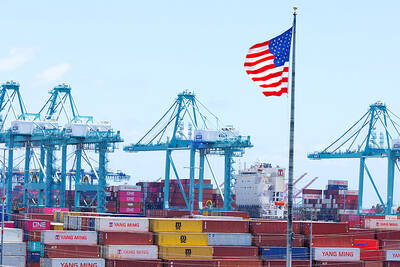
NOT IMMEDIATE: Taiwan has a chance to appeal the proposed 10 percent tariff before it starts, while other countries face a 12.5 percent tariff from the trade office Taiwan is among 60 economies determined by the US to have failed to impose or enforce a ban on the importation of goods produced with forced labor, according to a notice released on Tuesday by the Office of the US Trade Representative (USTR), which proposed imposing an additional 10 percent or more tariff on them. The USTR in a statement said that following an investigation, it had determined under Section 301 of the Trade Act of 1974 that the failure of the 60 economies to impose and effectively enforce a prohibition on the importation of goods produced with forced labor is

RIGHT DIRECTION: Taiwan’s efforts to prevent forced labor include a proposal to ‘fully prohibit’ employers from withholding workers’ documents, an official said Taiwan is to establish a mechanism to restrict imports of goods linked to forced labor, the Executive Yuan said yesterday, after the US proposed imposing additional tariffs on Taiwanese goods over labor concerns. “The Ministry of Labor and the Ministry of Economic Affairs are to establish an interministerial review procedure,” Executive Yuan spokesperson Michelle Lee (李慧芝) said at a news briefing in Taipei. “The government is to use the Foreign Trade Act [貿易法] as the legal basis to restrict imports of goods produced with forced labor” and bring its supply chain governance more in line with international standards on human rights, resilience


 RSS
RSS