


Singapore senior minister Lee Kuan Yew is perhaps one of the few world statesmen who, after leaving office, can find an open door to every head-of-state and government.
In June, he met Chinese President Jiang Zemin (
Born in Singapore in 1923, the 77-year-old founding father of Singapore was a third-generation descendant of immigrants from China's Guangdong Province. He read law at Cambridge University and in 1954, formed the People's Action Party (PAP). Five years later, the PAP won Singapore's general election, catapulting the 35-year-old Lee to the post of prime minister until 1990. In 1965, he oversaw Singapore's separation from Malaysia and subsequent independence. Despite his assumption of the post of senior minister in 1990, he still wields considerable power as a Cabinet member. "Without Lee, Singapore would not have become what it is today," a civil servant from Prime Minister Goh Chok Tong's office told the Taipei Times.
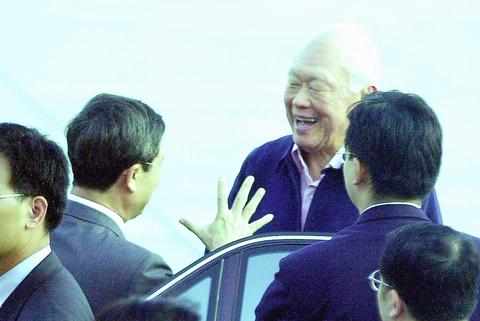
PHOTO: AFP
Transforming Singapore from a dependent colonial port into a prosperous and advanced city-state, Lee has established a towering position in the Lion City. The fact that Lee's photo has become perhaps the most frequent book cover one may see in major bookstores in Singapore is indicative of his unshakable omnipresence in the country.
But despite the respect Lee has received in Singapore -- as well as the magic he has to open the gate to each head-of-state and government -- Lee has led a controversial life as a political figure.
Former US Secretary of State Henry Kissinger, when commenting on Lee and the first volume of his memoirs, The Singapore Story, wrote: "Describing the motivations and concepts that have animated his conduct and explaining specific actions, he will undoubtedly raise many controversies. But whether one agrees or not, one will learn a great deal."
Singapore's iron-fisted rule on opposition movements as well as its shoddy human rights record are what Western countries often cite as the reasons behind their reservations about the country's founding father, said Chen Hurng-yu (陳鴻瑜), a Southeast Asia analyst from National Chengchi University.
Lee Lai-to, head of the department of political science at National University of Singapore, said that it was Lee's candid personality that made him controversial.
"Our senior minister speaks his mind all the time ... But I think, on the whole, he is a man of principle, and of course his straightforward remarks may create controversy," Lee told the Taipei Times.
Lee's recent remarks on cross-strait relations, for instance, have raised a lot of eyebrows in Taiwan. In an interview with the Far Eastern Economic Review in June, Lee urged Western powers not to encourage Taiwan to think of itself as a separate state because "no Chinese leader can survive if Taiwan is seen to be drifting away under his watch."
To avoid any prospect of war across the Taiwan Strait, which would destroy the stability of the Asia-Pacific region, the Taiwanese should be convinced that unification with China is inevitable, Lee said.
Lee also urged both sides to get off their high horses and talk. "It's better to talk than to trade statements in the press," he said. In another interview with Asiaweek this month, Lee reiterated his stance on cross-strait relations, saying, "If China does not disintegrate, unification is inevitable."
Although some analysts say Lee is qualified to predict the future scenario across the Taiwan Strait -- citing his past involvement in mediation between Taiwan and China -- many critics argue that Lee's inflexible attitude on the issue has largely reduced his usefulness as a third-party go-between for the two sides.
"His stark standpoints [on the issue] with an obvious bias toward one side will reduce his function [as a mediator]," said Shi Hwei-yow (
The organization is in charge of government-to-government talks with China via its counterpart, the Association for Relations across the Taiwan Strait (ARATS).
In fact, Singapore was where the unprecedented talks between SEF and ARATS leaders took place from April 27 to April 29, 1993. Without Lee's consent and mediation, the talks would have been impossible, analysts said.
But the Singaporean political science professor Lee said his senior minister's remarks regarding cross-strait issues were made from his status as "an observer."
"Whenever he's talking about cross-strait relations, it's from his own perspective. It's more from [his role as] an observer," Lee said.
But other critics said Lee's remarks were mainly related to the considerable business interests Singapore has in China -- considering the fact that the city-state's high-tech economy has become increasingly dependent on China's manufacturing sector.
"Singapore has seen tremendous trade and investment opportunities in China since it established formal ties with China in 1990. To safeguard the national interests of Singapore, it has shaken off its previous policy before 1990 to maintain a balance between Taiwan and China and instead si-ded with China," Chen said.
Singapore's recent intention to lure elite Chinese from overseas to fill the depleting Chinese population in the city-state was another factor that drove Singapore to take a rather pro-Beijing stance when dealing with cross-strait issues, Chen added.
Professor Lee, however, stressed that stability across the Taiwan Strait would create a win-win situation for all parties in the region.
"Singapore has a lot of interest in China in terms of trade and investment. But at the same time we also have substantial economic links with Taiwan. So we encourage both sides to engage in dialogue to sort their problems out. It's for the benefit of the Asia Pacific region particularly to see that there are no major confrontations between the two sides," Lee said.

A signaling system malfunction disrupted high-speed rail (HSR) services beginning at 8am today, with trains temporarily reduced to three northbound and three southbound trains per hour as authorities conduct inspections. The malfunction occurred on a section of track in Miaoli County during pre-operation checks early this morning, forcing northbound and southbound trains to use a single track, the HSR operator said. The regular schedule has been replaced with three hourly trains offering only nonreserved seating in each direction, stopping at every station, it said, adding that business class cars would still have reserved seating. Departures from terminal stations are scheduled at the top
Taiwan is still in the process of assessing the possibility of recruiting workers from Eswatini, the Ministry of Foreign Affairs said yesterday, adding that its goal is to help Eswatini upgrade its vocational training centers. If there are plans to recruit workers from Eswatini, safeguarding national security, protecting public health and ensuring the employment rights of Taiwanese would be prerequisites, Department of West Asian and African Affairs Director-General Yen Chia-liang (顏嘉良) told a news conference. Key considerations would also include filling labor shortages in specific industries, and fostering bilateral professional and technical exchanges, he said. Yen was asked about the progress of labor

A US uncrewed surface vessel (USV) encountered multiple Chinese warships during an autonomous transit of the Taiwan Strait, US defense company Seasats said in a statement on Wednesday. Seasats announced that a Lightfish USV had completed the first autonomous transit of the Taiwan Strait. Over five days, the USV traversed the entire length of the Strait while constantly monitoring surface vessel traffic, the company said. The Lightfish encountered multiple Chinese warships, one of which was a Chinese People’s Liberation Army Navy (PLAN) Type 056 corvette, it said. The Chinese vessels were operating “well within Taiwan’s exclusive economic zone without transmitting their identity via the

VERBOSE VESSELS: A CGA cutter and a China Coast Guard exchanged verbal barbs for more than a day in Taiwanese-controlled waters before the Chinese vessel left The Taiwanese and Chinese coast guards had a standoff near the strategically located Pratas Islands (Dongsha Islands, 東沙群島) in the north of the South China Sea, the Coast Guard Administration (CGA) said yesterday. The two sides engaged in intense radio exchanges over sovereignty claims during the 33-hour standoff. China Coast Guard vessel 3501 eventually left the restricted waters, 26.6 nautical miles (49.2km) west of the Pratas Islands, at 5pm yesterday, the CGA said. Lying approximately between southern Taiwan and Hong Kong, the Taiwan-controlled Pratas are seen by some security experts as vulnerable to Chinese attack due to their distance — more than


 RSS
RSS