


President Chen Shui-bian (
Upon arriving in Banjul yesterday, Chen was greeted by thousands of men and women dressed in colorful traditional outfits.
Many waved photographs of the president which read both in English and Chinese, "Welcome President Chen."
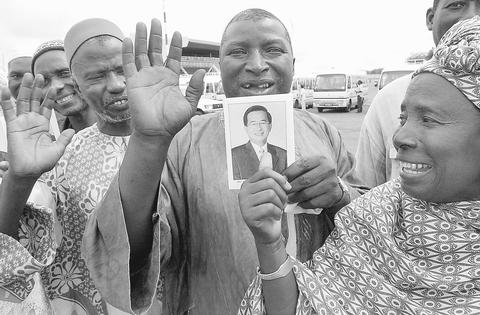
PHOTO: CHEN CHENG-CHANG, TAIPEI TIMES
In addition to a military salute, Chen was greeted with drums and dancing. The atmosphere was even more energetic and crowded than many of the rallies during Chen's election campaign.
Accompanied by Gambia's President Yahya Jammeh, the delegation traveled by motorcade to the Kairaba Beach Hotel.
While the trip lasted nearly a half-an-hour, flags of the Republic of China were seen along the streets in addition to photos of the Taiwanese president.
After arriving at the hotel, Chen was briefed by Taiwan's ambassador to Gambia, Lee Chen-hsiung (
During the meeting, Lee gave a detailed description of Taiwan's relations with Gambia and praised the country as one Taiwan's strongest allies.
Lee said that last year Jammeh's address in support of Taiwan was one of the longest addresses at the UN.
Gambia has also said it will not attend a conference in Beijing later this month which China has invited Taiwan's allies to attend, Lee said.
"What Gambia needs the most is help from Taiwan's industrial sector," Lee said.
After the briefing, Chen said that many people in his delegation were traveling to West Africa for the first time. Three years ago, when Taipei City became a sister city to Banjul, I was planning to come here to visit, Chen said.
"But when my grandmother passed away, I sent Vice Mayor Chen Shih-meng (
Chen confessed that originally he didn't dare think of visiting two continents in one trip.
However, after some encouragement from foreign ministry officials, he decided to visit Africa as well, Chen said.
"We decided to visit both, three countries in each, to be fair," Chen said.
Chen said that the first stop in Africa had significant meaning. Chen remarked on how happy he was that so many people had come out to greet the delegation from Taiwan.
"When we saw those people smiling and welcoming us we were impressed," Chen said.
"That must be why Gambia was once called the smiling coast. It is a country of smiling people," Chen said.
The second leg of Chen's trip in Africa will be a crucial one as China plans to invite Taiwan's allies to Beijing soon after Chen's visit.
China, which accuses Taiwan of buying diplomatic support, has invited eight of the island's allies in Africa to an economic aide forum in Beijing in October.
From Gambia, the president's tour will travel to Burkina Faso and Chad before heading home on Aug. 25.
Gambia, a country of just over one million people, is in the grip of an electricity crisis that dates back to 1977. Power outages are a daily feature of life. Engineers from Taiwan have been studying the problem.
The two countries established diplomatic relations in 1995, a year after President Jammeh came to power in a coup.
Taiwan has built an airport there and a triumphal arch. Sources say that it has pumped more than US$35 million into the Gambian economy, particularly into the health sector.
The story is the same in Burkina Faso and Chad. Government sources in Chad, which established diplomatic ties in 1997, say that Taiwan has granted aid worth US$128 million in areas such as health, education, water projects and transportation.
Gambia's neighbor, Senegal, is probably the most important of the eight African countries that recognize Taiwan.
Diplomats say Chen wanted to visit but that President Abdoulaye Wade, elected in March, responded with a diplomatic "No" -- saying that the government was on holiday at present.
Taiwan's other African supporters are Liberia and Sao Tome in the west and Malawi and Swaziland in the south.

‘NO SECURITY RISK’: The Railway Bureau reassured the public that the technicians’ activities were limited to technical guidance and did not involve sensitive systems The Railway Bureau yesterday said it had invited eight Chinese technicians to assist with an airport MRT construction project. The bureau issued the confirmation after an Internet user said Chinese nationals had entered the construction zone of Taiwan Taoyuan International Airport’s Terminal 3 project. They asked why “individuals from an enemy state” were allowed access to such a major national infrastructure project, which raised serious concerns over Taiwan’s industrial safety, sensitive systems and information security. The bureau’s Northern Region Engineering Branch Office said subcontractor Taiwan Handle Industrial Co (台灣手把工業) of the Taoyuan airport MRT’s “Contract No. CU05 Project A14 Station Civil, MEP &

A US uncrewed surface vessel (USV) encountered multiple Chinese warships during an autonomous transit of the Taiwan Strait, US defense company Seasats said in a statement on Wednesday. Seasats announced that a Lightfish USV had completed the first autonomous transit of the Taiwan Strait. Over five days, the USV traversed the entire length of the Strait while constantly monitoring surface vessel traffic, the company said. The Lightfish encountered multiple Chinese warships, one of which was a Chinese People’s Liberation Army Navy (PLAN) Type 056 corvette, it said. The Chinese vessels were operating “well within Taiwan’s exclusive economic zone without transmitting their identity via the

Taiwan is still in the process of assessing the possibility of recruiting workers from Eswatini, the Ministry of Foreign Affairs said yesterday, adding that its goal is to help Eswatini upgrade its vocational training centers. If there are plans to recruit workers from Eswatini, safeguarding national security, protecting public health and ensuring the employment rights of Taiwanese would be prerequisites, Department of West Asian and African Affairs Director-General Yen Chia-liang (顏嘉良) told a news conference. Key considerations would also include filling labor shortages in specific industries, and fostering bilateral professional and technical exchanges, he said. Yen was asked about the progress of labor
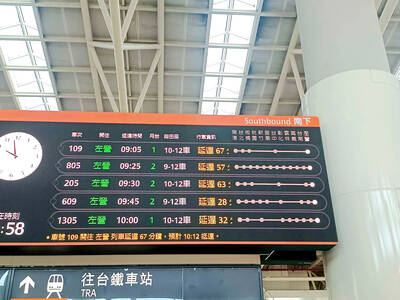
The nation’s usually punctual high-speed rail system yesterday was hit by major disruptions after all scheduled services were canceled and replaced with three hourly trains offering only non-reserved seating, affecting more than 200,000 passengers. Preliminary findings indicate the disruption was caused by a faulty power module in a track switch control cabinet, Taiwan High-Speed Rail Corp (THSRC) said, adding that as a full system inspection could only be conducted after operations end for the day, a decision on whether normal service would resume today would be announced before the first train departs. During a routine inspection early yesterday, a switch signal abnormality


 RSS
RSS