


The Kaoping River (
Three truck drivers hired by a licensed waste-handler had, on the previous day, dumped 25 tonnes of toxic chemical solvents, including xylene (
The 23 million residents of Taiwan did not realize that they had been living in communities at risk until prosecutors investigating the environmental crime announced that the toxic solvents dumped in the Kaoping River was just one incident among many.
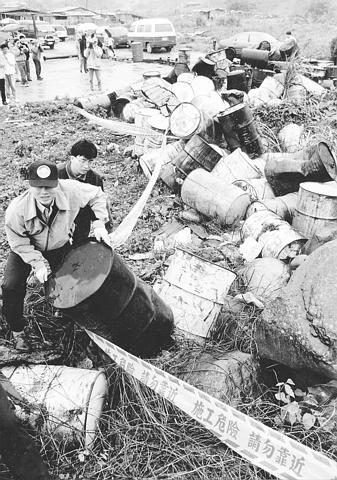
FILE PHOTO N
Prosecutors said that about 13,500 tonnes of such toxic waste generated by Eternal Chemical Company (
Prosecutors added that another 4,000 tonnes of toxic solvents produced by other companies were also dumped illegally by Shengli.
Prosecutors said that Shengli was involved in illegal dumping "everywhere" including Taichung, Taoyuan and Taipei counties and in central and northern Taiwan. But it was unclear how many other waste-handlers were still doing so.
According to the Environmental Protection Administration (EPA), only 40 percent of the 1.47 million tonnes of the hazardous industrial waste generated annually in Taiwan was properly treated, due to the scarcity of legal waste-handlers.
Officials said, however, that it was difficult to trace all industrial waste because some companies and waste-handlers gave the EPA inaccurate information.
Currently, neither the EPA nor the Industrial Development Bureau has been able to trace all the missing hazardous waste.
According to sources, truck drivers dumping hazardous waste illegally can command huge fees. They charge NT$8,000 for each tonne of hazardous waste, which means that a driver dumping three truckloads a day could make as much as NT$9 million a month.
Environmentalists, worried that the main rivers in central and northern Taiwan might have been heavily polluted, questioned the value of licensing waste-handlers.
"If the business was so lucrative, why was it monopolized by a limited number of waste-handlers?" said Lin Sheng-chung (
Lin said that the key point has nothing to do with technology, which is easily imported from advanced countries.
"It's obvious that you cannot be licensed unless you have good relations with both political figures and local organized crime," Lin said.
Paydirt
Concerns about an uncontrolled toxic waste crisis started to surface in environmental circles in the 1970s, when Taiwan's economic miracle began, and during which environmental concerns were sacrificed for the pursuit of profit.
The government encouraged the establishment of both small and medium-sized chemical companies, owned by investors who were unwilling to spend money on pollution prevention equipment. At the same time, environmentally-centered regulations on these profiteering industries were lax.
Much of the environmental legislation drafted in Taiwan -- which has been largely transplanted from the US -- introduced pollution control and waste management regulations on the basis of the kind of pollution -- air, water or land. The legislation lacked measures for dealing with pollutants at their source.
The number of new toxic chemicals entering the market each year placed enormous pressure on Taiwan's regulatory system, which was unable to contain the range of hazards represented by these new chemicals.
"What can we do now? While we are urging industry to reduce waste as much as they can, regulations implanted from the US might have to be reviewed to take the conditions in Taiwan into account," said Huang Hsiao-hsin (
"Local governments in Taiwan have less autonomy than those in the US," Huang said, adding that local officials occasionally came under pressure from local factions.
Environmental inspectors found that some illegal dumping cases were actually related to registered waste-handlers licensed by local governments.
"We suspect that the local governments did not carry out a comprehensive review of the applicants' abilities to treat waste," said Wu Tien-chi (
Wu said that inspectors, in cooperation with the environmental police, had brought 400 environmental criminals, hired by both legal and illegal waste handlers, to justice since last July.
What's the problem?
Scientists want to provide solutions, in terms of technology, to the problem of illegal dumping. They say existing landfill-oriented industrial waste management policies will eventually cause problems, such as water and soil contamination.
"Segregation cannot solve the problem thoroughly enough. Such hazardous waste has to be detoxified and re-enter the natural cycle of nature," said Lin Li-fu (
Lin said that one of the new ways of treating industrial waste -- plasma incineration technology -- had been adopted widely in developed countries to treat industrial waste, including radioactive material.
"It has been recognized by Western scientists as the most efficient way of dealing with hazardous waste, such as the bottom ash of waste incinerators. But Taiwan seems to fight against this trend in waste treatment because of its high cost," Lin said.
Ho Soon-ching (
The technology used by the EPA to treat toxic waste annoys environmentalists, who claim that it causes irreparable environmental damage, such as the accumulation of Persistent Organic Pollutants (POPs).
"If the EPA considers the combined cost of building landfills and dealing with local opposition, it may find that plasma technology is in fact cheaper and more effective," said Wang Kuen-sheng (王鯤生), environmental engineering expert at National Central University.
The way to go
Some scientists say reducing production is the basic solution.
"You create something, use it and dump it. It becomes waste awaiting appropriate treatment, incurring both financial and labor costs," said Professor Tsai Min-shing (
Tsai said that since the Industrial Revolution, consumerism has been stimulated in order to sustain mass production -- and now people are facing the consequences.
In terms of natural resources, Tsai said, less production is the best way of minimizing waste and illegal dumping.
Regin Jao (
"Toxic chemicals will eventually enter the human body through the food chain and accumulate there for a long time," said Jao, a toxicologist who was in charge of one of the worst chemical contamination cases in Taiwan's history two decades ago, when 1,500 people were poisoned by polychlorinated biphenyl (
Yet the people of Taiwan are still threatened by POPs accumulating in the environment because of illegal dumping of toxic waste.
DPP legislator Chang Ching-fang (
According to his survey, more than 110 million tubes of fluorescent lights and 20,000 tonnes of waste acid solvents generated by the steel industry, both containing toxic chemicals, were dumped on the island without proper treatment.
"No waste handler has been appointed to dispose of such waste," Chang said.

Japan has deployed long-range missiles in a southwestern region near China, the Japanese defense minister said yesterday, at a time when ties with Beijing are at their lowest in recent years. The missiles were installed in Kumamoto in the southern region of Kyushu, as Japan is attempting to shore up its military capacity as China steps up naval activity in the East China Sea. “Standoff defense capabilities enable us to counter the threat of enemy forces attempting to invade our country ... while ensuring the safety of our personnel,” Japanese Minister of Defense Shinjiro Koizumi said. “This is an extremely important initiative for
Chinese Nationalist Party (KMT) Chairwoman Cheng Li-wun (鄭麗文) today accepted an invitation from Chinese President Xi Jinping (習近平) to lead a delegation to China next month, saying she hopes to promote the peaceful development of cross-strait relations and bring stability to the Taiwan Strait. “I am grateful and happy to accept this invitation,” Cheng said in a statement from the KMT chairperson’s office. Cheng said she hopes both sides can work together to promote the peaceful development of cross-strait relations, enhance exchange and cooperation, bring stability to the Taiwan Strait and improve people’s livelihoods. At today's news conference, Cheng said any efforts to

MORE POPULAR: Taiwan Pass sales increased by 59 percent during the first quarter compared with the same period last year, the Tourism Administration said The Tourism Administration yesterday said that it has streamlined the Taiwan Pass, with two versions available for purchase beginning today. The tourism agency has made the pass available to international tourists since 2024, allowing them to access the high-speed rail, Taiwan Railway Corp services, four MRT systems and four Taiwan Tourist Shuttles. Previously, five types of Taiwan Pass were available, but some tourists have said that the offerings were too complicated. The agency said only two types of Taiwan Pass would be available, starting from a three-day pass with the high-speed rail and a three-day pass with Taiwan Railway Corp. The former costs NT$2,800

The nation’s fastest supercomputer, Nano 4 (晶創26), is scheduled to be launched in the third quarter, and would be used to train large language models in finance and national defense sectors, the National Center for High-Performance Computing (NCHC) said. The supercomputer, which would operate at about 86.05 petaflops, is being tested at a new cloud computing center in the Southern Taiwan Science Park in Tainan. The exterior of the server cabinet features chip circuitry patterns overlaid with a map of Taiwan, highlighting the nation’s central position in the semiconductor industry. The center also houses Taiwania 2, Taiwania 3, Forerunner 1 and


 RSS
RSS