


Taipei Fine Arts Museum (台北市立 美術館) Director Lin Mun-lee (林曼麗) yesterday claimed she had been forced to step down and urged the authorities to respect professionalism in the arts and stop the "abuse of administrative powers."
"I feel sorry that I have to leave, but I'm afraid I don't have much choice," she said at her final press conference yesterday. "I am not leaving to evade problems but for a simple reason -- dignity."
Lin had been scheduled to report on the progress of the upcoming second biennial international art exhibition entitled "2000 Taipei Biennial: The Sky is the Limit" (
Instead, she was pressed to deal with her controversial resignation, which is effective Aug. 1.
Lin said she had been asked to a take up a senior specialist position at the city's Bureau of Cultural Affairs (
"It's an insult to me not only personally but also professionally," Lin said of the offer.
After the five-hour meeting, she handed in her resignation on July 14, about four months before her contract expires in November.
Lin said she has learned a good lesson from the incident: "It highlights a larger and more serious problem, which is that authority interferes and abuses its administrative powers in the development of arts, rather than assists and respects professional expertise," she said.
"It also shows that our arts industry is at a crossroads and the question is to upgrade or downgrade its future development."
The war between the two women started on April 23 when Lin said in a seminar that Lung applied "White Terror' tactics, by requesting the city's anti-corruption unit investigate a room planning project at the Second Taipei Fine Arts Museum (台北市第二美術館).
"It's a surreal and ridiculous idea," Lin said. "You simply cannot make such a request unless a criminal action is suspected."
This criticism prompted city councilors to call for action from Lung and make a decision within 10 days about Lin's future.
On May 18, Lung invited Lin to a meeting, five hours long, after which both women said that there had been misunderstandings between them and they wanted to put these aside.
But, they were obviously still divided and Lung later said she was "deeply hurt" by the incident, when Lin accused her of being "a layman interfering in a professional's job." Lin responded by saying their differences were caused by their respective stances.
Lung later stressed the importance of "administrative ethics" -- meaning a subordinate should show respect for his or her supervisor -- and on May 19 she reportedly asked one of her assistants to tell Lin she wanted her to resign before she left on an overseas trip on July 14.
Lin complied with the request and Lung accepted the resignation. Taipei City Mayor Ma Ying-jeou (

‘NO SECURITY RISK’: The Railway Bureau reassured the public that the technicians’ activities were limited to technical guidance and did not involve sensitive systems The Railway Bureau yesterday said it had invited eight Chinese technicians to assist with an airport MRT construction project. The bureau issued the confirmation after an Internet user said Chinese nationals had entered the construction zone of Taiwan Taoyuan International Airport’s Terminal 3 project. They asked why “individuals from an enemy state” were allowed access to such a major national infrastructure project, which raised serious concerns over Taiwan’s industrial safety, sensitive systems and information security. The bureau’s Northern Region Engineering Branch Office said subcontractor Taiwan Handle Industrial Co (台灣手把工業) of the Taoyuan airport MRT’s “Contract No. CU05 Project A14 Station Civil, MEP &

A US uncrewed surface vessel (USV) encountered multiple Chinese warships during an autonomous transit of the Taiwan Strait, US defense company Seasats said in a statement on Wednesday. Seasats announced that a Lightfish USV had completed the first autonomous transit of the Taiwan Strait. Over five days, the USV traversed the entire length of the Strait while constantly monitoring surface vessel traffic, the company said. The Lightfish encountered multiple Chinese warships, one of which was a Chinese People’s Liberation Army Navy (PLAN) Type 056 corvette, it said. The Chinese vessels were operating “well within Taiwan’s exclusive economic zone without transmitting their identity via the
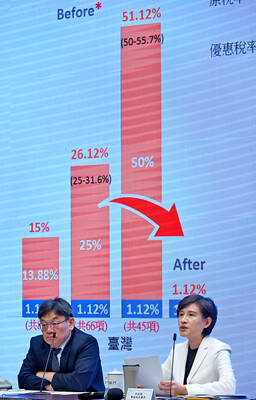
GREATER REACH? Auto parts and wood products would face tariffs of up to 15%, matching those targeting the EU, Japan and South Korea, Vice Premier said The US has announced that preferential tariff treatment for Taiwan’s non-semiconductor Section 232 goods would take effect retroactively from May 1, the Executive Yuan said yesterday. The US government yesterday posted a notice on the Federal Register’s public inspection Web site previewing tariff concessions for Taiwan under a memorandum of understanding (MOU) on Taiwan-US investment after two months of negotiations. The MOU signed on Jan. 15 stipulated three major preferential tariff arrangements: a 15 percent “reciprocal” tariff rate for Taiwan without stacking most-favored nation (MFN) rates; preferential Section 232 treatment for semiconductors and related products; and preferential Section 232 treatment for non-semiconductor

The National Chungshan Institute of Science and Technology yesterday showcased its locally developed variants of the Vision 60 robotic patrol dog, which it plans to deploy on the nation’s outlying territories in the South China Sea. The variants were produced under the Joint Lab project — created by the institute and domestic companies — and assembled with domestically produced motors, lenses and artificial intelligence (AI) systems alongside licensed tech from the US, Missile and Rocket Systems Research Division deputy director Jen Kuo-kang (任國光) told the media event at a military base in Taipei’s Dazhi (大直) area. Taiwan has built up its strengths


 RSS
RSS