


Rain or shine, Hsu Li-li (徐麗麗) visits Taipei City Hall every day. She has done so almost every day for the past five months. She goes there neither for fun nor for business, but to protest against what she calls the "injustice" perpetrated by the judicial system and the "lack of professionalism" of law enforcement officers.
A former municipal cleaning squad member, Hsu lost her mother in a hit-and-run car accident in 1996.
The suspect, an intelligence agent at the former Taiwan Garrison Command (警備總部), now the Coast Guard Administration (海岸巡防署), was acquitted due to "lack of evidence" and the only punishment handed down was by the police authorities to two police officers for their negligence in handling the case.
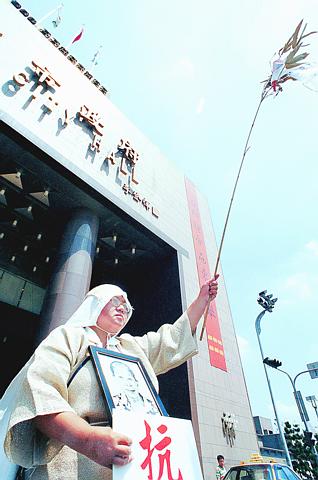
PHOTO: CHEN CHENG-CHANG, TAIPEI TIMES
Hsu, who quit her job the following year and is now a part-time housemaid, said such a light punishment was totally inadequate.
"We're talking about a person's life here, for God's sake, "she said. "I want to see all the wrongdoers behind bars, but until that happens, you'll see me out here every day."
The case is currently in the hands of the Supreme Court.
Tragic accident
The tragedy occurred at 2:30am on Nov. 15, 1996 when Hsu and her 72-year-old mother Yu Feng-ying (于鳳英) - who had quit the cleaning squad two years earlier - were cleaning the street in Anho Road. Yu was knocked down by a speeding car whose driver did not stop. She was pronounced dead six hours later at the nearby Jen Ai Municipal Hospital (仁愛醫院).
Although officer Wu Chung-tai (吳忠泰) from the Ta-an Police Precinct took no time to respond to the emergency call at 2:45am, he was reportedly so caught up with "collecting evidence" on the spot that he failed to seal off the crime scene, have photographs taken, and collect such vital pieces of evidence as the shattered fragments of glass which littered the spot.
It was then a further five hours before Wu initiated efforts to trace the suspect's vehicle, whose license number had been supplied by the only eyewitness, Chuang Sheng-hsiung (莊勝雄), a taxi driver.
The suspect vehicle was identified as a Cadillac owned by an intelligence agent, Lee Wen-cheng (李文正).
Chuang, the eyewitness, however, later retracted his testimony and failed to confirm the car's identity, saying the rain must have obscured his vision and that he may have made a mistake memorizing the license number in a hurry.
Weather reports later showed that it had not been raining at the time of the accident.
Police incompetence
Another police officer, Chen Cheng-wei (陳政偉), who wrote the report on the police interview with the eyewitness Chuang, failed to sign the report as required after making corrections regarding the car's color, name and brand - a move which later raised Hsu's suspicion that Chen had forged the witness statement.
Chen and Wu later were found liable in police disciplinary hearings on one and two counts respectively of "negligence" for their handling of the case. They received reprimands.
In October 1997, the police investigation had been underway for 11 months without any apparent sign of a breakthrough, according to Hsu. She lost her patience and filed a lawsuit against Lee Wen-cheng, for maliciously abandoning her mother and causing her death, with the Taipei District Prosecutors' Office. She also requested, and was granted, a lie detector test be carried out on Lee, which he failed.
In January 1998, the District Prosecutor's Office threw the case out for insufficient evidence, advising Hsu that if she still wished to pursue justice she should initiate a private prosecution.
Private prosecution
Hsu brought a private prosecution to the Taipei District Court in February 1998, in which Lee was acquitted. The verdict was upheld on appeal by the High Court in July of that year. Hsu appealed to the Supreme Court in August 1998 and still awaits its ruling.
"It's pathetic that people nowadays have to act on their own to get justice, "she said. "The legal system here sucks. It treats human life as valueless and fails to uphold human rights. It makes me sick to the stomach whenever I hear the police say they are determined to crack down on crime."
Hsu added that she may stage a protest outside the Ministry of Justice at an "appropriate time."
Hsu appealed for support to Taipei City Councilor Chin Li-fang (秦儷舫) of the New Party who responded by asking Taipei City Mayor Ma Ying-jeou (馬英九) to deliver a special report on the council floor.
Chin says that she is not optimistic about Hsu's chances.
"I don't think her appeals make any sense any more ... She has ... complicated what started out as a straightforward issue," she said. "Two negligent law enforcement officers have been disciplined, and the only evidence hanging over the suspect is the failed polygraph test, but it is not admissible as evidence in a court of law."
Besides, Chin said, it did not make sense that the suspect still possessed a vehicle which had been alleged to have caused death in an accident. As a city councilor, Chin said, she had done everything humanly possible to help Hsu, even offering to help her to apply for state compensation, an offer, she said, which was met with a lukewarm response. "I'm done with this case," she said.
Publicity
Ko Tsai Yu-chiung (柯蘇玉瓊), former chairman of the ROC Car Accident Rescuer Association (中華民國車禍救難者協會), said Hsu should pursue publicity and money. "When I lost my eldest son in a drink-driving accident in 1989, I went to the Legislature almost every day to have my voice heard. Nobody is going to care unless you're on TV," she said.
Ko's hard work eventually paid off eight years later when the Legislature passed an amendment to the "Compulsory Responsibility and Insurance Law for Motor Vehicles" (強制汽機車責任保險法).
The amendment, which took effect in 1998, mandates that each motor vehicle be insured, that a person killed in a car accident is entitled to a NT$1.2 million compensation (the Ministry of Finance has agreed to raise the amount to NT$1.4 million), and that 6 percent of the insurance premium goes to a special account to compensate for accidents in which the culprit is either not identified or lacks sufficient assets to meet the cost of compensating the victim.
"It takes a large amount of money to stage a long-term protest. Although money is not everything, you cannot do anything without it," she said, adding that Hsu could apply for criminal victim compensation since her case took place before the motor vehicle compulsory insurance law was passed.
The Criminal Victim Compensation Measure (犯罪被害人補償辦法) allows each crime victim compensation of NT$1.2 million and an additional NT$1 million per person for victim's siblings under the age of 18 and children under the age of 18.
Road accident deaths
The latest report released by the Ministry of Transportation and Communications showed that a total of 902 road accident deaths was recorded this year from January to April - an increase of 8 percent more than that of the same period last year.
A total of 2,392 road accident deaths was recorded last year, or 8.6 percent less than that of the previous year. According to the data, speeding - which ranks second among the causes of car accidents - accounts for 14.1 percent of all such accidents, followed by drunk driving, accounting for 10.7 percent.
Figures also show that fatalities among senior citizens last year constituted a high proportion of overall road accident deaths - out of every 10,000 car accidents, 2.3 percent result in the death of a senior citizen, whereas 1.1 percent - or less than half that figure, result in the death of a non-senior citizen.
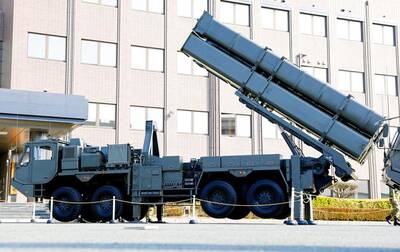
Japan has deployed long-range missiles in a southwestern region near China, the Japanese defense minister said yesterday, at a time when ties with Beijing are at their lowest in recent years. The missiles were installed in Kumamoto in the southern region of Kyushu, as Japan is attempting to shore up its military capacity as China steps up naval activity in the East China Sea. “Standoff defense capabilities enable us to counter the threat of enemy forces attempting to invade our country ... while ensuring the safety of our personnel,” Japanese Minister of Defense Shinjiro Koizumi said. “This is an extremely important initiative for
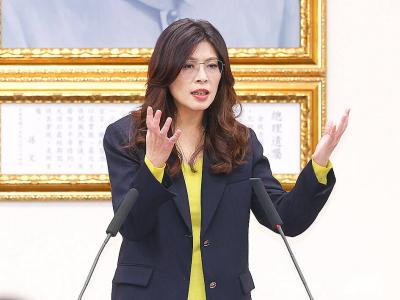
Chinese Nationalist Party (KMT) Chairwoman Cheng Li-wun (鄭麗文) today accepted an invitation from Chinese President Xi Jinping (習近平) to lead a delegation to China next month, saying she hopes to promote the peaceful development of cross-strait relations and bring stability to the Taiwan Strait. “I am grateful and happy to accept this invitation,” Cheng said in a statement from the KMT chairperson’s office. Cheng said she hopes both sides can work together to promote the peaceful development of cross-strait relations, enhance exchange and cooperation, bring stability to the Taiwan Strait and improve people’s livelihoods. At today's news conference, Cheng said any efforts to
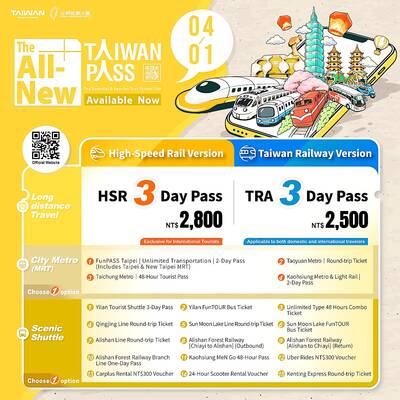
MORE POPULAR: Taiwan Pass sales increased by 59 percent during the first quarter compared with the same period last year, the Tourism Administration said The Tourism Administration yesterday said that it has streamlined the Taiwan Pass, with two versions available for purchase beginning today. The tourism agency has made the pass available to international tourists since 2024, allowing them to access the high-speed rail, Taiwan Railway Corp services, four MRT systems and four Taiwan Tourist Shuttles. Previously, five types of Taiwan Pass were available, but some tourists have said that the offerings were too complicated. The agency said only two types of Taiwan Pass would be available, starting from a three-day pass with the high-speed rail and a three-day pass with Taiwan Railway Corp. The former costs NT$2,800

The nation’s fastest supercomputer, Nano 4 (晶創26), is scheduled to be launched in the third quarter, and would be used to train large language models in finance and national defense sectors, the National Center for High-Performance Computing (NCHC) said. The supercomputer, which would operate at about 86.05 petaflops, is being tested at a new cloud computing center in the Southern Taiwan Science Park in Tainan. The exterior of the server cabinet features chip circuitry patterns overlaid with a map of Taiwan, highlighting the nation’s central position in the semiconductor industry. The center also houses Taiwania 2, Taiwania 3, Forerunner 1 and


 RSS
RSS