


The illegitimate grandson of former leader, Generalissimo Chiang Kai-shek (蔣中正) may fulfill his long-time dream and pay respects to his ancestors in China next month, the China Times reported yesterday.
John Chang (章孝嚴), the illegitimate son of the late president Chiang Ching-kuo (蔣經國), himself the son of Taiwan's late generalissimo, would be accompanied by his wife Huang Mei-lun (黃美倫) and three children on the homecoming trip which he has been waiting for all his life, the paper said.
The widow of Chang's twin brother, Chang Hsiao-tzu (章孝慈), and their two children would also join them in visiting the elder Chiang's birthplace in Fenghua (奉化), Zhejiang Province, the daily said.
They hope to pay their respects to the twins' mother Chang Ya-no (
Chang Ya-no died shortly after giving birth to the twin boys in 1941. The youngsters fled to Taiwan with their maternal uncle and grandmother who raised them after the Communist Party takeover of China. Chiang said that he would like to tell his mother personally about the good news that he has finally been embraced by the Chiang family in front of her grave.
Chang, former Minister of Foreign Affairs as well as former secretary general of the Presidential Office, hopes to be given the green light from Taiwanese authorities for the trip.
Under current rules, travel to China by former high-ranking officials within three years after leaving their posts requires prior governmental approval.
According to Chiang -- since he is no longer a governmental employee having resigned after being caught having an adulterous affair last year -- he would like to fulfill his dream of going back to China and to pay his respects to his mother and ancestors as soon as possible. If he cannot make it next month, he will probably try again by the end of this year.
Although he needs prior approval from the government in order to go to China, Chiang said, the government should consider his case on compassionate grounds. It would be a very simple family trip involving no political issues, Chiang stressed.
In 1994, Chang, then Minister of the Overseas Chinese Affairs Commission, was allowed to fly to Beijing after his twin died of a stroke there.
Chang now sits on the KMT's Central Standing Committee.

FREEDOM OF NAVIGATION: The UK would continue to reinforce ties with Taiwan ‘in a wide range of areas’ as a part of a ‘strong unofficial relationship,’ a paper said The UK plans to conduct more freedom of navigation operations in the Taiwan Strait and the South China Sea, British Secretary of State for Foreign, Commonwealth and Development Affairs David Lammy told the British House of Commons on Tuesday. British Member of Parliament Desmond Swayne said that the Royal Navy’s HMS Spey had passed through the Taiwan Strait “in pursuit of vital international freedom of navigation in the South China Sea.” Swayne asked Lammy whether he agreed that it was “proper and lawful” to do so, and if the UK would continue to carry out similar operations. Lammy replied “yes” to both questions. The

SECOND SPEECH: All political parties should work together to defend democracy, protect Taiwan and resist the CCP, despite their differences, the president said President William Lai (賴清德) yesterday discussed how pro-Taiwan and pro-Republic of China (ROC) groups can agree to maintain solidarity on the issue of protecting Taiwan and resisting the Chinese Communist Party (CCP). The talk, delivered last night at Taoyuan’s Hakka Youth Association, was the second in a series of 10 that Lai is scheduled to give across Taiwan. Citing Taiwanese democracy pioneer Chiang Wei-shui’s (蔣渭水) slogan that solidarity brings strength, Lai said it was a call for political parties to find consensus amid disagreements on behalf of bettering the nation. All political parties should work together to defend democracy, protect Taiwan and resist
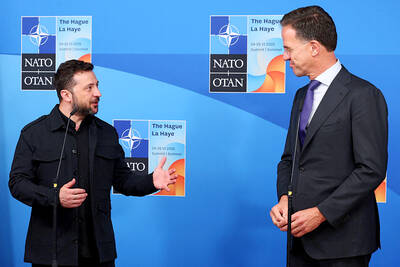
By refusing to agree spending increases to appease US President Donald Trump, Spanish Prime Minister Pedro Sanchez threatened to derail a summit that NATO Secretary-General Mark Rutte needs to run smoothly for the sake of the military alliance’s future survival. Ahead of yesterday’s gathering in The Hague, Netherlands, things were going off the rails. European officials have expressed irritation at the spoiler role that Sanchez is playing when their No. 1 task is to line up behind a pledge to raise defense spending to 5 percent of GDP. Rutte needed to keep Spain in line while preventing others such as Slovakia
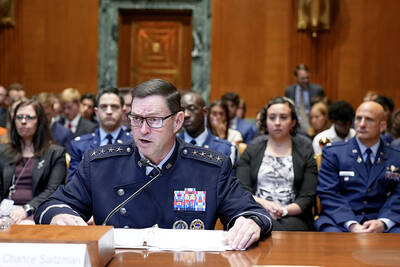
SHIFT PRIORITIES: The US should first help Taiwan respond to actions China is already taking, instead of focusing too heavily on deterring a large-scale invasion, an expert said US Air Force leaders on Thursday voiced concerns about the Chinese People’s Liberation Army’s (PLA) missile capabilities and its development of a “kill web,” and said that the US Department of Defense’s budget request for next year prioritizes bolstering defenses in the Indo-Pacific region due to the increasing threat posed by China. US experts said that a full-scale Chinese invasion of Taiwan is risky and unlikely, with Beijing more likely to pursue coercive tactics such as political warfare or blockades to achieve its goals. Senior air force and US Space Force leaders, including US Secretary of the Air Force Troy Meink and


 RSS
RSS