


Cheng Lung-ping, (鄭浪平) author of The Intercalary August of 1995 (一九九五閏八月), invited to visit Taiwan by the New Party, gave a press conference yesterday in which he warned of the dangers posed by the continuing stand-off between Taiwan and China and blasted the idea of "offshore engagement," Taiwan's new defense strategy.
New Party Legislator Hsieh Chi-ta (
Cheng argued that Taiwan was now all the more at risk for having a president who "was previously known for promoting the independence of Taiwan for the DPP."

PHOTO: GEORGE TSORNG, TAIPEI TIMES
Cheng warned that "the stimulation of nationalism among the people of China is irresistible" and might cause war now that the DDP was the ruling party.
He also condemned the government's idea of "offshore engagement" (
Taiwan, remarked Cheng, far from avoiding a comprehensive war, would "lose the war before it starts." China's coastal cities, he said, on the basis of both his own observations and those of Chinese colleagues, had been well prepared by the People's Liberation Army (PLA).
Ou Si-fu (
Ou argued that Beijing's priority was to accelerate its economic reforms and improve its international position, which made the Taiwan dispute a relatively minor issue. Moreover, he said the "fourth generation of Chinese communist leaders" from Shanghai, who had benefited from economic reforms and now taken over the reins of power, would not support any war that might damage China's economy. He reckoned that the PLA's conduct was merely designed to make symbolic threats to Taiwan.
Ou further said that Cheng was overly sensitive on the matter, suggesting that he might have been "brainwashed" by the previous (KMT) government into believing that the DPP's claims for Taiwan independence might lead to war. Ou said he believed that the aim of Taiwan independence had been simply a strategy designed to coalesce opposition power against the former KMT regime, an aim which might be shelved now that the DPP has taken over the presidency.
On the question of "offshore engagement" Ou observed that the Chinese military also had its problems,indicating that, comparatively, Taiwan's military would not be as weak as Cheng had suggested.
Chinese legend has it that disasters always strike in intercalary Augusts. The power of this myth was not lost on Cheng, who, seizing the moment in 1995 one year before the "mysterious" month last came round, claimed that a lethal cross-strait war would break out as China appeared stable under Deng Xiao-ping's (
His claim intimidated Taiwan society and triggered a boom in emigration.
Responding to criticism of the "failure" of his earlier "prophecy," Cheng said that he was not trying to supply a time frame for the outbreak of hostilities, but merely seeking to provide a stark reminder of the risks that would come from any attempt by Taiwan to break away from China.
The New Party will hold a panel discussion at the legislature today in order for Cheng to be available for questioning by legislators from all parties.
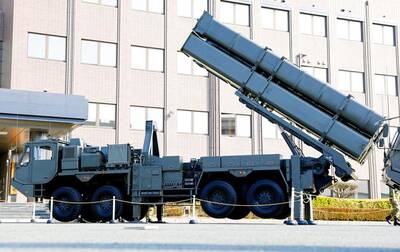
Japan has deployed long-range missiles in a southwestern region near China, the Japanese defense minister said yesterday, at a time when ties with Beijing are at their lowest in recent years. The missiles were installed in Kumamoto in the southern region of Kyushu, as Japan is attempting to shore up its military capacity as China steps up naval activity in the East China Sea. “Standoff defense capabilities enable us to counter the threat of enemy forces attempting to invade our country ... while ensuring the safety of our personnel,” Japanese Minister of Defense Shinjiro Koizumi said. “This is an extremely important initiative for
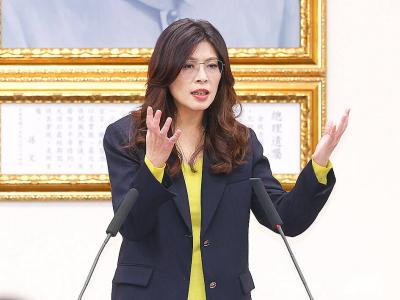
Chinese Nationalist Party (KMT) Chairwoman Cheng Li-wun (鄭麗文) today accepted an invitation from Chinese President Xi Jinping (習近平) to lead a delegation to China next month, saying she hopes to promote the peaceful development of cross-strait relations and bring stability to the Taiwan Strait. “I am grateful and happy to accept this invitation,” Cheng said in a statement from the KMT chairperson’s office. Cheng said she hopes both sides can work together to promote the peaceful development of cross-strait relations, enhance exchange and cooperation, bring stability to the Taiwan Strait and improve people’s livelihoods. At today's news conference, Cheng said any efforts to

MORE POPULAR: Taiwan Pass sales increased by 59 percent during the first quarter compared with the same period last year, the Tourism Administration said The Tourism Administration yesterday said that it has streamlined the Taiwan Pass, with two versions available for purchase beginning today. The tourism agency has made the pass available to international tourists since 2024, allowing them to access the high-speed rail, Taiwan Railway Corp services, four MRT systems and four Taiwan Tourist Shuttles. Previously, five types of Taiwan Pass were available, but some tourists have said that the offerings were too complicated. The agency said only two types of Taiwan Pass would be available, starting from a three-day pass with the high-speed rail and a three-day pass with Taiwan Railway Corp. The former costs NT$2,800

The nation’s fastest supercomputer, Nano 4 (晶創26), is scheduled to be launched in the third quarter, and would be used to train large language models in finance and national defense sectors, the National Center for High-Performance Computing (NCHC) said. The supercomputer, which would operate at about 86.05 petaflops, is being tested at a new cloud computing center in the Southern Taiwan Science Park in Tainan. The exterior of the server cabinet features chip circuitry patterns overlaid with a map of Taiwan, highlighting the nation’s central position in the semiconductor industry. The center also houses Taiwania 2, Taiwania 3, Forerunner 1 and


 RSS
RSS