


Chen Chi-li (
Chen was arrested at his Phnom Penh home in a joint military and municipal police raid on Saturday, which resulted in the confiscation of 21 weapons. The Cambodian government put in place strict regulations on guns a year ago.
Cambodian law dictates that people must face court proceedings within 48 hours of their arrest.
Cambodian police allegedly were incensed by repeated broadcasts on Taiwanese cable TV channels -- widely available in Cambodia -- of Chen showing off his guns to Taiwanese reporters, and so moved to arrest him.
Reports on Chen featured prominently in several Taiwanese newspapers, which can be easily obtained in stores in the capital.
"The Taiwanese media is stuck on Chen Chi-li," a local Cambodian reporter surnamed Shih said. "No one would broadcast guns so boldly on television."
The reporter said the authorities were forced to act out of fear the broadcasts would be sent around the world and damage Cambodia's reputation.
Another Chinese-Cambodian reporter surnamed Huang, who has covered business associations for six years, said Taiwanese newspapers had sensationalized the story.
A report in a Taiwanese daily highlighted Chen's involvement in another Chinese gang and disputes between business associations yesterday. However, Chen had little to do with China or local business associations in Cambodia, Huang said.
Many of Chen's acquaintances said they did not understand why Chen had so brazenly showed his guns to reporters on July 4. "He is going senile," one said.
Chen said at the time that the guns were bought for self-defense during the 1997 coup.
Cambodian Prime Minister Hun Sen has reportedly asked Sao Sokha, chief of the military police, to be careful in his remarks to the press on the issue.
Phnom Penh mayor Chea Sothara said on Sunday that Chen would be charged with keeping illegal weapons
Chea also said that Chen had not been implicated in the murder last week of Lee Hsim-hsin (
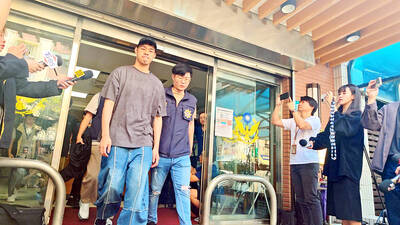
FALSE DOCUMENTS? Actor William Liao said he was ‘voluntarily cooperating’ with police after a suspect was accused of helping to produce false medical certificates Police yesterday questioned at least six entertainers amid allegations of evasion of compulsory military service, with Lee Chuan (李銓), a member of boy band Choc7 (超克7), and actor Daniel Chen (陳大天) among those summoned. The New Taipei City District Prosecutors’ Office in January launched an investigation into a group that was allegedly helping men dodge compulsory military service using falsified medical documents. Actor Darren Wang (王大陸) has been accused of being one of the group’s clients. As the investigation expanded, investigators at New Taipei City’s Yonghe Precinct said that other entertainers commissioned the group to obtain false documents. The main suspect, a man surnamed

DEMOGRAPHICS: Robotics is the most promising answer to looming labor woes, the long-term care system and national contingency response, an official said Taiwan is to launch a five-year plan to boost the robotics industry in a bid to address labor shortages stemming from a declining and aging population, the Executive Yuan said yesterday. The government approved the initiative, dubbed the Smart Robotics Industry Promotion Plan, via executive order, senior officials told a post-Cabinet meeting news conference in Taipei. Taiwan’s population decline would strain the economy and the nation’s ability to care for vulnerable and elderly people, said Peter Hong (洪樂文), who heads the National Science and Technology Council’s (NSTC) Department of Engineering and Technologies. Projections show that the proportion of Taiwanese 65 or older would

The government is considering polices to increase rental subsidies for people living in social housing who get married and have children, Premier Cho Jung-tai (卓榮泰) said yesterday. During an interview with the Plain Law Movement (法律白話文) podcast, Cho said that housing prices cannot be brought down overnight without affecting banks and mortgages. Therefore, the government is focusing on providing more aid for young people by taking 3 to 5 percent of urban renewal projects and zone expropriations and using that land for social housing, he said. Single people living in social housing who get married and become parents could obtain 50 percent more
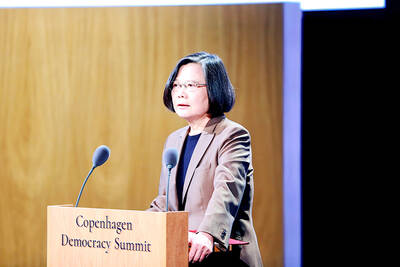
Democracies must remain united in the face of a shifting geopolitical landscape, former president Tsai Ing-wen (蔡英文) told the Copenhagen Democracy Summit on Tuesday, while emphasizing the importance of Taiwan’s security to the world. “Taiwan’s security is essential to regional stability and to defending democratic values amid mounting authoritarianism,” Tsai said at the annual forum in the Danish capital. Noting a “new geopolitical landscape” in which global trade and security face “uncertainty and unpredictability,” Tsai said that democracies must remain united and be more committed to building up resilience together in the face of challenges. Resilience “allows us to absorb shocks, adapt under


 RSS
RSS