


The Taipei City Government yesterday designated the remaining section of a 62-year-old farmhouse in Peitou as a municipal heritage site and said it would restore part of the building recently demolished by the local farmers' association.
Despite last week's rushed demolition of the building, Bureau of Cultural Affairs chief Lung Ying-tai (
"The building is highly educational in terms of the development history of the island's rice industry," she said at yesterday's evaluation meeting.
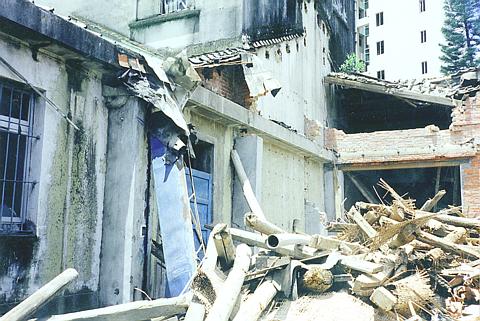
PHOTO: PEITOU ECOLOGY AND HUMANITY STUDIO
Before the Japanese introduced Penglai rice to Taiwan in 1899, Taiwan produced only Tsailai rice.
In 1923, a trial crop of the new rice was successfully raised in Chutzu Lake in Taipei's Yangmingshan and the rice was named Penglai -- which means "fairyland" -- in 1926.
Lung said the city also wants to prove to local residents that cultural and commercial development can occur simultaneously.
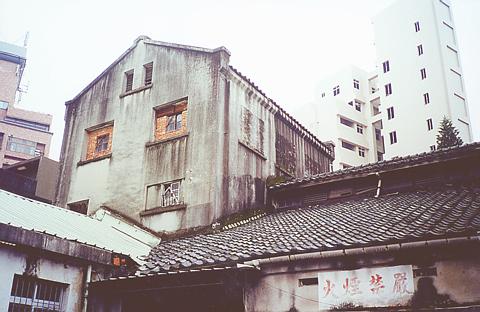
PHOTO: COURTESY OF PEITOU ECOLOGY AND HUMANITY STUDIO
"Look at it this way, once it becomes a heritage site, the area is bound to attract more tourists and will bring more commercial opportunities," she said.
Wang Mao-sung (王茂松), chairman of Peitou Farmers' Association (北投區農會) -- which is the legal owner of the property -- however, said that the association was unhappy with the decision and will resort to legal means, if necessary, to overturn the bureau's ruling.
"It seems like the bureau is playing two roles, both the player and the umpire," he said. "Don't get me wrong, I agree with the idea of conservation but not the designation of a heritage site. A 62-year-old house simply doesn't deserve such an honor."
Built in 1938, the 2,000m2 farming complex consists of 12 barns constructed along Peitou's Tatung Street.
After a farmhouse in Neihu was demolished in 1994, the house in Peitou became the city's only remaining farming complex that was still in relatively good condition.
On July 7, one day before the bureau was scheduled to hold a public hearing to decide whether to designate the farmhouse as a heritage site, the east side of the No. 3 house was torn down by the association, reportedly to make room for a rice distribution center and a museum.
Lung later denounced the act as a "lynching" and a direct "challenge to authority."
A sign was later erected on the spot ordering those carrying out the demolition project to immediately stop or face the possibility of five years' imprisonment or a fine of up to NT$300,000.
The association in turn accused the bureau of failing to inform the association, in writing, about the public hearing and for its belated warning to not carry out the demolition.
"We were just doing our job," Wang said. "The Bureau of Public Works has asked us to take care of the building. Besides, the part we tore down was condemned and beyond repair."
A letter dated April 24 this year from the BPW showed that the association had been asked to apply for a public safety check for the building before May 31 or face fines of between NT$60,000 and NT$300,000.
Wang instead applied to the city's Bureau of Reconstruction for permission to demolish the unused buildings. Wang was granted permission to go ahead with the plan, according to a letter dated May 31 from the reconstruction bureau.
Chen Ju-shun (
"Since the buildings were erected in the Japanese colonial period they don't have a construction license in the first place. So there is no need for the association to apply for a demolition," he said.
However, construction regulations revised in 1998 mandate that a demolition license is required for buildings regardless of whether they have a construction license or not.
Those who demolish buildings without the required permit are subject to fines between NT$10,000 and NT$30,000, which Wang said his association was willing to pay.
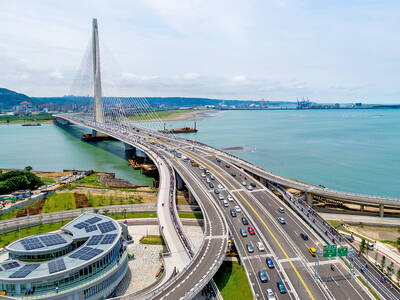
The Ministry of Transportation and Communications yesterday inaugurated the Danjiang Bridge across the Tamsui River in New Taipei City, saying that the structure would be an architectural icon and traffic artery for Taiwan. Feted as a major engineering achievement, the Danjiang Bridge is 920m long, 211m tall at the top of its pylon, and is the longest single-pylon asymmetric cable-stayed bridge in the world, the government’s Web site for the structure said. It was designed by late Iraqi-British architect Zaha Hadid. The structure, with a maximum deck of 70m, accommodates road and light rail traffic, and affords a 200m navigation channel for boats,

PRECISION STRIKES: The most significant reason to deploy HIMARS to outlying islands is to establish a ‘dead zone’ that the PLA would not dare enter, a source said A High Mobility Artillery Rocket System (HIMARS) would be deployed to Penghu County and Dongyin Island (東引) in Lienchiang County (Matsu) to force the Chinese military to retreat at least 100km from the coastline, a military source said yesterday. Taiwan has been procuring HIMARS and Army Tactical Missile Systems (ATACMS) from the US in batches. Once all batches have been delivered, Taiwan would possess 111 HIMARS units and 504 ATACMS, which have a range of 300km. Considering that “offense is the best defense,” the military plans to forward-deploy the systems to outlying islands such as Penghu and Dongyin so that

WHAT WAS ALL THAT FOR? Jaw Shaw-kong said that Cheng Li-wen had pushed for more drastic cuts and attacked him, just for the outcome to be nearly identical to his bill The legislature yesterday passed a supplementary budget bill to fund the purchase of separate packages of US military equipment, with the combined amount of spending capped at NT$780 billion (US$24.8 billion). The Chinese Nationalist Party (KMT) and Taiwan People’s Party (TPP) used their legislative majority to pass the bill, which runs until 2033 and has two main funding provisions. One was for NT$300 billion of arms sales already approved by the US for Taiwan on Dec. 17 last year, the other was for NT$480 billion for another arms package expected to be announced by Washington. The bill, which fell short of the NT$1.25

‘CLEAR MESSAGE’: The bill would set up an interagency ‘tiger team’ to review sanctions tools and other economic options to help deter any Chinese aggression toward Taiwan US Representative Young Kim has introduced a bill to deter Chinese aggression against Taiwan, calling for an interagency “tiger team” to preplan coordinated sanctions and economic measures in response to possible Chinese military or political action against Taiwan. “[Chinese President] Xi Jinping [習近平] has directed the People’s Liberation Army to be ready to invade Taiwan by 2027. China has a plan. America should have one too,” Kim said in a news release on Thursday last week. She introduced the “Deter PRC [People’s Republic of China] aggression against Taiwan act” to “ensure the US has a coordinated sanctions strategy ready should


 RSS
RSS