


Minister of Justice Chen Ding-nan's (
At an interpellation session at the Legislative Yuan yesterday, Chen declined to respond to lawmakers' requests to shake hands with Wang Kuang-ru (
KMT legislator Liu Shen-liang (

PHOTO: CHIANG YING-YING, TAIPEI TIMES
He asked Chen to confirm whether he had said that some people from the Investigation Bureau had "intimidated" him.
"I did say that someone from the MJIB had `sent a message' to me," Chen said. But, I never used the word "intimidate."
Chen declined to name who had sent the message to him.
Wang, responding to Liu, said that he did not know about any message sent to Chen.
"But, I am willing to talk to Minister Chen in private and if it's true, I will investigate the matter," Wang said.
Liu pressed further, asking Chen and Wang to shake hands to show harmony. The two both smiled with embarrassment and Wang tentatively put his hand out to Chen, but the latter avoided eye contact with Wang and did not reciprocate.
The scene surprised all, but Chen explained his action to Liu: "To shake hands here is not unusual, but it would be unusual to do so by request of a legislator. It would be politicized," Chen said.
The fight between Chen and Wang began on Monday morning when Chen, in a radio interview, agreed with the hostess that he felt "powerless" in working with the MJIB and said that the MJIB "dealt with cases selectively."
The issue behind the dispute is the identity and function of the MJIB. The MJIB is involved in both intelligence gathering and criminal investigations. Its intelligence functions are overseen by both the National Security Bureau, which is under the National Security Council, and thePresidential Office, while the Ministry of Justice oversees its criminal investigations.
Wang acknowledged that he has "two bosses" but has said that the current method of operation is not a problem.
Chen hopes that the MJIB will return its intelligence work to the the National Security Bureau.
Meanwhile, as the open conflict between Chen and Wang continues, prosecutors from Hsinchu, Tainan, and Chiayi District prosecutors' offices have signed statements to express their support for Chen. The statements say that in criminal investigations the MJIB must comply with the directives of prosecutors and that the leadership of the MJIB does not have the discretion to decide which cases to investigate.
"Our action is not about a power struggle," a Tainan prosecutor said. "The MJIB's current centralized system allows its leadership to interfere in investigations and this is wrong."
According to the regulations, agents of the MJIB have to obtain approval from their headquarters before investigating a case.
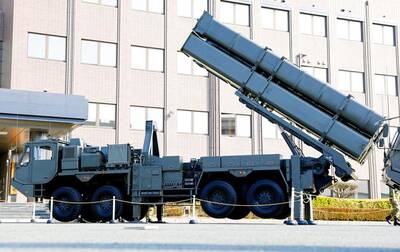
Japan has deployed long-range missiles in a southwestern region near China, the Japanese defense minister said yesterday, at a time when ties with Beijing are at their lowest in recent years. The missiles were installed in Kumamoto in the southern region of Kyushu, as Japan is attempting to shore up its military capacity as China steps up naval activity in the East China Sea. “Standoff defense capabilities enable us to counter the threat of enemy forces attempting to invade our country ... while ensuring the safety of our personnel,” Japanese Minister of Defense Shinjiro Koizumi said. “This is an extremely important initiative for
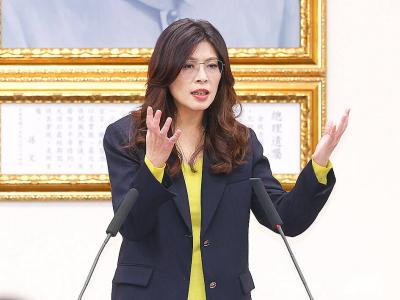
Chinese Nationalist Party (KMT) Chairwoman Cheng Li-wun (鄭麗文) today accepted an invitation from Chinese President Xi Jinping (習近平) to lead a delegation to China next month, saying she hopes to promote the peaceful development of cross-strait relations and bring stability to the Taiwan Strait. “I am grateful and happy to accept this invitation,” Cheng said in a statement from the KMT chairperson’s office. Cheng said she hopes both sides can work together to promote the peaceful development of cross-strait relations, enhance exchange and cooperation, bring stability to the Taiwan Strait and improve people’s livelihoods. At today's news conference, Cheng said any efforts to

MORE POPULAR: Taiwan Pass sales increased by 59 percent during the first quarter compared with the same period last year, the Tourism Administration said The Tourism Administration yesterday said that it has streamlined the Taiwan Pass, with two versions available for purchase beginning today. The tourism agency has made the pass available to international tourists since 2024, allowing them to access the high-speed rail, Taiwan Railway Corp services, four MRT systems and four Taiwan Tourist Shuttles. Previously, five types of Taiwan Pass were available, but some tourists have said that the offerings were too complicated. The agency said only two types of Taiwan Pass would be available, starting from a three-day pass with the high-speed rail and a three-day pass with Taiwan Railway Corp. The former costs NT$2,800

The nation’s fastest supercomputer, Nano 4 (晶創26), is scheduled to be launched in the third quarter, and would be used to train large language models in finance and national defense sectors, the National Center for High-Performance Computing (NCHC) said. The supercomputer, which would operate at about 86.05 petaflops, is being tested at a new cloud computing center in the Southern Taiwan Science Park in Tainan. The exterior of the server cabinet features chip circuitry patterns overlaid with a map of Taiwan, highlighting the nation’s central position in the semiconductor industry. The center also houses Taiwania 2, Taiwania 3, Forerunner 1 and


 RSS
RSS