


Taiwan's national welfare lottery has been running for just six months, but yesterday ticket vendors -- most of whom are mentally or physically challenged -- said they are already seeing dwindling profits and are asking Taipei City officials for help.
Lottery sellers made the claim at a public hearing yesterday organized by KMT City Councilor Lin Yi-hua (
The two Taipei City officials were prompted to hold the hearing following a recent initiative by the Taipei County Government to provide disadvantaged and low-income groups with low-interest employment loans.
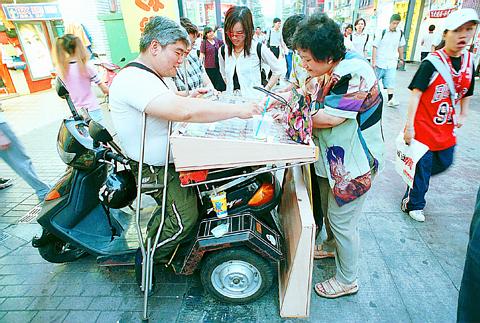
PHOTO: CHEN CHENG-CHANG, TAIPEI TIMES
The officials wanted to find out if a similar scheme could work for disadvantaged or low-income groups in Taipei and if so, to provide them with similar loans.
A percentage of the proceeds from lottery sales goes to an employment subsidy account that pays out to disadvantaged vendors. Attendees yesterday attributed what they called a "retrogression" of the business to several factors.
Wang Jung-chang (王榮璋), secretary-general of the Coalition for the Handicapped and Disabled (殘障福利聯盟), said the swelling number of vendors was partly to blame.
"There are a total of 50,000 vendors -- legal and illegal -- in the market islandwide, 10 times more than there were when it [the lottery] started six months ago. How do you expect us to compete?" Wang said.
He also said he had doubts about the point of the lottery. He said that the government could be seen as taking advantage of the less well-off, by getting these people to raise funds, but not paying those funds out.
"We don't mind if we benefit from it, but we don't," Wang said. "We see the government is not doing a good job in cracking down on illegal vendors or in improving the worsening business."
Su Chih-wen (
"We simply cannot afford loan applications because we don't have any collateral to begin with," he said. "Why doesn't the city channel disabled welfare funds to us individually instead of to groups like it's doing now?"
Yang Chin-chung (
"There are no scratch prizes any more and the winning rate has been changed from 40 percent to 20 percent for no reason. I suggest to have more small winning prizes, plus one big prize to attract more business," he said.

CREDIT-GRABBER: China said its coast guard rescued the crew of a fishing vessel that caught fire, who were actually rescued by a nearby Taiwanese boat and the CGA Maritime search and rescue operations do not have borders, and China should not use a shipwreck to infringe upon Taiwanese sovereignty, the Coast Guard Administration (CGA) said yesterday. The coast guard made the statement in response to the China Coast Guard (CCG) saying it saved a Taiwanese fishing boat. The Chuan Yu No. 6 (全漁6號), a fishing vessel registered in Keelung, on Thursday caught fire and sank in waters northeast of Diaoyutai Islands (釣魚台). The vessel left Keelung’s Badouzih Fishing Harbor (八斗子漁港) at 3:35pm on Sunday last week, with seven people on board — a 62-year-old Taiwanese captain surnamed Chang (張) and six

RISKY BUSINESS: The ‘incentives’ include initiatives that get suspended for no reason, creating uncertainty and resulting in considerable losses for Taiwanese, the MAC said China’s “incentives” failed to sway sentiment in Taiwan, as willingness to work in China hit a record low of 1.6 percent, a Ministry of Labor survey showed. The Directorate-General of Budget, Accounting and Statistics (DGBAS) also reported that the number of Taiwanese workers in China has nearly halved from a peak of 430,000 in 2012 to an estimated 231,000 in 2024. That marked a new low in the proportion of Taiwanese going abroad to work. The ministry’s annual survey on “Labor Life and Employment Status” includes questions respondents’ willingness to seek employment overseas. Willingness to work in China has steadily declined from

The Legislative Yuan’s Finance Committee yesterday approved proposed amendments to the Amusement Tax Act (娛樂稅法) that would abolish taxes on films, cultural activities and competitive sporting events, retaining the fee only for dance halls and golf courses. The proposed changes would set the maximum tax rate for dance halls and golf courses at 50 and 20 percent respectively, with local governments authorized to suspend the levies. Article 2 of the act says that “amusement tax shall be levied on tickets sold or fees charged by amusement places, facilities or activities” in six categories: “Cinema; professional singing, story-telling, dancing, circus, magic show, acrobatics
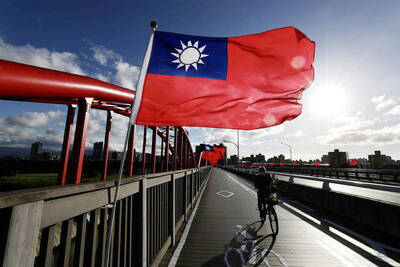
INFLATION UP? The IMF said CPI would increase to 1.5 percent this year, while the DGBAS projected it would rise to 1.68 percent, with GDP per capita of US$44,181 The IMF projected Taiwan’s real GDP would grow 5.2 percent this year, up from its 2.1 percent outlook in January, despite fears of global economic disruptions sparked by the US-Iran conflict. Taiwan’s consumer price index (CPI) is projected to increase to 1.5 percent, while unemployment would be 3.4 percent, roughly in line with estimates for Asia as a whole, the international body wrote in its Global Economic Outlook Report published in the US on Monday. The figures are comparatively better than the IMF outlook for the rest of the world, which pegged real GDP growth at 3.1 percent, down from 3.3 percent


 RSS
RSS