


With the Legislative Yuan gaining more power after marginalizing the National Assembly last month, there are growing concerns that the radical reform was precipitous.
Academics fear fundamental changes could topple the current structure of Taiwan's government, which they believe is already unbalanced after six rounds of constitutional reforms over the past decade.
In an effort to centralize powers that had been divided between the National Assembly and Legislative Yuan, the April 24 reform of the Constitution passed to the legislature the power to initiate impeachment of the president or vice president, to amend the constitution and to propose changes in the nation's boundaries.
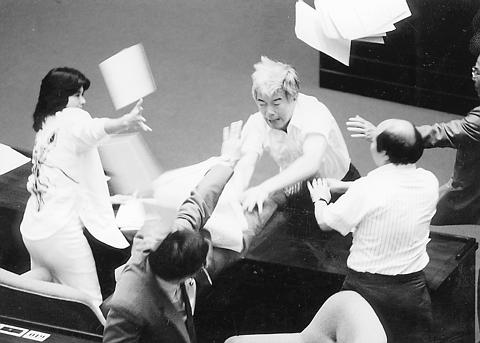
PHOTO: FILE
Once passed by the legislature the resolutions only need to be ratified by the Assembly before being adopted.
Other functions taken from the Assembly are to elect the vice president if the office is vacant; to initiate proposals to recall the president or vice president; and to confirm Judicial Yuan, Examination Yuan and Control Yuan personnel appointments after they have been forwarded by the president.
Semi-presidential stalemate?
"While the constitutional system is already slanted in a very serious way, the Legislative Yuan has gained many influences that perhaps are too strong under the present system," said Tsai Tzung-jen (
Following the 1994 constitutional reform under which the direct, popular election of the president was introduced, efforts were made during reforms in 1997 to adjust the governmental structure that made it into something similar to the so-called "semi-presidential" system of France.
But unlike the French system -- in which the president's appointment of premier goes through a confirmation process in the legislature, and in which the president has the power to dissolve the legislature -- the Taiwan system allows the president to appoint the premier without having to obtain the legislature's approval.
Under the current system, the Legislative Yuan may propose a no-confidence vote against the premier which may in turn lead to a retaliatory move from the president to dismiss the legislature and force re-elections.
Should more than one-half of the total number of legislators approve the no-confidence motion, the premier has to tender his resignation within 10 days, and at the same time may request that the president dissolve the legislature.
Should the no-confidence motion fail, the Legislative Yuan may not initiate another no-confidence motion against the same premier within a one-year period.
Tsai argued that under this system, the checks against the legislature are very weak because the threat to dissolve the legislature is nothing more than "nominal" in strength.
Furthermore, since the premier's appointment is not officially endorsed by the legislature, political chaos could result if the presidency and the majority of legislative seats are controlled by different political parties.
In fact this is the present state of affairs following the March 18 presidential election.
"Legislators can make all kinds of trouble to act against the president and the Cabinet. They don't need to launch a vote of no-confidence at all, and thus they can protect themselves from the threat of dismissal," Tsai said.
The politics appointment
Although most of the functions transferred from the Assembly to the Legislative Yuan are not to be exercised on a regular basis, the legislature's confirmation of the major Judicial Yuan, Examination Yuan and Control Yuan personnel appointments is considered one that could catalyze a substantial change in the power relationship between the president and the legislature.
To win the legislature's approval for his nomination, the president needs to consider the preferences of the majority of legislators, Tsai said.
"While the legislature is allowed to gain more political influence, there are no mechanisms to guard against the dangers underlying these influences," Tsai said. "Passing more powers to the legislature will only further worsen this slanting, fragile governmental structure."
Su Yeong-chin (
"Personnel appointments by the three bodies really need to transcend the boundaries of political parties," Su said.
At present, such appointments are approved by an absolute majority, which Su said is very rare in countries where party politics are practiced.
Su noted that countries including Germany, Italy and Belgium -- with similar systems to Taiwan -- have all adopted a two-thirds majority as the threshold for personnel confirmation.
Quality control
The questionable backgrounds and monied interests of certain legislators has also become a factor in public apprehension over making the legislature more powerful.
"The functions that were passed to the Legislative Yuan are in fact those normally enjoyed by a legislative body in most countries. But the quality of these legislators is what makes people worry," said Lee Chun-yi (李俊俋), a professor of public administration at Tamkang University.
Lee said the problem should be tackled by reforming the electoral system and culture.
The electoral system in Taiwan, in which more than one seat is elected from the same constituency, has been criticized as a cause for the inferior quality of many politicians.
Critics have argued that under this system, a candidate can get elected relatively easily by appealing to a small group of the electorate.
While some politicians have resorted to vote-buying to beat their rivals, the system also makes it easy for politicians with gangster backgrounds or connections to win votes by violent threats.
Over the past few years there has been a great deal of public discussion about changing the electoral method and following Germany with a two-vote system.
In this system, the voters cast two ballots. On the first ballot, voters mark their preferences for one of the individual candidates running for legislators in the district.
On the second ballot, they mark their preferences for the political party they would most like to see in control of the legislature.
While a certain number of seats are directly elected from each constituency, the rest of the seats are allocated on the basis of the list of candidates put up by political parties according to their vote share in the second ballot.
Whose majority?
Meanwhile, proposals have also been put forward to reform the method of electing the president, and thereby increase political stability.
Hu Fu (胡佛), a professor of constitutional law at National Taiwan University, said that it is necessary to require a candidate to win an absolute majority of the votes to be elected the president.
For instance, Hu said, President-elect Chen Shui-bian (
Hu said a run-off should have been held so that voters had the chance to choose between the top two candidates.
"This can protect the voters' right to vote and prevent the president from having a weak support base, which can prevent him carrying out his policies," Hu said.
Another equally important issue is to restore the checks and balances of the governmental structure, which Hu said have suffered severe damage after six round of constitutional reforms over the past decade.
Hu said that as a result of these reforms, the president is now the head of state as well as the government leader with the most substantial powers.
However, the premier, who is appointed by the president without the legislature's approval, is the one who is accountable to the legislature.
"The president is powerful but not held responsible, but the premier is held responsible but kept powerless," Hu said. "This is against the principles of having checks and balances in a democracy."
To ensure the current governmental structure works, Tsai argued that the critical elements for a semi-presidency must be included in the Constitution, since Taiwan has opted for this system.
In addition to the absolute-majority threshold for a presidential election, the appointment of premier should go through the legislature's confirmation, and the president should be granted the power to dissolve the legislature on a proactive basis, Tsai said.
"A key consideration of this design is not to prevent the legislature from enjoying any ability to paralyze government operations," Tsai said.
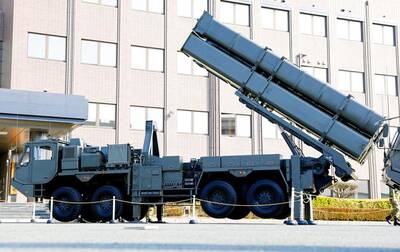
Japan has deployed long-range missiles in a southwestern region near China, the Japanese defense minister said yesterday, at a time when ties with Beijing are at their lowest in recent years. The missiles were installed in Kumamoto in the southern region of Kyushu, as Japan is attempting to shore up its military capacity as China steps up naval activity in the East China Sea. “Standoff defense capabilities enable us to counter the threat of enemy forces attempting to invade our country ... while ensuring the safety of our personnel,” Japanese Minister of Defense Shinjiro Koizumi said. “This is an extremely important initiative for
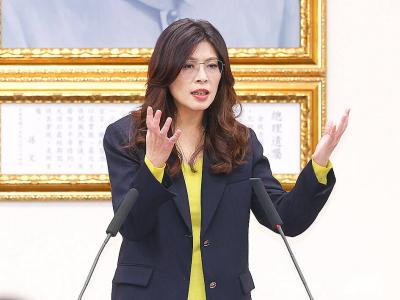
Chinese Nationalist Party (KMT) Chairwoman Cheng Li-wun (鄭麗文) today accepted an invitation from Chinese President Xi Jinping (習近平) to lead a delegation to China next month, saying she hopes to promote the peaceful development of cross-strait relations and bring stability to the Taiwan Strait. “I am grateful and happy to accept this invitation,” Cheng said in a statement from the KMT chairperson’s office. Cheng said she hopes both sides can work together to promote the peaceful development of cross-strait relations, enhance exchange and cooperation, bring stability to the Taiwan Strait and improve people’s livelihoods. At today's news conference, Cheng said any efforts to

MORE POPULAR: Taiwan Pass sales increased by 59 percent during the first quarter compared with the same period last year, the Tourism Administration said The Tourism Administration yesterday said that it has streamlined the Taiwan Pass, with two versions available for purchase beginning today. The tourism agency has made the pass available to international tourists since 2024, allowing them to access the high-speed rail, Taiwan Railway Corp services, four MRT systems and four Taiwan Tourist Shuttles. Previously, five types of Taiwan Pass were available, but some tourists have said that the offerings were too complicated. The agency said only two types of Taiwan Pass would be available, starting from a three-day pass with the high-speed rail and a three-day pass with Taiwan Railway Corp. The former costs NT$2,800

The nation’s fastest supercomputer, Nano 4 (晶創26), is scheduled to be launched in the third quarter, and would be used to train large language models in finance and national defense sectors, the National Center for High-Performance Computing (NCHC) said. The supercomputer, which would operate at about 86.05 petaflops, is being tested at a new cloud computing center in the Southern Taiwan Science Park in Tainan. The exterior of the server cabinet features chip circuitry patterns overlaid with a map of Taiwan, highlighting the nation’s central position in the semiconductor industry. The center also houses Taiwania 2, Taiwania 3, Forerunner 1 and


 RSS
RSS