


Officials at the Miaoli District Agricultural Improvement Station (MLDAIS 苗栗區農業改良場) said yesterday that a Council of Agriculture project aimed at promoting beekeeping has been launched nationwide in a bid to raise pollination efficacy, and to boost the quality of agricultural production.
"One common reason for the malformation of fruits, such as asymmetric carambola or pears, is incomplete pollination," said Lin Hsin-shan (
A decline in the bee population and other pollinators in Taiwan is a problem caused by human disruption of their habitats and the extensive use of pesticides on farmland.
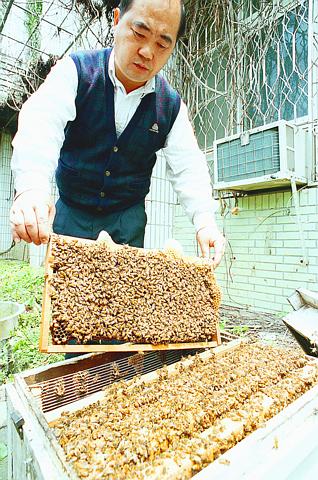
PHOTO: CHEN CHENG-CHANG, TAIPEI TIMES
Touring the gardens at the station yesterday with reporters, Lin said that if it were not for the presence of bees, many plants would be unable to produce fruits or seeds.
Scientific research has shown that bees are responsible for pollinating more flowers than any other creature on the planet, Lin said.
"That's why we are working with other stations around the country to raise and improving the Italian honeybee population to meet farmers' demands," Lin said, adding that this particular type of bee is an efficient pollinator.
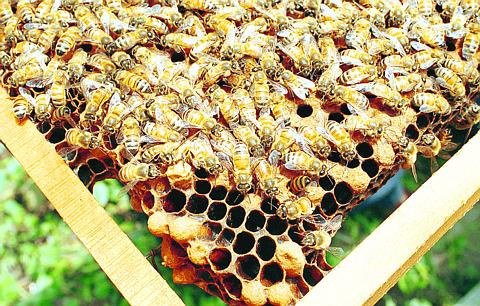
PHOTO: CHEN CHENG-CHANG, TAIPEI TIMES
Scientific researchers at the station said that while visiting flowers, honeybees pick up pollen grains from the anthers on male stamens, which stick to the insect's heads, wings and legs.
A honeybee can carry on its body about 5 million pollen grains at a time -- which then brush off onto other flowers of the same species to pollinate them, Lin said.
"Besides producing natural health products, such as honey and royal jelly, honeybees are also very valuable insects as pollinators," Lin said.
"In Taiwan, 44 agricultural crops depend on pollinators such as honeybees or other insects that disseminate pollen, accounting for about NT$52.3 billion in production," Lin said. Around 20 percent, or NT$10.47 billion, of that total is attributable to the honeybee alone, Lin said.
Agricultural officials at the station said according to scientific research by the US Department of Agriculture, improving honeybee pollination could boost total crop production by 20 percent to 30 percent.
Anticipating the economic impact caused by Taiwan's entry into the World Trade Organization, agricultural researchers have come up with strategies to save labor and enhance the quality of agricultural production, such as raising pollination efficacy.
"We are improving greenhouse pollination techniques. As long as we can expand cultivated acreage and reduce malformation, the quantity of production will be improved," said Wu Teng-chen (吳登楨), head of the silkworm and honeybee division at the station.
Wu said that honeybee pollination of crops grown inside greenhouses could replace labor-intensive hand-pollination that is currently the standard practise here.
Officials at the station said that the area of cultivated crops using honeybee pollination has reached 3,500 acres, and that coverage is still expanding.
By the end of 1999, there were 1,052 registered beekeepers in Taiwan. However, agricultural officials said the figure would increase because the government had chosen to focus its efforts on beekeeping.
Lin stressed that comprehensive pest control work could keep Taiwan's honeybee population from being threatened by its worst natural enemies -- varroa mites and small hive beetles.
As for criticism from conservationists regarding the choice of raising the Italian honeybee rather than the original native wild bee, agricultural officials said that Italian honeybees are more valuable economically.
"It's difficult to estimate the population of Taiwan's wild bees, but their number is surely declining," Wu said.
That main reason for the decline could be that native vegetation such as wild flowers, which native pollinators depend upon to feed themselves and their larvae, have declined with the widespread farming of cash crops.
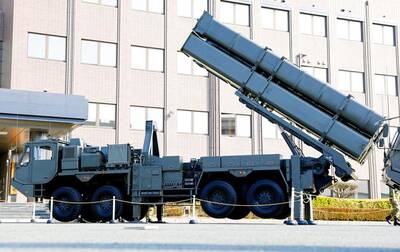
Japan has deployed long-range missiles in a southwestern region near China, the Japanese defense minister said yesterday, at a time when ties with Beijing are at their lowest in recent years. The missiles were installed in Kumamoto in the southern region of Kyushu, as Japan is attempting to shore up its military capacity as China steps up naval activity in the East China Sea. “Standoff defense capabilities enable us to counter the threat of enemy forces attempting to invade our country ... while ensuring the safety of our personnel,” Japanese Minister of Defense Shinjiro Koizumi said. “This is an extremely important initiative for

Chinese Nationalist Party (KMT) Chairwoman Cheng Li-wun (鄭麗文) today accepted an invitation from Chinese President Xi Jinping (習近平) to lead a delegation to China next month, saying she hopes to promote the peaceful development of cross-strait relations and bring stability to the Taiwan Strait. “I am grateful and happy to accept this invitation,” Cheng said in a statement from the KMT chairperson’s office. Cheng said she hopes both sides can work together to promote the peaceful development of cross-strait relations, enhance exchange and cooperation, bring stability to the Taiwan Strait and improve people’s livelihoods. At today's news conference, Cheng said any efforts to

MORE POPULAR: Taiwan Pass sales increased by 59 percent during the first quarter compared with the same period last year, the Tourism Administration said The Tourism Administration yesterday said that it has streamlined the Taiwan Pass, with two versions available for purchase beginning today. The tourism agency has made the pass available to international tourists since 2024, allowing them to access the high-speed rail, Taiwan Railway Corp services, four MRT systems and four Taiwan Tourist Shuttles. Previously, five types of Taiwan Pass were available, but some tourists have said that the offerings were too complicated. The agency said only two types of Taiwan Pass would be available, starting from a three-day pass with the high-speed rail and a three-day pass with Taiwan Railway Corp. The former costs NT$2,800

The nation’s fastest supercomputer, Nano 4 (晶創26), is scheduled to be launched in the third quarter, and would be used to train large language models in finance and national defense sectors, the National Center for High-Performance Computing (NCHC) said. The supercomputer, which would operate at about 86.05 petaflops, is being tested at a new cloud computing center in the Southern Taiwan Science Park in Tainan. The exterior of the server cabinet features chip circuitry patterns overlaid with a map of Taiwan, highlighting the nation’s central position in the semiconductor industry. The center also houses Taiwania 2, Taiwania 3, Forerunner 1 and


 RSS
RSS