


With Martin Lee in town, it is with great trepidation that I attempt to draw comparisons between Hong Kong and Taiwan a day before the election. Knowing nowhere near as much as he does about the difficulties faced by his Democratic Party in the former British colony -- returned to China in 1997 -- I cannot possibly try to sound authoritative on the subject. So I guess a personal account is going to have to suffice.
The reason why I find a comparison interesting is not, strangely enough, because Taiwan's democracy is more advanced. Rather, it's because Hong Kong's economy and society seem to have largely escaped the ravages of incompetency and conflicts of interest that "one country, two systems" was supposed to bring to it after the handover, as many analysts, myself included, had predicted. And as we enter the last day of campaigning before the presidential election, it is instructive to examine this contention, if only to gain an understanding of just how -- and why -- tomorrow's voting is so important to Taiwan's development as a modern, pluralistic society.
It's not so bad
Having lived in both places (I was at the South China Morning Post from February, 1994 until September, 1996) it peeves me to hear Taiwanese compare their land to Hong Kong, because the two are so fundamentally different.
Indeed, Taiwanese are very quick to wag fingers at Hong Kong. It seems like every time something happens there, such as the madness of the TOM.COM share offering, people here find an excuse to climb on their democratic high horses and say, "See, we told you so. Beijing is messing the place up."
To a certain extent, they're not often wrong. Hong Kong has had a lot of problems since its return to "the motherland" nearly three years ago. Tung Chee-hwa's administration has obviously come under enormous pressure from Beijing on numerous occasions, and it has indeed messed up big at times, with perhaps the most classic example being the opening of the international airport. (It was behind schedule and construction was in disarray, but it absolutely had to open in time for Jiang Zemin to arrive on July 1, 1998, a year after the handover. It was chaos.)
On the less visible side, too, China's hand has clearly been at work. How, for instance, can anyone forget the the Hong Kong Court of Final Appeal's revised decision on the right of abode for children born on the mainland?
Yet much as I have always been, and always will be, a staunch opponent of the "one country, two systems" model for Taiwan, it has to be said that the universal suffrage bestowed by the KMT on Taiwan has not -- yet -- given Taiwanese a whole lot more bang for their buck. In fact, if I were a Taiwanese voter with a week to go before the presidential election, I'd be looking rather enviously at a lot of what Hong Kong does have.
More than business
For a start, it's got that airport. Chek Lap Kok may have been opened to scenes of toilets overflowing, but it's now the most awesome place you could ever hope to arrive in on a plane. Service throughout the complex, from baggage collection to the express train journey into the city, is truly world-class. The only thing that's world-class about Taiwan's CKS International Airport is the amount of money that has been spent on its second terminal, which has fallen so deeply into the pit of "black-gold" politics that I wonder if anyone can remember when it's supposed to be finished.
Downtown Hong Kong still has many basic weaknesses: the overwhelming number of people living there is one example. But traffic is autobahn-like compared with Taipei and I bet a lot more of those tall, thin buildings would have remained standing in an earthquake the size of the one that rattled Taiwan last September.
Beyond esthetics or concerns of convenience, Hong Kong also has, perhaps most importantly, a legal system that is still -- despite the Court of Final Appeal ruling -- trusted by both the world's biggest corporations and the territory's rank and file. Taiwan, meanwhile, has a bunch of twentysomethings for judges and the influence of gang bosses and their thugs.
Admittedly, Hong Kong has an executive branch that is securely in the clutches of a few business groups, especially the Li family, which has a staggering 40 percent-plus share of Hong Kong's market capitalization. But what people easily forget is that Li Ka-shing and his two sons have been Hong Kong's royal family for some time, and they would not be where they are now were it not for Hongkong Bank, that most British of institutions. And in any case, how is the Li family all that different from the Koo and Wang families in Taiwan, which have been allowed to divide both the cable TV and, soon, broadband markets between them?
Yet even if this still does not suffice to convince Taiwanese voters that they are not really living in greener pastures, they need only take a look at just how accountable their government is in comparison with Hong Kong's. And then they might also want to consider the role that their media plays in keeping it that way.
Does Taiwan, for instance, have an Apple Daily? Jimmy Lai's well-known "tabloid" newspaper may have had problems since the handover, but it has still been breaking corruption cases in the Hong Kong government. The South China Morning Post, meanwhile, is not the Beijing mouthpiece that many had said it would become. Its editors may be a bit clueless about the intricacies of Taiwan politics, but that's what you get for not having a circulation here, and hence no bureau -- it's not really about that guy in the corner office that everyone knows about.
Of course, I'm not doubting for a minute that Taiwan has far greater long-term potential, thanks to the base of democracy upon which it has been set.
But just looking at the widening gap between Hong Kong and Taiwan's standards and quality of life, and considering that the KMT's candidate is relying on promises of "more of the same" to win the coming election, I truly wonder if Taiwan's potential will ever be realized if it elects Lien Chan, democracy or no.
But ...
But that, in itself, is the beauty of a real democracy. Hong Kong's destiny is pretty much set for the next 47 years. It has to keep going the way it is. There can be no revolution. Taiwan, however, can decide, tomorrow, that it wants to have a clean judiciary (not to mention a clean airport), an accountable civil service, smooth-flowing traffic, etc. It can have all that Hong Kong has -- and more. Can Hong Kong decide that it wants to pursue what Taiwan has?
That is precisely what makes this election so important. After tomorrow, nobody else can be blamed for Taiwan's problems, and nobody else can be praised for its achievements. The man who brought real democracy to his people, Lee Teng-hui (
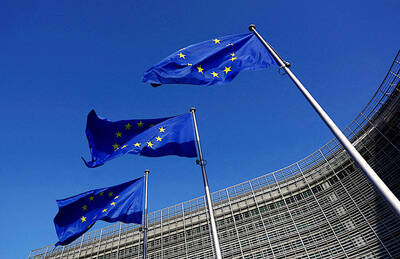
LEVERAGE: China did not ‘need to fire a shot’ to deny Taiwan airspace over Africa when it owns ‘half the continent’s debt,’ a US official said, calling it economic warfare The EU has raised concerns about overflight rights following the delay of President William Lai’s (賴清德) planned state visit to the Kingdom of Eswatini after three African nations denied overflight clearance for his charter at the last minute. Taiwanese allies Paraguay and Saint Kitts and Nevis, as well as several US lawmakers and the Inter-Parliamentary Alliance on China (IPAC) condemned China for allegedly pressuring the countries. Lai was scheduled to fly directly to Taiwan’s only African ally from yesterday to Sunday to celebrate the 40th anniversary of King Mswati III’s accession and his 58th birthday, but Seychelles, Mauritius and Madagascar suddenly revoked
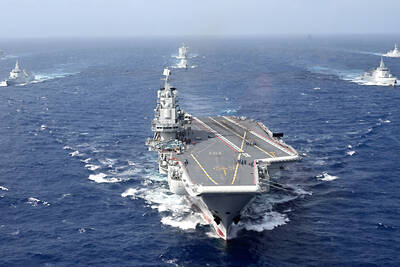
PROVOCATIVE: Chinese Deputy Ambassador to the UN Sun Lei accused Japan of sending military vessels to deliberately provoke tensions in the Taiwan Strait China denounced remarks by Japan and the EU about the South China Sea at a UN Security Council meeting on Monday, and accused Tokyo of provocative behavior in the Taiwan Strait and planning military expansion. Ayano Kunimitsu, a Japanese vice foreign minister, told the Council meeting on maritime security that Tokyo was seriously concerned about the situation in the East China and South China seas, and reiterated Japan’s opposition to any attempt to change the “status quo” by force, and obstruction of freedom of navigation and overflight. Stavros Lambrinidis, head of the EU delegation to the UN, also highlighted South China Sea
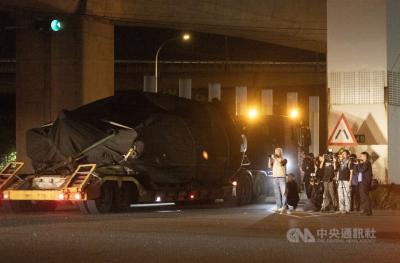
The final batch of 28 M1A2T Abrams tanks purchased from the US arrived at Taipei Port last night and were transported to the Armor Training Command in Hsinchu County’s Hukou Township (湖口), completing the military’s multi-year procurement of 108 of the tanks. Starting at 12:10am today, reporters observed more than a dozen civilian flatbed trailers departing from Taipei Port, each carrying an M1A2T tank covered with black waterproof tarps. Escorted by military vehicles, the convoy traveled via the West Coast Expressway to the Armor Training Command, with police implementing traffic control. The army operates about 1,000 tanks, including CM-11 Brave Tiger
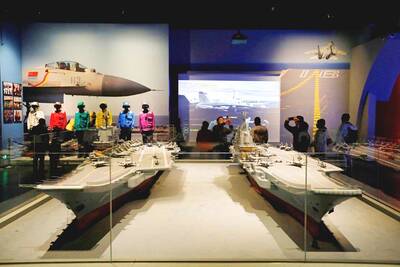
China on Wednesday teased in a video an aircraft carrier that could be its fourth, and the first using nuclear power, while making an allusion to Taiwan and vowing to further build up its islands, as it looks to boost maritime power, secure resources and bolster territorial claims. The video, issued on the eve of the 77th founding anniversary of the Chinese People’s Liberation Army Navy, featured fictional officers with names that are homophones of three commissioned aircraft carriers, the Liaoning (遼寧), Shandong (山東) and Fujian (福建). Titled Into the Deep, it showed a 19-year-old named “Hejian” (何劍) joining the group, sparking


 RSS
RSS