


A meeting of Taiwanese businesspeople working in China organized as a speaking event for KMT presidential candidate Lien Chan (連戰) yesterday took an unexpected turn when former party heavyweight Chen Li-an (陳履安) voiced his consternation at the audience for ignoring his own speech on cross-strait security.
Chen -- who ran as an independent candidate in the 1996 presidential election and served as president of the Control Yuan -- used the occasion to reproach his audience for not paying attention to his previous warnings about the tensions in the Taiwan Strait.
Chen, who was seated prominently at the luncheon attended by many Taiwanese businesspeople operating enterprises in China, spoke before Lien Chan arrived at the scene.
"During this election, many people in Taiwan have persistently put aside the cross-strait issue. The US is even more nervous about this than we are, and our own people don't care about it," Chen said.
"After I voiced my opinions, some people have said I was scaring people. I'm not. I'm waking everybody up," Chen said in an agitated tone.
Chen Li-an quit the KMT to make an unsuccessful run for the presidency four years ago, claiming Lee Teng-hui was leading Taiwan down the path toward eventual war with China.
He announced his endorsement for Lien Chan on Feb. 28, saying the KMT candidate was the only candidate who could ensure peace across the Taiwan Strait and improve relations between the two sides.
"China has the ability to attack Taiwan. They've got missiles and advanced weapons, and a war would not be conventional. They are also capable of hitting [American] aircraft carriers," Chen said. "China will not be lenient toward Taiwan."
Chen, however, struggled to be heard over the loud din of conversation in the jovial atmosphere permeating the meeting.
Visibly annoyed, Chen snapped at the audience.
"I'm speaking here, and everybody's just eating and chatting as usual! This is just typical of Taiwan!" Chen shouted.
Without his admonishments triggering any response, Chen left the meeting shortly after speaking.
Lien himself arrived soon after, praising Taiwanese businessmen and investors in China for their contribution to improving China's economy and the living standard of the Chinese people. He also reiterated his mainland policies.
"You people who do business and invest in China are most concerned with cross-strait relations," he said.
"And I was the first candidate to propose the idea of signing agreements with China to secure Taiwanese businessmen's rights and interests," Lien said.
"Any factor causing instability over the Taiwan Strait should be repressed on March 18," Lien said, referring to his rival, the DPP's Chen Shui-bian (
In a number of recent polls, businesspeople working in China have largely favored independent candidate James Soong (
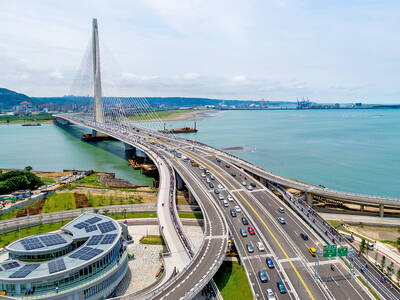
The Ministry of Transportation and Communications yesterday inaugurated the Danjiang Bridge across the Tamsui River in New Taipei City, saying that the structure would be an architectural icon and traffic artery for Taiwan. Feted as a major engineering achievement, the Danjiang Bridge is 920m long, 211m tall at the top of its pylon, and is the longest single-pylon asymmetric cable-stayed bridge in the world, the government’s Web site for the structure said. It was designed by late Iraqi-British architect Zaha Hadid. The structure, with a maximum deck of 70m, accommodates road and light rail traffic, and affords a 200m navigation channel for boats,
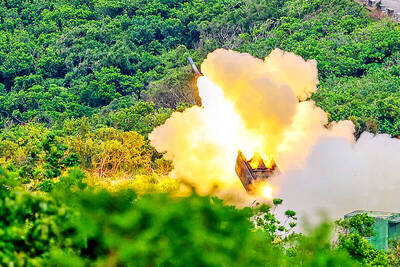
PRECISION STRIKES: The most significant reason to deploy HIMARS to outlying islands is to establish a ‘dead zone’ that the PLA would not dare enter, a source said A High Mobility Artillery Rocket System (HIMARS) would be deployed to Penghu County and Dongyin Island (東引) in Lienchiang County (Matsu) to force the Chinese military to retreat at least 100km from the coastline, a military source said yesterday. Taiwan has been procuring HIMARS and Army Tactical Missile Systems (ATACMS) from the US in batches. Once all batches have been delivered, Taiwan would possess 111 HIMARS units and 504 ATACMS, which have a range of 300km. Considering that “offense is the best defense,” the military plans to forward-deploy the systems to outlying islands such as Penghu and Dongyin so that
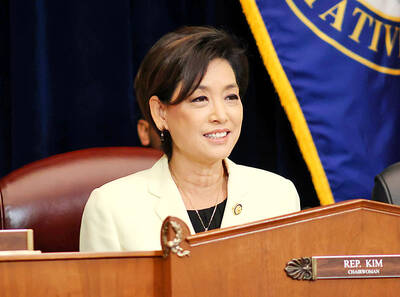
‘CLEAR MESSAGE’: The bill would set up an interagency ‘tiger team’ to review sanctions tools and other economic options to help deter any Chinese aggression toward Taiwan US Representative Young Kim has introduced a bill to deter Chinese aggression against Taiwan, calling for an interagency “tiger team” to preplan coordinated sanctions and economic measures in response to possible Chinese military or political action against Taiwan. “[Chinese President] Xi Jinping [習近平] has directed the People’s Liberation Army to be ready to invade Taiwan by 2027. China has a plan. America should have one too,” Kim said in a news release on Thursday last week. She introduced the “Deter PRC [People’s Republic of China] aggression against Taiwan act” to “ensure the US has a coordinated sanctions strategy ready should

TAIWAN ISSUE: US treasury secretary Scott Bessent said on the first day of meetings that ‘it wouldn’t be a US-China summit without the Taiwan issue coming up’ There were no surprises on the first day of the summit between US President Donald Trump and Chinese President Xi Jinping (習近平), the Mainland Affairs Council (MAC) said yesterday, as the government reiterated that cross-strait stability is crucial to the Asia-Pacific region, as well as the world. As the two presidents met for a highly anticipated summit yesterday, Chinese state media reported that Xi warned Trump that missteps regarding Taiwan could push their two countries into “conflict.” Trump arrived in China with accolades for his host, calling Xi a “great leader” and “friend,” and extending an invitation to visit the White House


 RSS
RSS