


Four years after running in the first direct presidential election, Chen Li-an (
It remains, however, unclear what impact the blue-blooded veteran politician will have on the election. But a look at Chen's pivotal role in Taiwan's politics may offer some clues.
During the 1996 presidential election, Chen and his then running mate, lawyer Wang Ching-feng (
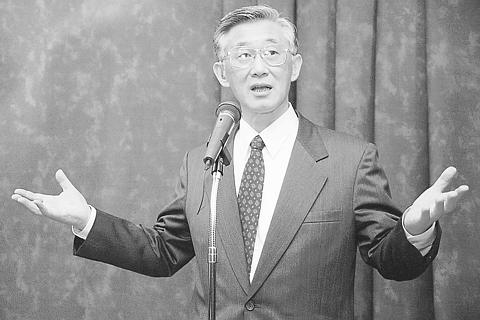
PHOTO: SUNG CHIH-HSIUNG, LIBERTY TIMES
The spiritual tone of campaigning resulted in an impressive election achievement and also turned Chen into something of a moral and spiritual leader among Taiwan's politicians.
But to many middle-aged Taiwanese, especially those with family roots in China, Chen's image is a far cry from the Buddhist practitioner that he and Wang Ching-feng tried to cast themselves as four years ago.
He was a son of Chen Cheng (
Chen earned a PhD in mathematics from New York University and gained extensive experience in government posts. His previous posts were as Control Yuan Speaker, Defense Minister and Minister of Economic Affairs.
While in these posts, he built strong relations with Taiwan's major enterprises, including "the god of business management" Wang Yung-ching (
Wang appointed Chen as headmaster of the Ming-chi Technology College (
And Wang also endorsed Chen during the 1996 election, according to local media reports.
Born into a well-to-do family with a military background (Chen Cheng was a member of Chiang Kai-shek's general staff), Chen had good relations with not only the Chiang family but also other prominent families in Taiwan, including the Lien family.
It has been rumored that Chen's eldest son Chen Yu-ting (
Converting to Buddhism more than 20 years ago brought a major change not only to Chen Li-an but his whole family.
Chen not only changed his image as a "prince" in political circles, but began to use his influence to promote Buddhism.
His Hwa-yu Foundation (
The foundation has long supported the Karma Kagyu sect of Tibetan Buddhism, helping to repair temples in Lhasa and supported the Karmapa Lama, who made a dramatic escape from Tibet to India on Jan. 5 this year.
Chen also became friends with Master Wei Chueh (
Master Wei Chueh yesterday made a remark that was interpreted as a show of support for Lien. Master Hsing Yun four years ago openly supported Chen's bid for president, which, allegedly brought tensions to the master's tight connection with the KMT.
But Chen's remarks on cross-strait relations yesterday made people more curious about his connections with the mainland.
After the 1996 election, Chen announced that he would never run again for a public post. He has since made visits to Nepal, Tibet and China. From 1996 to 1998, Chen visited China at least three times, and met with high officials including Chinese president Jiang Zemin (
"Jiang Zemin's policy is simple: Taiwanese must admit they are Chinese and not resort to separatism. The rest of it is nothing frightful," Chen was quoted as saying in an interview with local media two years ago.
Chen also criticized Lee Teng-hui's "go slow, be patient"(
Apart from close relations with Tibetan Buddhist temples and some officials, Chen has been making efforts in promoting charities in China, especially for the welfare of that country's minorities.
According to Chen, he has been traveling back and forth between Macau in the past two years, negotiating with Chinese scientists to promote charity activities.
Staff from the Hwa-yu Foundation yesterday denied that Chen had spoken to high-ranking Chinese before making his remarks on cross-strait affairs. But after yesterday's statements, Chen has jumped into the campaign not only as a moral leader but as an active participant in cross-strait relations.
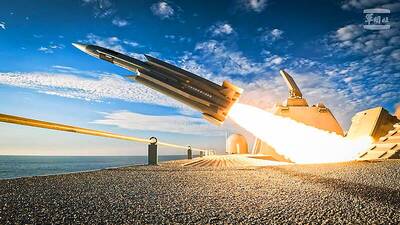
DETERRENCE: With 1,000 indigenous Hsiung Feng II and III missiles and 400 Harpoon missiles, the nation would boast the highest anti-ship missile density in the world With Taiwan wrapping up mass production of Hsiung Feng II and III missiles by December and an influx of Harpoon missiles from the US, Taiwan would have the highest density of anti-ship missiles in the world, a source said yesterday. Taiwan is to wrap up mass production of the indigenous anti-ship missiles by the end of year, as the Chungshan Institute of Science and Technology has been meeting production targets ahead of schedule, a defense official with knowledge of the matter said. Combined with the 400 Harpoon anti-ship missiles Taiwan expects to receive from the US by 2028, the nation would have
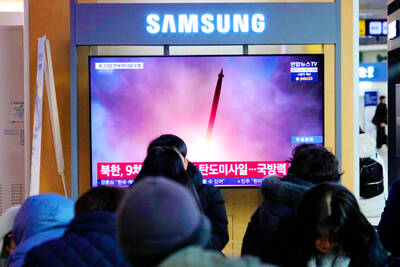
North Korea yesterday fired about 10 ballistic missiles to the sea toward Japan, the South Korean Joint Chiefs of Staff (JCS) said, days after Pyongyang warned of “terrible consequences” over ongoing South Korea-US military drills. Pyongyang recently dashed hopes of a diplomatic thaw with Seoul, Washington’s security ally, describing its latest peace efforts as a “clumsy, deceptive farce.” Seoul’s military detected “around 10 ballistic missiles launched from the Sunan area in North Korea toward the East Sea [Sea of Japan] at around 1:20pm,” JCS said in a statement, referring to South Korea’s name for the body of water. The missiles
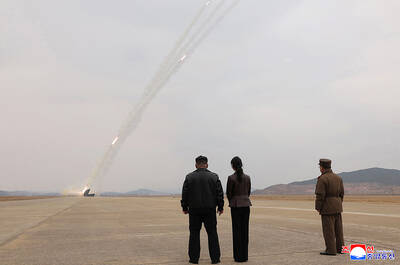
North Korea tested nuclear-capable rocket launchers, state media reported yesterday, a day after Seoul detected the launch of about 10 ballistic missiles. The test comes after South Korean and US forces launched their springtime military drills, due to run until Thursday. North Korean leader Kim Jong-un on Saturday oversaw the testing of the multiple rocket launcher system (MRLS), the Korean Central News Agency (KCNA) said. The test involved 12 600mm-caliber ultra-precision multiple rocket launchers and two artillery companies, it said. Kim said the drill gave Pyongyang’s enemies, within the 420km striking range, a sense of “uneasiness” and “a deep understanding

‘UNWAVERING FRIENDSHIP’: A representative of a Japanese group that co-organized a memorial, said he hopes Japanese never forget Taiwan’s kindness President William Lai (賴清德) yesterday marked the 15th anniversary of the Tohoku earthquake and tsunami, urging continued cooperation between Taiwan and Japan on disaster prevention and humanitarian assistance. Lai wrote on social media that Taiwan and Japan have always helped each other in the aftermath of major disasters. The magnitude 9 earthquake struck northeastern Japan on March 11, 2011, triggering a massive tsunami that claimed more than 19,000 lives, according to data from Japanese authorities. Following the disaster, Taiwan donated more than US$240 million in aid, making it one of the largest contributors of financial assistance to Japan. In addition to cash donations and


 RSS
RSS