


Caught in the middle
Tiwanese investors in China say they often find themselves used as pawns in political issues affecting cross-strait ties. Yesterday, over 100 businessmen were invited by the Straits Exchange Foundation to Hsinchu, the site of a detention facility for overstaying Chinese visitors. As staff reporter William Ide discovered, the delegation was asked to make the appropriate noises in China to speed up the repatriation of the facility's `guests'
In an effort to speed up the repatriation of illegal migrants from China, officials from the Straits Exchange Foundation (SEF) -- Taiwan's semi-official body in charge of cross-strait affairs -- took members of Taiwanese business associations on a tour of a detention center for illegal immigrants in Hsinchu yesterday.
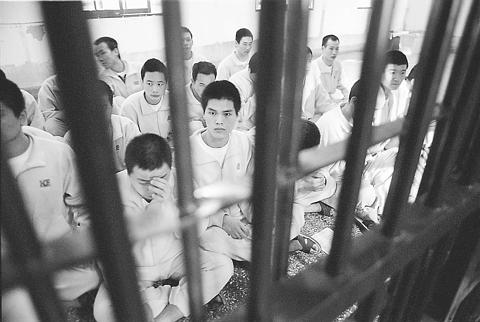
The visit was aimed at prompting Taiwanese businessmen to talk to people in China, in the hope that delays and foot-dragging by Beijing authorities on the repatriation issue will be soon resolved.
The issue of repatriation became particularly thorny after President Lee Teng-hui (
"We hope you will give us your suggestions and opinions ? and that you can help the Chinese authorities understand what the situation is like here," said Lai Hsieh-yi (
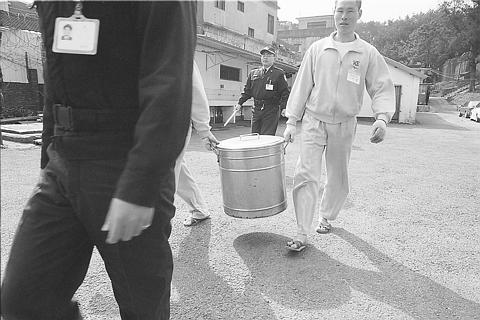
PHOTO: CHEN CHENG-CHANG, TAIPEI TIMES
Although Taiwan authorities are serious about solving the current deadlock, Lai said that at the center, they try to treat the detainees "like family."
"Some like it here so much they hate the idea of leaving," he said, before presenting a slide show on the facility to over 100 visitors who do business in China.
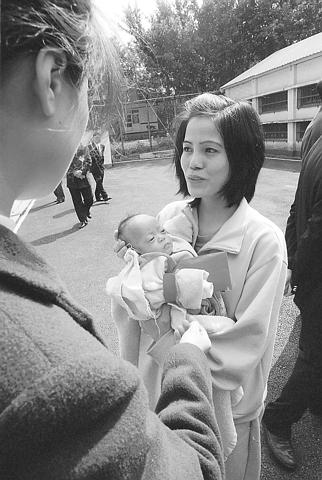
Authorities say that since Taiwan began permitting visits by Chinese relatives of Taiwanese citizens in 1987, around 38,000 illegal overstayers have been detained.
PHOTOS: CHEN CHENG-CHANG, TAIPEI TIMES
It has cost the government about NT$600 million to incarcerate the overstayers.
"China always has some excuses. The waves are too big or the boats are being fixed. It's a strange situation," said Wu Hsin-hsing (
"We hope you can talk with them about the [detainees]," Wu said.
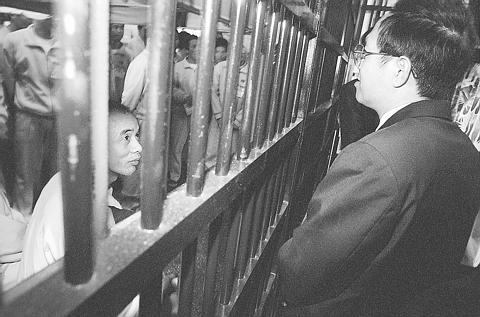
PHOTO: CHEN CHENG-CHANG, TAIPEI TIMES
In the end, a simple task that should take six months, can some times take years, authorities say.
Taiwanese businessmen were given a police escort to the Hsinchu detention center, and Lai pointed out that they had even purchased a new gate to improve the center's look.
The solution to the problem, say cross-strait officials, is to urge the rich network of Taiwan's business associations in China to persuade the authorities to stop stalling.
But as to whether this will solve the problem, some businessmen thought it unlikely.
"I don't know what this will do," said Chen Shih-ling (
"It's hard to say what everyone will do with the message," he added.
While most seemed a little out of place at the center, wondering why they were there, one businessman, stepping out of the new gate at the entrance of the center said, "I hate to leave."
Another was not so enthused.
Hayes Lou (
Too often, Taiwanese investors find themselves in the middle of political issues, he said.
"Both sides focus on small things and forget to look at the bigger picture," Lou said.
Whether it was repatriation or any other issue, Lou said both sides could be a little more flexible when it came to working through problems. Instead, both Taiwan and China are preoccupied with bitter wrangling, he said.
"Both sides are always trying to brainwash us," Lou said. "They just try to attack one another. I just don't get it."

FREEDOM OF NAVIGATION: The UK would continue to reinforce ties with Taiwan ‘in a wide range of areas’ as a part of a ‘strong unofficial relationship,’ a paper said The UK plans to conduct more freedom of navigation operations in the Taiwan Strait and the South China Sea, British Secretary of State for Foreign, Commonwealth and Development Affairs David Lammy told the British House of Commons on Tuesday. British Member of Parliament Desmond Swayne said that the Royal Navy’s HMS Spey had passed through the Taiwan Strait “in pursuit of vital international freedom of navigation in the South China Sea.” Swayne asked Lammy whether he agreed that it was “proper and lawful” to do so, and if the UK would continue to carry out similar operations. Lammy replied “yes” to both questions. The
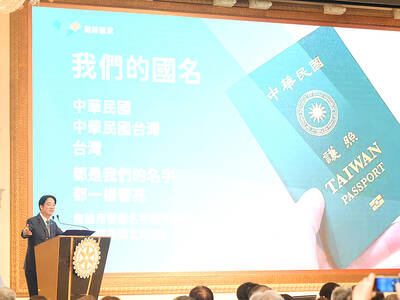
‘OF COURSE A COUNTRY’: The president outlined that Taiwan has all the necessary features of a nation, including citizens, land, government and sovereignty President William Lai (賴清德) discussed the meaning of “nation” during a speech in New Taipei City last night, emphasizing that Taiwan is a country as he condemned China’s misinterpretation of UN Resolution 2758. The speech was the first in a series of 10 that Lai is scheduled to give across Taiwan. It is the responsibility of Taiwanese citizens to stand united to defend their national sovereignty, democracy, liberty, way of life and the future of the next generation, Lai said. This is the most important legacy the people of this era could pass on to future generations, he said. Lai went on to discuss
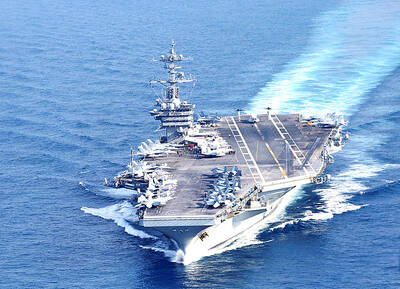
MISSION: The Indo-Pacific region is ‘the priority theater,’ where the task of deterrence extends across the entire region, including Taiwan, the US Pacific Fleet commander said The US Navy’s “mission of deterrence” in the Indo-Pacific theater applies to Taiwan, Pacific Fleet Commander Admiral Stephen Koehler told the South China Sea Conference on Tuesday. The conference, organized by the Center for Strategic and International Studies (CSIS), is an international platform for senior officials and experts from countries with security interests in the region. “The Pacific Fleet’s mission is to deter aggression across the Western Pacific, together with our allies and partners, and to prevail in combat if necessary, Koehler said in the event’s keynote speech. “That mission of deterrence applies regionwide — including the South China Sea and Taiwan,” he
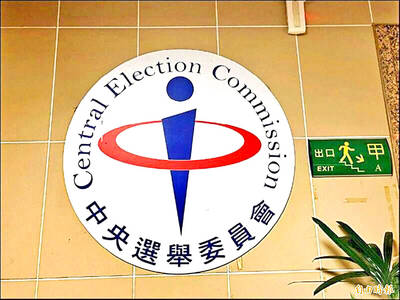
UNPRECEDENTED: In addition to the approved recall motions, cases such as Ma Wen-chun’s in Nantou are still under review, while others lack enough signatures The Central Election Commission (CEC) announced yesterday that a recall vote would take place on July 26, after it approved the first batch of recall motions targeting 24 Chinese Nationalist Party (KMT) lawmakers and Hsinchu Mayor Ann Kao (高虹安). Taiwan is in the midst of an unprecedented wave of mass recall campaigns, following a civil society push that echoed a call made by Democratic Progressive Party (DPP) caucus whip Ker Chien-ming (柯建銘) in January to initiate signature drives aimed at unseating KMT legislators. Under the Civil Servants Election and Recall Act (公職人員選舉罷免法), Taiwanese can initiate a recall of district-elected lawmakers by collecting


 RSS
RSS