


It has been said that the ideal presidential candidate for southern Taiwanese voters should meet three conditions: be a native Taiwanese, have an "international outlook"and be able to work with Beijing.
According to the first requirement, either KMT presidential candidate Lien Chan (
Lien's family comes from Tainan County but Lien himself was born in Xian in China and he is more closely associated with the power centers of Taipei. It is the other Tainan County scion Chen, who was actually born there, who is regarded as the true son of the south.
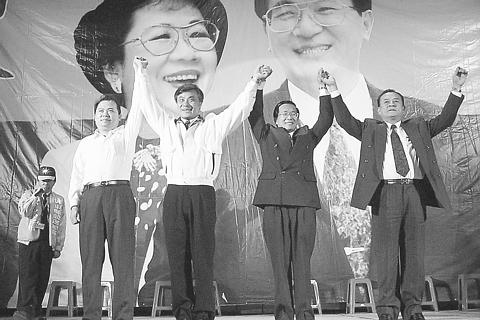
PHOTO: FILE PHOTO, LIBERTY TIMES
Voters in the south have a strong sense of Taiwanese identity and appear frustrated that Soong's popularity remains high in the region. Taiwanese from the south feel that they have been neglected by past administrations and hope to fix things by putting a southern-born man in the presidential office.
Soong has two strikes against him: his mainlander background and his recent financial scandal.
For these reasons, the fight in the south is between Chen and Lien.
China policy hobbles Chen
Chen has a relatively clean image, but there are concerns about his policies toward China and whether he can find enough capable people for his cabinet.
Chen has no high-profile economists or financial advisers in his camp, and many business leaders seem worried that he could bring instability, or even war, with China.
However, the general public regards Chen as a good financial manager because he grew up in a poor family and should know the importance of saving money. National financial stability has precedence over diplomatic stability abroad for many southern voters, according to a straw poll of voters.
In addition, Chen is the only presidential candidate who has proposed specific measures for the south. He has said that if elected, he would merge the municipal Kaohsiung administration with the city's port facility -- one of the largest in the world -- and build an industrial park for marine businesses.
He has also announced plans to build industrial parks for bio-chemical sciences in Pingtung County and high-tech industries in Kaohsiung County.
Even though the DPP has been gradually softening its pro-independence policy, Chen remains unpopular with mainlanders in the south. One Kaohsiung resident, a native of Shandong Province, said that Chen should forget about the mainlander vote.
"There are 100,000 natives of Shandong in Kaohsiung, but not one of them will vote for Chen," she said.
Chen will have to convince everyone, mainlanders and native Taiwanese alike, that he can work with Beijing before he is elected, according to political observers. Chou Shi-hsiung (
KMT background handicaps Lien
Lien, for his part, carries the stigma of old KMT corruption and nepotism, but he is arguably the best-educated and experienced candidate among the three main presidential hopefuls, having served as Minister of Foreign Affairs, premier and currently holding the post of vice president.
According to Gu Chang-yong (
A more likely scenario, according to critics such as Hong Dun-mo (
According to recent survey results, over 90 percent of voters believe the same thing.
But vote-buying could cost the KMT support in other areas.
Lin Long-rei (
Instead, some say Lien will focus attention on undecided voters.
"These hidden votes will be decisive for Lien," says Liu Hsien-tong (
Another potential windfall for Lien is President Lee Teng-hui's (
Chu Wen-shen (朱文森), the KMT's election committee coordinator in Kaohsiung, hinted that if Lee were to offer to step down from the party chairmanship, this would heal the rift in the KMT and bring back old-guard heavyweights such as Hau Pei-tsun (郝柏村) and Hsu Li-rong (許歷農), taking Soong's supporters out from under his nose.
James Soong has Hakka support
As for Soong, critics say his ability to lead and to put together a good government has been compromised by the tainting of his once-clean image by the recent financial scandals.
But at the same time, Soong gained a great deal of respect from people in the south while he was provincial governor.
Lien Chan supporter Lin Long-rei admits Soong was good for Fengshan, and DPP Kaohsiung County Chief Yu Cheng-hsien (
However, despite the fact that Annette Lu (
Tactical voting
Some critics have argued that in 1994, Chen's mayoral victory in Taipei was made possible because the KMT dropped support for their official candidate, Huang Ta-chou (
Moreover, recent speculation in the media has suggested similar tactics could be used against Soong, the front runner who enjoys wide mainlander support. If a Soong victory looked likely, pro-Taiwanese forces in the KMT and DPP could unite voters by dropping either Chen or Lien and supporting the other candidate to defeat him.
Kaohsiung's DPP Mayor, Frank Hsieh (謝長廷), disagrees. He has suggested that such tactical maneuvers could backfire by further solidifying the Soong vote. Hsieh was referring to the 1987 South Korean presidential election, in which Roh Tae Woo beat his two reformist opponents while they squabbled over who should step aside.
"Debating about dropping one man and supporting another only serves to spilt the votes even more," Hsieh said. "Chen and Lien are different candidates, and Chen's supporters should not think about switching their vote to Lien."
And while the KMT may be split, the DPP is far from united. Independent candidate and ex-DPP leader, Hsu Hsin-liang's (
Can Lien win the south?
Chen Ming-tze (陳明智), senior secretary to DPP Kaohsiung County Commissioner Yu Cheng-hsien, thinks that Lien will win in the south -- an incredible admission, since if the DPP loses in Chen's heartland, they have no chance of taking Chen to the presidential office.
In Kaohsiung County, he predicts that out of 860,000 registered voters, 240,000 will vote for Lien, 230,000 for Chen, and 130,000 for Soong.
Politics in Kaohsiung County, as is the case in several places, is divided politically by faction rather than by party -- a custom that has its roots in the martial law era when opposition parties were banned. Rival groups in local elections would wear different-colored clothing to distinguish themselves from each other.
The powerful "white" faction, according to insiders, is behind Lien. Legislative Speaker Wang Jin-ping (
"The KMT's power base and ability to mobilize at the grassroots level will swing the vote in Lien's favor," Chen says.
But the County Commissioner himself disagrees. Yu said he believes Chen will win 41 percent in his territory.
This is a confident prediction since 38 percent is generally thought to be the winning figure.
Lin Long-rui, meanwhile, is a former mayor of Fengshan, where voter trends are believed to be representative of the rest of Kaohsiung County. He supports Lien and expects the candidate to win 45 percent of the vote there, with Chen coming in second with 35 percent.
But in what could be one of the many family splits caused by this election, his uncle -- Lin Yun-yuan (
"Soong is the only man who can clean up the KMT," the senior Lin said.
But Chen could do well in Kaohsiung City on the back of the rising popularity of Frank Hsieh, who says he will begin building the long-awaited Kaohsiung MRT this year.
Residents of Tainan County, meanwhile, led by popular DPP County Commissioner Mark Chen (
On the other hand, George Chang (
Despite Lien's inability to stir up the kind of passionate support President Lee enjoys among southern voters, some KMT supporters still expect him to win in the south.
"The material advantages the KMT holds in capital, manpower and influence will be the decisive factors," one supporter said. "The south loves Chen, but he will have to wait until next time before he will win here."

SILENCING CRITICS: In addition to blocking Taiwan, China aimed to prevent rights activists from speaking out against authoritarian states, a Cabinet department said The Ministry of Foreign Affairs (MOFA) yesterday condemned transnational repression by Beijing after RightsCon, a major digital human rights conference scheduled to be held in Zambia this week, was abruptly canceled due to Chinese pressure over Taiwanese participation. This year’s RightsCon, the world’s largest conference discussing issues “at the intersection of human rights and technology,” was scheduled to take place from tomorrow to Friday in Lusaka, and expected to draw 2,600 in-person attendees from 150 countries, along with 1,100 online participants. However, organizers were forced to cancel the event due to behind-the-scenes pressure from China, the ministry said, expressing its “strongest condemnation”
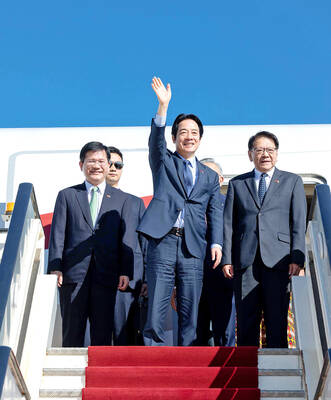
DELAYED BUT DETERMINED: The president’s visit highlights Taiwan’s right to international engagement amid regional pressure from China President Willaim Lai (賴清德) yesterday arrived in Eswatini, more than a week after his planned visit to Taiwan’s sole African ally was suspended because of revoked overflight permits. “The visit, originally scheduled for April 22, was postponed due to unforeseen external factors,” Lai wrote on social media. “After several days of careful arrangements by our diplomatic and national security teams, we successfully arrived today.” Lai said he looked forward to further deepening Taiwan-Eswatini relations through closer cooperation in the economy, agriculture, culture and education, as well as advancing the nation’s international partnerships. The president was initially scheduled to arrive in time to celebrate
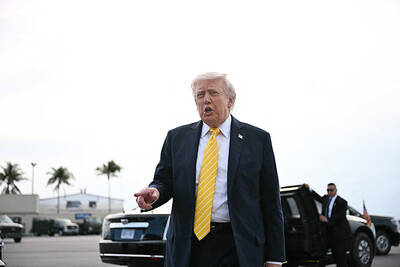
Iran’s Islamic Revolutionary Guard Corp (IRGC) yesterday said the US faced a choice between an “impossible” military operation or a “bad deal” with Tehran, after US President Donald Trump disparaged Iran’s latest peace proposal. Negotiations between the two countries have been deadlocked since a ceasefire came into effect on April 8, with only one round of direct peace talks held so far. Iran’s Tasnim and Fars news agencies reported that Tehran had submitted a 14-point proposal to mediator Pakistan, but Trump was quick to cast doubt on it. “I will soon be reviewing the plan that Iran has just sent to us, but

A group affiliated with indicted Chinese immigrant Xu Chunying (徐春鶯) is to be dissolved for monitoring Chinese immigrants in Taiwan, a source said yesterday. Xu, the secretary-general of the Cross-Strait Marriage and Family Service Alliance, was indicted on March 24 on charges of violating the Anti-Infiltration Act (反滲透法). The alliance “illegally monitored" Chinese immigrants living in Taiwan on behalf of the Chinese Communist Party (CCP) and the Ministry of the Interior is expected to dissolve the organization in the coming days under provisions of the Civil Associations Act (人民團體法), the source said. Xu, who married a Taiwanese in 1993 and became a Republic


 RSS
RSS