


A woman who was named in a sex scandal that forced then-Presidential Office secretary-general John Chang (章孝嚴) to resign from his post in disgrace formally hit back at her accusers yesterday, launching a lawsuit against the China Times Express.
After attending the first court hearing yesterday in a defamation lawsuit she brought against the newspaper, Wang Hsiao-chan (王筱蟬) reiterated that she had never engaged in any sort of extramarital relationship with Chang.
Chang resigned from his post on Dec. 22 last year, a day after the Chinese-language evening newspaper Power News (
Chang admitted that due to "personal factors," he was no longer able to properly fulfill his duties, and that he had therefore requested permission to leave office as soon as possible.
Wang said her colleagues will testify that she was attending a meeting at her company on Nov. 10, when Chang allegedly signed a note in a local five-star hotel promising to divorce his wife.
The note was the prime evidence used by the press in breaking the story.
Wang said she had named the China Times Express in her lawsuit because of an article that appeared in its Dec. 29 edition, in which a photograph of the note in question appeared, with her name on it.
The name had been partially obscured, but the newspaper claimed it had used a computer algorithm to recreate her name and back up its story.
Wang added she had enough evidence to disprove claims of her alleged trysts with Chang, as has been reported in the media.
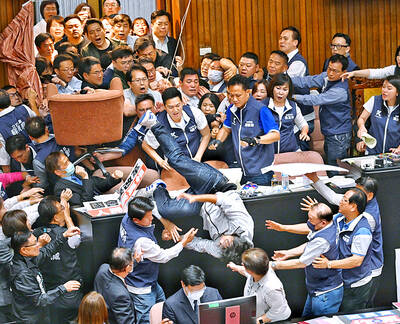
MUSICAL INTERLUDE: During the altercations, KMT Legislator Hsu Chiao-hsin at one point pulled out a flute and started to play the national anthem A massive brawl erupted between governing and opposition lawmakers in the main chamber of the legislature in Taipei yesterday over legislative reforms. President-elect William Lai (賴清德) is to be inaugurated on Monday, but his Democratic Progressive Party (DPP) lost its majority in the legislature and the Chinese Nationalist Party (KMT) has been working with the Taiwan People’s Party (TPP) to promote their mutual ideas. The opposition parties said the legislative reforms would enable better oversight of the Executive Yuan, including a proposal to criminalize officials who are deemed to make false statements in the legislature. “The DPP does not want this to be
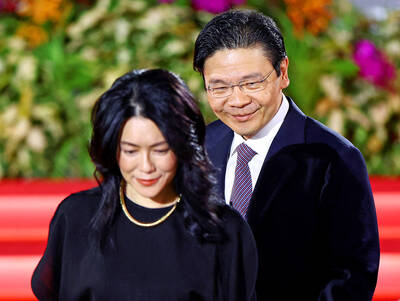
Singapore yesterday swore in Lawrence Wong (黃循財) as the city-state’s new prime minister in a ceremony broadcast live on television after Lee Hsien Loong (李顯龍) stepped down following two decades in office. Wong, formerly deputy prime minister, was inaugurated at the Istana government office shortly after 8pm to become the second person outside the Lee family to lead the nation. “I ... do solemnly swear that I will at all times faithfully discharge my duties as prime minister according to law, and to the best of my knowledge and ability, without fear or favor, affection or ill-will. So help me God,” the

A group of 30 foreign academics yesterday released a statement condemning legislative reforms proposed by opposition lawmakers, saying they are unconstitutional and undermine the objective of good governance. The statement publicized at a news conference in Taipei is cosigned by international academics, journalists and politicians, including former American Institute in Taiwan directors William Stanton and Stephen Young, and Formosan Association for Public Relations president Bob Yang (楊英育). The Chinese Nationalist Party (KMT) and Taiwan People’s Party (TPP) have put forward a set of legislative reforms that would introduce “contempt of legislature” charges, require the president to answer lawmakers’ questions and expand the

PURSUING PEACE: As the new president took office, he reiterated Taiwan’s sovereignty while saying that the nation must cooperate with other democracies President William Lai (賴清德) in his inaugural speech yesterday called on Beijing to acknowledge Taiwan’s government and engage in dialogue with Taipei, saying that both sides are responsible for promoting peace in the Taiwan Strait. “I hope that China will face the reality of the Republic of China’s existence” and “in good faith ... engage in cooperation with the legal government chosen by Taiwan’s people,” Lai said in front of the Presidential Office Building in Taipei. Lai reaffirmed that his government would adhere to former president Tsai Ing-wen’s (蔡英文) policy toward China and work to maintain the “status quo.” Lai advocated for dialogue


 RSS
RSS