


A potential row between the New Party and its presidential candidate, Li Ao (李敖), which could have taken the party out of the presidential race, appeared to be averted yesterday after the party announced that legislator Elmer Fung (馮滬祥) would be Li's running mate.
"Our presidential ticket has been officially decided, and we are now launching our challenge," announced Lee Ching-hua (
The decision ended speculation that Li -- who is not a New Party member himself -- might quit the campaign over what he had said was the party's reluctance to cooperate with him over the issue.
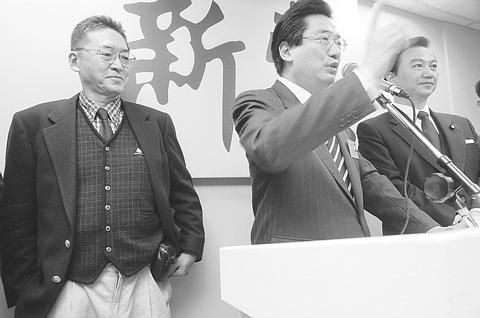
PHOTO: CHEN CHENG-CHANG, TAIPEI TIMES
Li, who has refused to join the New Party despite representing the party in the campaign, initially had three favored choices -- Lee, former DPP spokeswoman Sisy Chen (
While Lee and Chang turned down the offer, the choice of Chen met with strong opposition within the party due to her ideological differences.
After Lee said the New Party might be forced to quit the presidential campaign, Fung offered to be Li's running mate.
Li agreed to accept Fung if the party recommended him officially.
Yesterday, Lee admitted that Fung was in fact on a list of 14 people whom he had proposed to Li as candidates, but that Fung had not been shortlisted.
Li did not explain why he had not considered Fung initially, though he apparently is aware of the controversy surrounding him.
"Fung is a very handsome and knowledgeable man, but he is also much misunderstood -- being suspected of having too close a relationship with the People's Republic of China," Li said.
Fung, who leads a private group promoting unification between Taiwan and China, has made frequent visits to Beijing and has met with senior Communist officials.
Fung explained that the fact he has kept close contact with Beijing does not mean he is "pro-Chinese communists" or supports "hasty unification."
"The Cold War is over and confrontation should be replaced with negotiation," Fung said. Fung, who was a National Assembly deputy before being elected a legislator, worked as secretary to the late President Chiang Ching-kuo (
Fung allegedly played a part in the KMT-sponsored suppression of academic freedom at National Taiwan University in 1973, now known as the "philosophy department incident."
In 1985, Fung also sued a magazine headed by Chen Shui-bian (
Chen was sentenced to one year in jail, and ordered to pay Fung NT$2 million. The verdict, which appeared to mix elements of a criminal trial with civil responsibility, was allegedly the result of political interference.

PROVOCATIVE: Chinese Deputy Ambassador to the UN Sun Lei accused Japan of sending military vessels to deliberately provoke tensions in the Taiwan Strait China denounced remarks by Japan and the EU about the South China Sea at a UN Security Council meeting on Monday, and accused Tokyo of provocative behavior in the Taiwan Strait and planning military expansion. Ayano Kunimitsu, a Japanese vice foreign minister, told the Council meeting on maritime security that Tokyo was seriously concerned about the situation in the East China and South China seas, and reiterated Japan’s opposition to any attempt to change the “status quo” by force, and obstruction of freedom of navigation and overflight. Stavros Lambrinidis, head of the EU delegation to the UN, also highlighted South China Sea

SILENCING CRITICS: In addition to blocking Taiwan, China aimed to prevent rights activists from speaking out against authoritarian states, a Cabinet department said The Ministry of Foreign Affairs (MOFA) yesterday condemned transnational repression by Beijing after RightsCon, a major digital human rights conference scheduled to be held in Zambia this week, was abruptly canceled due to Chinese pressure over Taiwanese participation. This year’s RightsCon, the world’s largest conference discussing issues “at the intersection of human rights and technology,” was scheduled to take place from tomorrow to Friday in Lusaka, and expected to draw 2,600 in-person attendees from 150 countries, along with 1,100 online participants. However, organizers were forced to cancel the event due to behind-the-scenes pressure from China, the ministry said, expressing its “strongest condemnation”
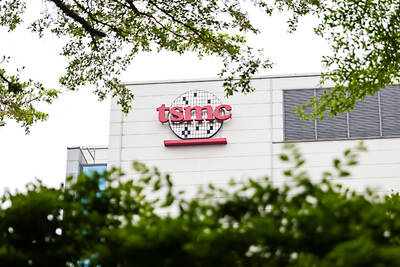
Taiwan Semiconductor Manufacturing Co (TSMC, 台積電), the world’s largest contract chipmaker, said it expects its 2-nanometer (2nm) chip capacity to grow at a compound annual rate of 70 percent from this year to 2028. The projection comes as five fabs begin volume production of 2-nanometer chips this year — two in Hsinchu and three in Kaohsiung — TSMC senior vice president and deputy cochief operating officer Cliff Hou (侯永清) said at the company’s annual technology symposium in Silicon Valley, California, last week. Output in the first year of 2-nanometer production, which began in the fourth quarter of last year, is expected to
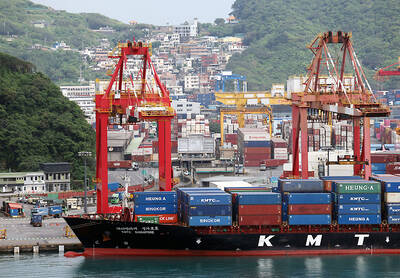
Taiwan’s economy grew far faster than expected in the first quarter, as booming demand for artificial intelligence (AI) applications drove a surge in exports, spilling over into investment and consumption, the Directorate-General of Budget, Accounting and Statistics (DGBAS) said yesterday. GDP growth was 13.69 percent year-on-year during the January-to-March period, beating the DGBAS’ February forecast by 2.23 percentage points and marking the most robust growth in nearly four decades, DGBAS senior official Chiang Hsin-yi (江心怡) told a news conference in Taipei. The result was powered by exports, which remain the backbone of Taiwan’s economy, Chiang said. Outbound shipments jumped 51.12 percent year-on-year to


 RSS
RSS