


Today's by-election in Yunlin County has put the national spotlight on the county -- with attention turned to allegations of vote-buying, a heightened police presence and family denials of gangster connections. But one thing the TV cameras do not show is the subtle -- and powerful -- workings of the local factions that arguably have the biggest influence in the election.
Over the past 28 years in Yunlin County, the results of each county commissioner election have done more than merely bring changes to the local political climate; they have been watermarks of growth and decline in factional influence over the allocation of resources.
In the late 1970s, when Lin Heng-sheng (
In fact, the county commissioner's post has long been coveted as the nexus from which local factions are born and bred. The position wields considerable influence over the allocation of resources and brings together an entire network of local cooperation.
It is no surprise that faction leaders are keenly interested in the outcome of the commissioner race, and not a few of them would like to hold the position themselves.
Huang Chen-yue (
"Each campaign brings out different levels of mobilization. Both legislators and commissioners can form a faction if they want to do so," he said.
According to Chen Ming-tung (3祟?q), a noted local faction specialist at National Taiwan University, local factions are the natural result of elections. But at the same time, elections become the most urgent reason for their existence. "Even if there are neither strong candidates nor attractive positions to offer, faction leaders still have to take part in the elections. Otherwise, their local supporters could switch allegiance because they aren't getting any favors," Chen wrote in a book titled Factional Politics and the Transformation of Taiwan's Political Landscape.
No doubt, local factions consist of interpersonal connections, and such connections are the basis for the development of factions. However, the fundamental groundwork for these interpersonal connections are built on the exchange of favors.
Yunlin County in particular has long suffered from a variety of problems, such as its infertile soil, and has long occupied the position of poorest or second-poorest among Taiwan's 21 counties.
"Yunlin County residents are in extreme fear of remaining poor,(
Some argue that, stemming from this great fear of becoming destitute, vote-buying has taken shape as the most stable mechanism between factions and their major supporters.
Analyst also say that in remote rural districts, because of governmental inefficiency, people would rather believe a "mafia code" than the laws of the government.
Reflecting on the alliances between faction leaders and their supporters -- so-called "boosters" -- Chen described them as "patron-client ties."
"Local residents cast their votes for a specific faction in exchange for some protection or favor. Favors can be invisible -- even just a politician's appearance at a wedding or funeral, for example, which could give a person something to be proud of," Chen said.
To further consolidate coherence within factions, leaders inevitably take advantage of other relationships to expand their territory, such as those based on either ancestral ties, marriage or geographical connections.
Yunlin' County's "Hsu faction" can serve as a good example. Founder Hsu Wen-chi laid the groundwork for his son, Hsu Shu-po's (3舒3? career as a legislator; another of his sons, Hsu Wen-tsun (3?憪?, is a former National Assembly delegate.
Hsu Shu-po says another "Hsu faction" KMT legislator, Tseng Tsai Mei-tso (
In addition to KMT factions, the DPP also shares a portion of the votes in the Yunlin political landscape. Its development has followed a similar path as that of the KMT's.
The famous "DPP Su family," one major faction, is based in Peikang township (
In Yunlin County, the KMT has come to rely on local factions to preserve its control, a phenomenon one party official has said means that qualifications are not the most crucial consideration in winning an election, but whether or not the candidate can obtain recognition from local factions.
Even President Lee Teng-hui (
Facing tough competition from the former county council speaker, the KMT's director of organizational affairs, Johnson Chen (
"The huge overlapping of our local boosters with those of Chang Jung-wei is the biggest challenge for the KMT to overcome," he said.
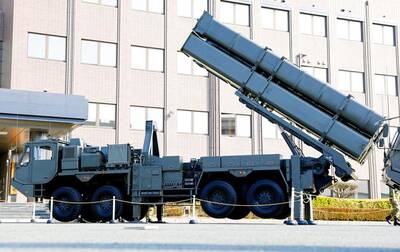
Japan has deployed long-range missiles in a southwestern region near China, the Japanese defense minister said yesterday, at a time when ties with Beijing are at their lowest in recent years. The missiles were installed in Kumamoto in the southern region of Kyushu, as Japan is attempting to shore up its military capacity as China steps up naval activity in the East China Sea. “Standoff defense capabilities enable us to counter the threat of enemy forces attempting to invade our country ... while ensuring the safety of our personnel,” Japanese Minister of Defense Shinjiro Koizumi said. “This is an extremely important initiative for
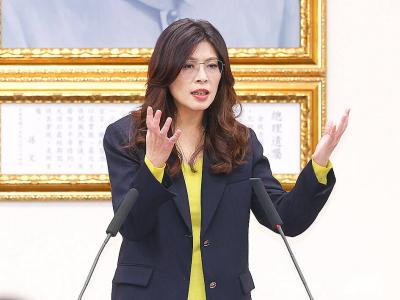
Chinese Nationalist Party (KMT) Chairwoman Cheng Li-wun (鄭麗文) today accepted an invitation from Chinese President Xi Jinping (習近平) to lead a delegation to China next month, saying she hopes to promote the peaceful development of cross-strait relations and bring stability to the Taiwan Strait. “I am grateful and happy to accept this invitation,” Cheng said in a statement from the KMT chairperson’s office. Cheng said she hopes both sides can work together to promote the peaceful development of cross-strait relations, enhance exchange and cooperation, bring stability to the Taiwan Strait and improve people’s livelihoods. At today's news conference, Cheng said any efforts to
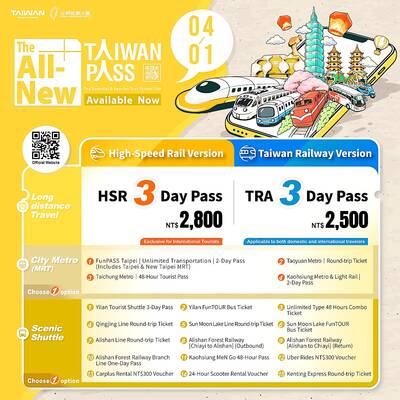
MORE POPULAR: Taiwan Pass sales increased by 59 percent during the first quarter compared with the same period last year, the Tourism Administration said The Tourism Administration yesterday said that it has streamlined the Taiwan Pass, with two versions available for purchase beginning today. The tourism agency has made the pass available to international tourists since 2024, allowing them to access the high-speed rail, Taiwan Railway Corp services, four MRT systems and four Taiwan Tourist Shuttles. Previously, five types of Taiwan Pass were available, but some tourists have said that the offerings were too complicated. The agency said only two types of Taiwan Pass would be available, starting from a three-day pass with the high-speed rail and a three-day pass with Taiwan Railway Corp. The former costs NT$2,800

The nation’s fastest supercomputer, Nano 4 (晶創26), is scheduled to be launched in the third quarter, and would be used to train large language models in finance and national defense sectors, the National Center for High-Performance Computing (NCHC) said. The supercomputer, which would operate at about 86.05 petaflops, is being tested at a new cloud computing center in the Southern Taiwan Science Park in Tainan. The exterior of the server cabinet features chip circuitry patterns overlaid with a map of Taiwan, highlighting the nation’s central position in the semiconductor industry. The center also houses Taiwania 2, Taiwania 3, Forerunner 1 and


 RSS
RSS