


As the dust settles and the work of assessing the extent of the damage from the 921 earthquake begins, an odd -- and telling -- fact is beginning to emerge: among the damaged or collapsed structures in stricken areas, many were public buildings -- including schools, township offices and police stations. What makes this fact stand out, according to civil engineers, is that public buildings must be constructed according to safety guidelines that are one and a half times more stringent than private buildings.
The reason behind this apparent contradiction, according to research conducted by a police officer early this year, is both simple and sinister. What is happening, according to the officer's report, is that local assemblymen, many with backgrounds in locally-based organized crime groups, are heavily involved in public construction projects -- and their methodical siphoning-off of cash from the projects has resulted in poor-quality buildings that, as has been proven, are no match for an earthquake of the magnitude that was felt in central Taiwan.
According to the report, since the 1980s increasing numbers of assembly members with shady backgrounds have been elected as lawmakers or local assemblymen. Many have subsequently taken the reins in the distribution of public construction budgets and in the process receive kickbacks from building contractors. The result: less than sufficient funds for proper construction.
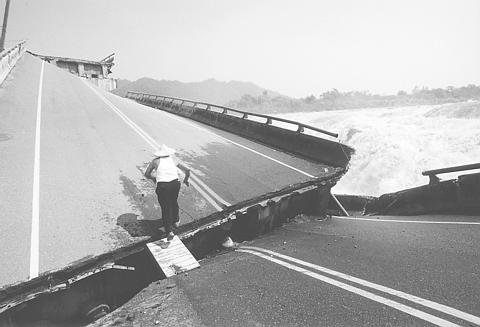
PHOTO: CHUANG CHUNG-LANG, LIBERTY TIMES
The report, which maps out how local gangsters have muscled into the public construction business in recent years in Taiwan, was conducted privately by a former deputy chief of the Taiwan provincial government's vice squad. Although no specific names of local officials are mentioned, it does describe some of the basic models for their intervention in the public construction process. Because he is still on active duty as an officer, he asked to remain unnamed.
`Local construction expenses'
Those familiar with local politics would agree it is an open secret that a tacit agreement between local governments and local assemblies exists that allows assembly members to siphon off funds from government budgets under review at the local level. The mechanism, called "local construction expenses" (
Within the quota, the assembly member can "assign" which road to be built by which contractor, according to one county commissioner's aide who requested anonymity.
"We have to make these concessions in return for getting our budgets passed by the assembly," he said, adding that such quotas exist not only in public construction, but in other areas of government expenditure such as hosting exhibitions.
To put the problem of local assemblies in perspective, it is important to understand their distribution. According to the Ministry of the Interior, there are 4,570 elected local assemblymen -- including village, township and county delegates. This means there is one local assemblyman elected for approximately every 20,000 people on the island.
In comparison, there are 63,807 local assemblymen in Japan, according to the Japanese Ministry of Home Affairs. The proportion is 50,000 Japanese to one local delegate -- a much smaller ratio than found in Taiwan.
The local government system containing three levels of public election -- counties, towns and villages -- can be traced to the time when Taiwan was a Japanese colony, DPP National Assembly member Chung Jia-bin (鍾佳濱) said.
Chung said that the KMT, which ruled the island as an outside power 50 years ago, also used techniques similar to those of the Japanese. For decades, local assemblymen have been the party's means for exerting influence.
Chung said this style of government has become ingrained in the electorate in Taiwan to the extent that assemblymen are elected for their personal connections rather than for any compelling political reasons. Thus, a person can be elected without having any concrete political opinions or platform; even a sense of political morality has never been of great importance in these elections.
The problem of institutional corruption
For reasons of economy and efficiency, the KMT and DPP agreed during the 1996 bilateral National Development Conference to do away with the election of mayors and assemblymen in towns and villages.
This also laid the foundation for the downsizing of the provincial government. But a final agreement to phase out these local elections ended up being crowded out by constitution amendments made by the National Assembly in 1997 amid fierce debate over provincial downsizing.
This, says Chung, was also a sensitive constitutional issue with a huge impact on Taiwan's political life.
In addition to the institutional inefficiency of maintaining so many assemblymen, academic research indicates that the vast corruption in local assemblies is actually a result of the electoral system itself, which allows candidates from dubious backgrounds to be easily elected.
Taiwan is alone in the world with its system of "single non-transferable votes" (
Such a system has resulted in competition within each political party instead of between political parties, said Lin. The trick to win a seat is to gain the support of a small group of voters -- since only a small number of votes are needed to be elected.
"Vote-buying -- which serves specific interests and causes clashes among local factions -- has become common in elections on Taiwan," he said.
Consequently, he added, it's not difficult to understand why many assemblymen, after spending a lot of money during the election, are eager to bid for public construction projects.
Tunghai University political scientist Wang Yeh-li (
Other professionals at the local level, such as teachers and civil servants, are restricted in their ability to take leaves of absence to run for elections and become assembly members, Wang said. This leaves the business community as the main source for potential candidates.
"The pool of local people to run for an assembly seat is limited in Taiwan," he said.
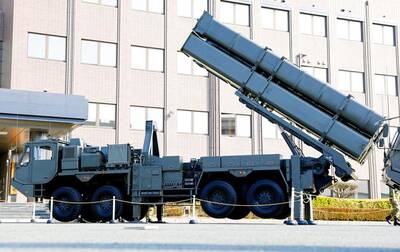
Japan has deployed long-range missiles in a southwestern region near China, the Japanese defense minister said yesterday, at a time when ties with Beijing are at their lowest in recent years. The missiles were installed in Kumamoto in the southern region of Kyushu, as Japan is attempting to shore up its military capacity as China steps up naval activity in the East China Sea. “Standoff defense capabilities enable us to counter the threat of enemy forces attempting to invade our country ... while ensuring the safety of our personnel,” Japanese Minister of Defense Shinjiro Koizumi said. “This is an extremely important initiative for
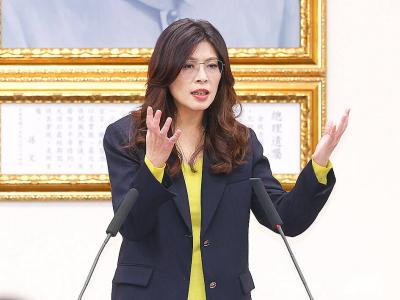
Chinese Nationalist Party (KMT) Chairwoman Cheng Li-wun (鄭麗文) today accepted an invitation from Chinese President Xi Jinping (習近平) to lead a delegation to China next month, saying she hopes to promote the peaceful development of cross-strait relations and bring stability to the Taiwan Strait. “I am grateful and happy to accept this invitation,” Cheng said in a statement from the KMT chairperson’s office. Cheng said she hopes both sides can work together to promote the peaceful development of cross-strait relations, enhance exchange and cooperation, bring stability to the Taiwan Strait and improve people’s livelihoods. At today's news conference, Cheng said any efforts to
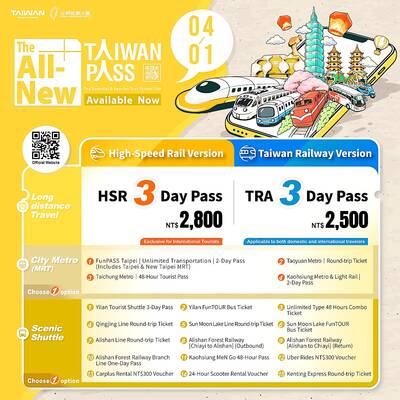
MORE POPULAR: Taiwan Pass sales increased by 59 percent during the first quarter compared with the same period last year, the Tourism Administration said The Tourism Administration yesterday said that it has streamlined the Taiwan Pass, with two versions available for purchase beginning today. The tourism agency has made the pass available to international tourists since 2024, allowing them to access the high-speed rail, Taiwan Railway Corp services, four MRT systems and four Taiwan Tourist Shuttles. Previously, five types of Taiwan Pass were available, but some tourists have said that the offerings were too complicated. The agency said only two types of Taiwan Pass would be available, starting from a three-day pass with the high-speed rail and a three-day pass with Taiwan Railway Corp. The former costs NT$2,800

The nation’s fastest supercomputer, Nano 4 (晶創26), is scheduled to be launched in the third quarter, and would be used to train large language models in finance and national defense sectors, the National Center for High-Performance Computing (NCHC) said. The supercomputer, which would operate at about 86.05 petaflops, is being tested at a new cloud computing center in the Southern Taiwan Science Park in Tainan. The exterior of the server cabinet features chip circuitry patterns overlaid with a map of Taiwan, highlighting the nation’s central position in the semiconductor industry. The center also houses Taiwania 2, Taiwania 3, Forerunner 1 and


 RSS
RSS