


Thirty years after his death, Yin Hai-kuang (殷海光), Taiwan's frontier liberalist, still plays an influential role in the island's political and academic arena. But it never occurred to the scholar that his liberal thoughts would have such a great impact on the island's intellectuals, his wife recalled yesterday.
"In 20 years, there will be no one reading my books," Hsia Chun-lu (夏君璐), Yin's 72-year-old wife, quoted him as saying in an interview with the Taipei Times after she attended a two-day seminar yesterday held at the Academia Sinica in memory of Yin. "He was not perceived as a mainstream thinker when alive, so it also surprises me that his political views and academic perspectives have been given more and more attention over the last few years," Hsia said.
Yin, then a philosophy professor at National Taiwan University, was forced to leave the university in 1967 as a result of his acute criticism of the KMT government, which was published in the island's frontier opposition publication, Free China Biweekly (自由中國半月刊).
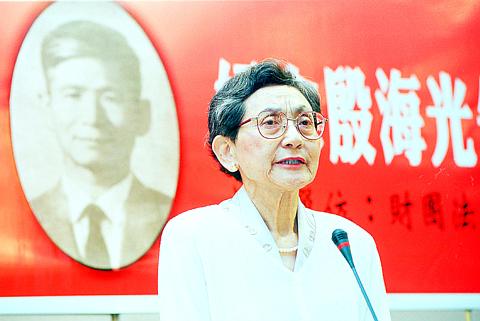
PHOTO: CHEN CHENG-CHANG, TAIPEI TIMES
In the 1950s and 1960s, when criticism against the government often led to threats of political suppression, Yin and other contemporary critics, such as Lei Chen (
Up to this day, their perspectives on freedom, democracy and social justice are still valued by intellectuals and have become mainstream views.
"Though not tolerable to the authorities, Yin's acute views on social issues have become golden rules widely upheld by the island's intellectuals," said Ku Chung-hwa (顧忠華), a professor at National Chengchi University and executive-general of the Yin Hai-kung Foundation (殷海光文教基金會).
Yin, who at the same time played roles as scholar and political commentator, had strongly advocated liberal values and enlightened many of his students, who subsequently became the backbone of the island's intellectual elite.
However, Yin's anti-government remarks exposed him and his family to constant fears that he would be jailed at any moment.
"We have only one child, and that was intended to save me from financial difficulties in case he was arrested," Hsai said. "I was no different from any other woman who wants nothing but a peaceful life with their family. But the only reason I gave him my wholehearted support is that I believe in what he was doing."
Because of his strong opposition to communism, Yin was once a devotee of the KMT government, which fled to Taiwan in 1949 after a civil war with the Chinese Communist Party. However, the liberalist became disillusioned as he found the KMT government, then ruled by Chiang Kai-shek (
In retrospect, Hsia said she could recall Yin's strong resentment toward the authoritarian style of the KMT government.
"He once tore my daughter's homework into pieces because the content was filled with KMT propaganda. And that was just the typical output of education at that time," she said. "His resentment against the KMT was such that he once said he wanted me and our daughter to leave the country as soon as he died."
Three decades since Yin's death, Taiwan has undergone drastic socio-political changes. Chief among them was probably the lifting of martial law in 1987 and the reversion to effective rule under the Constitution.
Yin's political philosophy has become synonymous with the island's liberal movement in the past few decades, and his thoughts are particularly valued given the political context he was living in.
"As the island is now in a situation where multiple values are tolerated, intellectuals today have played an important role in the policy-making process," Ku said.
"However, at the time of authoritarian rule, Yin's outspokenness and his active participation in politics was something unusual, and was thus given relatively high regard," Ku said.
On the first day of the seminar yesterday, a number of the island's scholars held lively discussions on newly published papers on liberalism.
The seminar is scheduled to finish this afternoon.
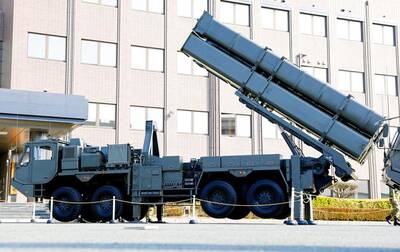
Japan has deployed long-range missiles in a southwestern region near China, the Japanese defense minister said yesterday, at a time when ties with Beijing are at their lowest in recent years. The missiles were installed in Kumamoto in the southern region of Kyushu, as Japan is attempting to shore up its military capacity as China steps up naval activity in the East China Sea. “Standoff defense capabilities enable us to counter the threat of enemy forces attempting to invade our country ... while ensuring the safety of our personnel,” Japanese Minister of Defense Shinjiro Koizumi said. “This is an extremely important initiative for
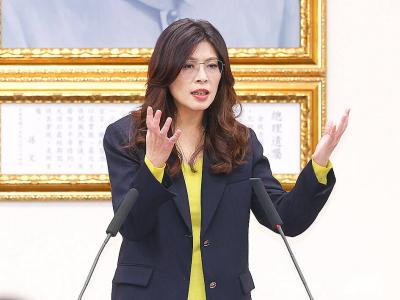
Chinese Nationalist Party (KMT) Chairwoman Cheng Li-wun (鄭麗文) today accepted an invitation from Chinese President Xi Jinping (習近平) to lead a delegation to China next month, saying she hopes to promote the peaceful development of cross-strait relations and bring stability to the Taiwan Strait. “I am grateful and happy to accept this invitation,” Cheng said in a statement from the KMT chairperson’s office. Cheng said she hopes both sides can work together to promote the peaceful development of cross-strait relations, enhance exchange and cooperation, bring stability to the Taiwan Strait and improve people’s livelihoods. At today's news conference, Cheng said any efforts to
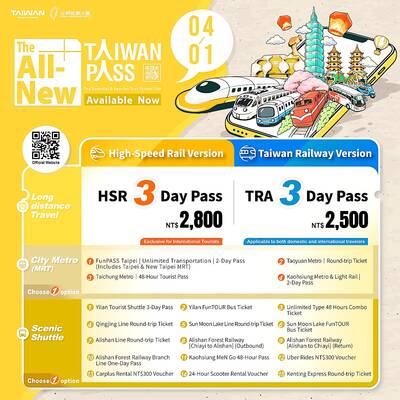
MORE POPULAR: Taiwan Pass sales increased by 59 percent during the first quarter compared with the same period last year, the Tourism Administration said The Tourism Administration yesterday said that it has streamlined the Taiwan Pass, with two versions available for purchase beginning today. The tourism agency has made the pass available to international tourists since 2024, allowing them to access the high-speed rail, Taiwan Railway Corp services, four MRT systems and four Taiwan Tourist Shuttles. Previously, five types of Taiwan Pass were available, but some tourists have said that the offerings were too complicated. The agency said only two types of Taiwan Pass would be available, starting from a three-day pass with the high-speed rail and a three-day pass with Taiwan Railway Corp. The former costs NT$2,800

The nation’s fastest supercomputer, Nano 4 (晶創26), is scheduled to be launched in the third quarter, and would be used to train large language models in finance and national defense sectors, the National Center for High-Performance Computing (NCHC) said. The supercomputer, which would operate at about 86.05 petaflops, is being tested at a new cloud computing center in the Southern Taiwan Science Park in Tainan. The exterior of the server cabinet features chip circuitry patterns overlaid with a map of Taiwan, highlighting the nation’s central position in the semiconductor industry. The center also houses Taiwania 2, Taiwania 3, Forerunner 1 and


 RSS
RSS