


Laptop chipmakers such as Intel and AMD should be worried about their new rival Nvidia, experts say, after the US hardware titan announced on June 1 a push into the personal computer market.
But despite Nvidia boss Jensen Huang’s assertion that homes will soon contain AI supercomputers, the race is still on to develop an ubiquitous, one-size-fits-all intelligent device.
Huang vowed to “reinvent the PC” with Nvidia’s powerful chip for Windows machines, calling it “as big of a deal as the reinvention of the phone into what we now know as the smartphone.”
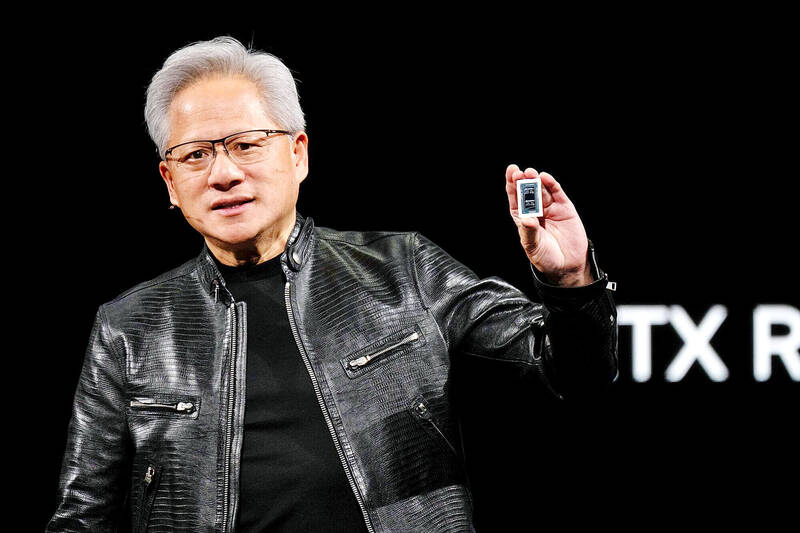
Photo: Bloomberg 照片:彭博社
Su Lian-jye, a chief analyst at Omdia, told AFP that “legacy” laptop chip makers were now facing a challenge from Nvidia laptops optimised for AI.
“Both Intel and AMD are ready hardware-wise, but the question is software — and creating the right type of device that can match consumer expectations,” he said.
Nvidia is the world’s most valuable company thanks to a construction boom of AI data centres packed with its advanced chips.
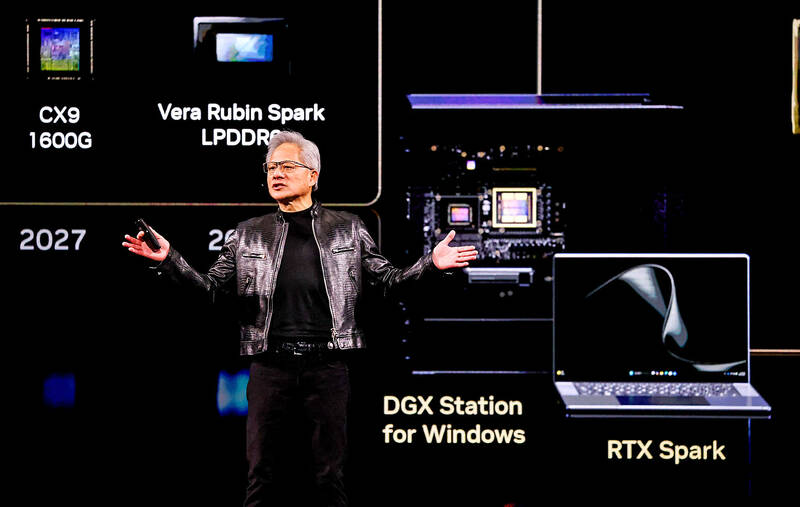
Photo: AFP 照片:法新社
Xiao Zhibin, CEO of the US company ZFlow AI, said in Taipei — where major industry show Computex takes place this week — that Nvidia bringing its AI prowess to laptops was a “game changer.”
“There will be more people working on AI agents,” and then “once you have developers, then you have more applications, and then people will buy the AI PC as a consumer,” he said.
Others gave similar assessments, although Al Benzoni of Aperion Technologies said he would wait before buying one of the new Nvidia-powered Windows PCs, available later this year.
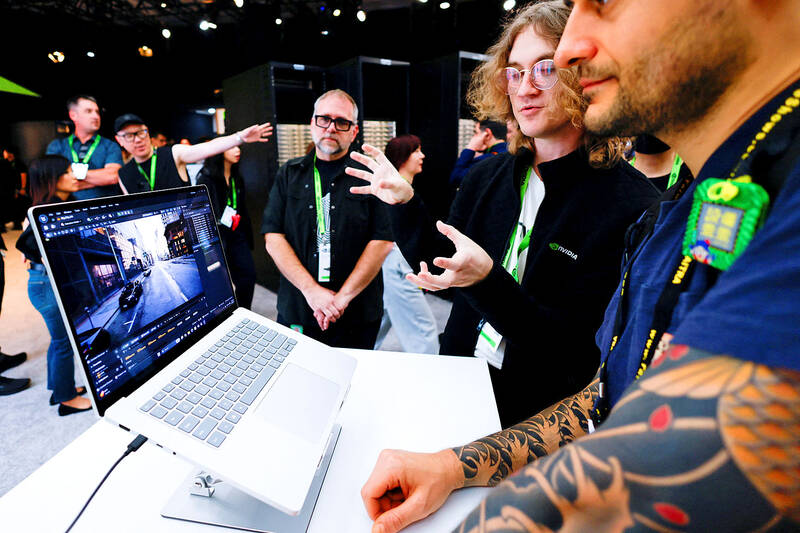
Photo: Reuters 照片:路透
“I wouldn’t want to be the first guinea pig,” as “it’s not so easy to have everything just smooth” like Apple has managed to do with its laptops.
NEXT BIG THING
Creating the world’s next big gadget — whether static, handheld or wearable like earbuds, pendants and brooches — is something of a holy grail for AI companies.
“It could be PC, but we are also looking at AI glasses,” although neither can be seen as a killer device in the industry at this point, Omdia’s Su said.
“There was a point where even an AI PC was not a convincing pitch,” but the sudden popularity of agent tool OpenClaw has changed that, he added.
Some companies are also betting on smartphones, although attempts to ditch apps for agentic AI have so far run into problems with computing power and gaining permission to access on-device tools run by different firms.
And ChatGPT maker OpenAI is working with renowned industrial designer Jony Ive on a mystery device for interacting with AI, expected to be ready by next year.
Glasses are the top pick for tech influencer Selina Liu, whose “gptsavyy” Instagram account has more than 300,000 followers.
“Because it’s really close to what we see and how we talk, how we interact with people,” she reasoned.
In Taipei, Qualcomm boss Cristiano Amon also weighed in on the topic on June 1.
“At home, you’re going to have agents. They’re going to basically update everyone on your activity and your schedule — all of the things that you need to do at work,” he said.
“Today’s devices were not designed for those experiences,” Amon said.
But what kind of gadget people will use isn’t too important, he added, because “the agent isn’t tied to the device.”
“It actually moves with the user and is there with the user, regardless of the device that you have.”
(AFP)
專家表示,美國科技巨擘輝達(Nvidia)6月1日宣布進軍個人電腦市場後,筆記型電腦晶片製造商英特爾(Intel)與超微(Advanced Micro Devices, AMD)恐怕得要開始擔心這個新對手了。
不過,儘管輝達執行長黃仁勳宣稱未來每個家庭都將會有AI超級電腦,但業界距離打造出一款真正普及且通用的智慧裝置,仍有一段距離。
黃仁勳表示,輝達將透過專為Windows裝置打造的強大晶片「重新定義個人電腦(PC)」,並形容其重要性「就像手機進化成今日智慧型手機一樣具有革命性」。
市場研究機構Omdia首席分析師蘇廉節接受法新社訪問時表示,傳統筆電晶片大廠如今正面臨來自輝達AI筆電的挑戰。
「Intel與AMD在硬體方面其實都已準備就緒,問題在於軟體,以及如何打造符合消費者期待的裝置」,他說。
憑藉AI資料中心建設熱潮,以及搭載輝達高階晶片之伺服器的大量需求,輝達已成為全球市值最高的企業。
美國AI公司ZFlow AI執行長肖志斌上週在台北國際電腦展期間表示,輝達將其AI實力帶入筆記型電腦市場,將是一項「改變遊戲規則」的發展。
「未來會有更多人投入AI代理人(AI agents)的開發」,他表示,「當開發者增加後,應用程式也會跟著增加,而消費者最終就會購買AI PC」。
其他業界人士也有類似看法。不過,Aperion Technologies的艾爾.班佐尼表示,他會先觀望,不會急著購買今年稍晚推出的新款輝達Windows AI PC。
「我不想成為第一隻白老鼠」,他說,因為要像Apple筆電那樣達到所有功能都流暢無縫運作,其實並不容易。
下一個科技革命性產品?
對AI產業而言,打造下一個改變世界的裝置——無論是桌上型設備、手持裝置,或是耳機、項鍊、胸針等穿戴式產品——幾乎可說是業界的「聖杯」。
蘇聯傑表示:「有可能是PC,但我們也在觀察AI眼鏡。」然而,目前沒有任何產品能被視為產業公認的殺手級裝置。 蘇廉節表示:「有可能是AI,但我們也在觀察AI眼鏡」。然而,目前沒有任何產品能被視為產業公認的殺手級裝置(killer device)。
他指出:「曾有一段時間,就連AI PC這個概念都沒有說服力」。但AI代理工具 OpenClaw 的爆紅突改變了這種情況。
一些企業則押注在智慧型手機上。不過,以AI代理人取代App的嘗試,目前仍受限於運算能力,以及取得不同公司裝置權限的問題。
另一方面,OpenAI正與知名工業設計師強尼.艾夫合作開發一款神祕AI裝置,預計最快明年問世。
科技內容創作者Selina Liu則認為,AI眼鏡最有機會成為下一波主流裝置。她經營的 Instagram 帳號「gptsavyy」擁有超過30萬名追蹤者。
「因為它最貼近我們看東西、說話以及與他人互動的方式」,她解釋道。
同樣在台北,高通執行長克里斯蒂亞諾.艾蒙,6月1日也談到了未來AI裝置的發展方向。
他表示:「未來家裡會有AI代理人,它們基本上會隨時向你更新行程安排、活動狀況,以及所有工作上需要處理的事情」。
艾蒙指出,現有的裝置其實並非為這類體驗而設計。
不過,他認為最終人們使用什麼裝置並不是最重要的問題,因為「AI代理人並不依附於特定裝置」。
「它會跟著使用者移動,無論你手上使用的是哪一種裝置,它都會陪伴著你」,他說。
(台北時報林俐凱編譯)

In 2023, an 80-year-old woman in Taipei suffocated her paralyzed son after over five decades of caring for him. Turning herself in immediately, she confessed that worsening health and anxiety about who would care for him after her death had driven her to act. The court, acknowledging her difficult situation, sentenced her to two-and-a-half years in prison while recommending a presidential pardon. This rare judicial recommendation drew a complicated social response. Supporters argue that the mother’s half-century of caregiving renders her deserving of compassion instead of incarceration, believing that allowing her to live her final years in dignity and

A: Over 130,000 college graduates are about to enter the workforce upon graduation. B: According to a survey, the top 10 most desired careers among Taiwanese are: independent content creator, civil servant, information engineer, financial professional, medical worker, content planner, flight attendant, news anchor, designer and fitness trainer. A: What are the “dream jobs” for young Gen Zers? B: The top three for men are YouTuber, pro gamer and engineer. For women, they are writer, social media editor and YouTuber. A: Every profession has its champion. Just look at Taiwanese fire dancer Yang Li-wei — who was on fire

A: While AI is reshaping the world, “Money Talks News” revealed seven career fields that are “AI-proof.” First is the healthcare field, like nursing jobs, personal care aides, and social work specialists. B: This type of job is indeed in high demand. So what’s next? A: Up next are skill-based positions, like electricians, mechanics, and construction workers. Then there’s the field of education, like teachers, tutors, and education specialists. Fourth is the mental health field, like jobs in counseling, therapy, and social work. B: I didn’t expect teaching to be safe from AI. What else is

India has launched one of the world’s largest social policy experiments by transferring cash directly to housewives in recognition of their unpaid domestic labor. Across 12 states, an estimated 118 million adult women regularly receive 1,000 to 2,500 rupees (NT$348 to NT$871), equal to about 5% to 12% of household income. Surveys show Indian women devote nearly five hours per day to household tasks — over 7.6 times men’s contribution. This imbalance is a major factor in India’s low female labor force participation. Though modest in amount, the transfers symbolically acknowledge the hidden labor supporting families and society.


 RSS
RSS