


Why mastering ‘drift’ makes or breaks a shuttler
For elite athletes to perform at their highest levels, they need to adapt.
Runners must to learn how to sprint on wet track, surfers have to deal with uncertain currents, and tennis players have to learn how to switch between grass, clay and hardcourts.
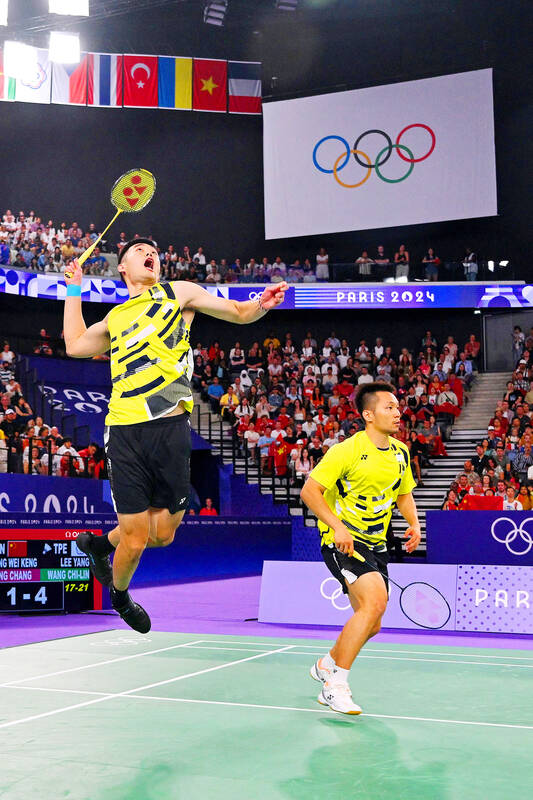
照片:美聯社 照片:法新社
The challenge for badminton players is learning how to predict the effect of wind, or “drift,” on the shuttlecock.
The shuttlecock, or birdie, with its open cone of goose feathers embedded in a rounded cork base, usually weighs about five grams and has feathers shorter than 70mm.
Hundreds of tiny variables can affect how true it flies, from fans opening the doors to arenas, to the body temperatures of spectators and the air-conditioning and size of the hall.
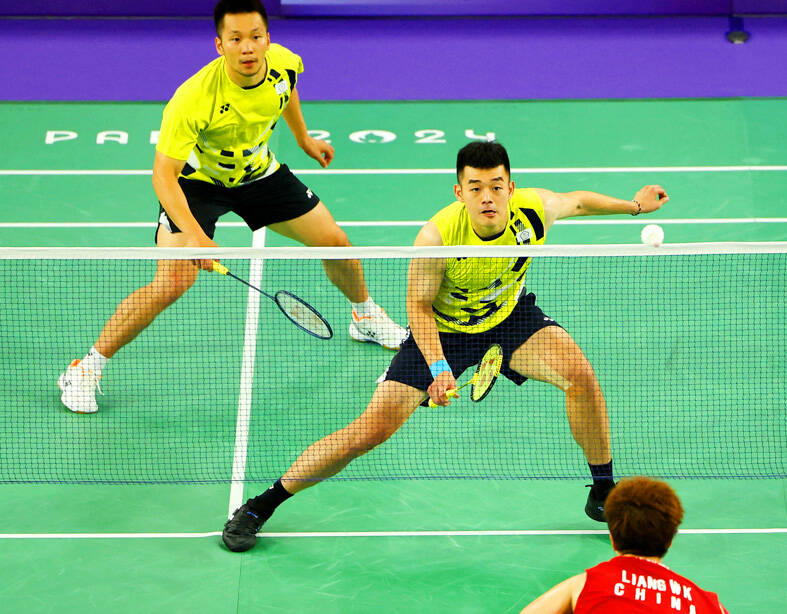
Photo: Reuters 照片:路透
If the wind is behind a player, they have to “lift” the shuttlecock higher so it does not go out of the court.
“Faster” wind can also increase the speed generated by a smash, which can reach as high as 500km per hour.
A hall the size of the Port de La Chapelle in Paris would always have a certain amount of drift, said Ian Wright, the Badminton World Federation’s director of development, who oversees the sport’s science and research division.
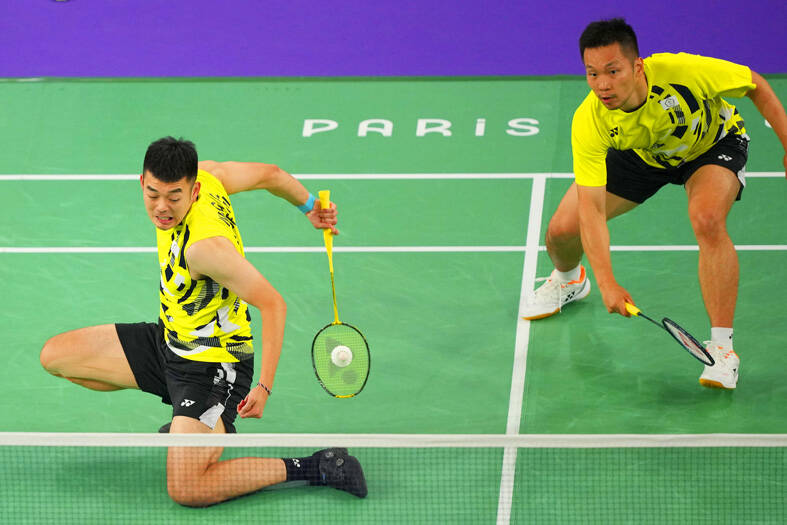
Photo: AP 照片:美聯社
“When you start at the beginning of the day, normally the temperature of the hall will be slightly lower, so the shuttles fly slightly slower. As it warms up when you’ve got a full audience, the shuttle will get slightly quicker,” he added.
“But elite players adapt to it very, very quickly and it impacts tactics from one side to the other.”
Tall and small have tactical advantages
Two-time world champion Akane Yamaguchi of Japan stands at just over 152.4 cm and has faced India’s PV Sindhu, who won silver at the Rio Olympics and has over 22.9 cm on her, on court 25 times in their careers.
Sindhu has won 14 times and Yamaguchi has won 11 times.
Elite shuttlers come in all shapes and sizes and there can be an advantage whether you are taller or shorter.
Being shorter makes it easier to change direction and stay agile but harder to return a well-angled smash. If you are taller, it is easier to hit a forehand smash on the shuttlecock at a sharper angle but harder to move around.
Speed is not necessarily a factor in terms of smashes from a height.
A study on the jump smash by researchers at Loughborough University showed a “non-significant correlation” between shuttlecock speed and jump height. Eighteen male badminton players of regional, national and international standards participated in the study, each performing a series of forehand jump smashes.
“Akane (Yamaguchi) might have to take an extra step but she’s great on defense and can bounce right up,” said Charmaine Reid, who competed at the Athens Games in 2004 and now commentates on the sport.
Yamaguchi, who lost in the quarter-finals in Paris, is “more flexible than taller players,” Reid said.
Paris men’s singles Olympic champion Viktor Axelsen of Denmark towers over most of his opponents at about 6 feet 4 inches. It is no wonder that with a roughly 27-inch (68.6 cm) badminton racket in his hand he can leap into the air to make one of his signature smashes that few players in the world can return successfully.
“He’s tall, hits very, very good angles from the back of the court so it’s difficult to defend against them,” said Wright. He said Axelsen could be smashing from roughly 320 cm (10 feet and 6 inches) off the ground.
“But when Viktor plays someone (shorter) with a little bit of deception, it’s harder for him to turn quickly because he’s tall.”
(Reuters)
為何掌握「飄移」攸關羽球運動員成敗?
精英運動員需要做出適應,才能夠發揮最高水準。
跑者必須學習在潮濕的跑道上衝刺,衝浪手必須應對不確定的水流,網球選手必須學習在草地、紅土和硬地之間切換。
羽毛球運動員面臨的挑戰,是學習預測風(即「飄移」)對羽球的影響。
羽毛球(英文稱shuttlecock或birdie)是以鵝毛排列成底部開放的圓錐形嵌入圓形軟木座,一般重約5公克,羽毛短於70公釐。
數以百計的微小變數會影響羽球的實際飛行——從球迷打開場館大門,到觀眾的體溫,以及球場的空調與大小。
如果是順風,球員必須將羽球「挑」得更高,才不會飛出界。
更快的風速還可提高殺球的速度。殺球的球速最高可達每小時500公里。
負責羽球運動科學研究部門的世界羽球聯盟發展總監伊恩.賴特表示,像巴黎拉沙佩勒門體育館那麼大的場館,總會產生一定程度的飄移。
「一天剛開始的時候,場館的溫度通常會稍微低一點,所以羽球的飛行速度會慢一些。觀眾滿座時,就會暖起來,羽球的飛行速度也就會變快一點」,他補充說。
「但是精英球員非常快就能適應,這對球場兩邊的戰術都會產生影響」。
高矮各有戰術優勢
兩屆世錦賽冠軍日本選手山口茜身高略高於152.4公分(5英呎),里約奧運銀牌得主印度選手辛度,比山口茜高超過22.9公分(9英吋),山口茜與辛度在職業生涯中曾交手25次。
辛度贏了14次,山口茜贏11次。
精英羽球運動員有各種體型,無論是高是矮,都有優勢。
身材矮小可以更輕易轉向並能維持敏捷,但對於角度好的殺球,則較難回擊。如果你個子較高,則較能以更尖銳的角度正手殺球,但較難移動身體。
對高空殺球而言,速度不一定是要素。
英國羅浮堡大學研究人員對跳殺進行的一項研究顯示,羽球速度與跳躍高度之間「並無顯著相關性」。18名地區、國家與國際級的男子羽球運動員參與了這項研究,每個人都做了一連串正手跳殺。
「(山口)茜可能需要多走一步,但她的防守非常出色,而且可以迅速彈跳起來」,2004年雅典奧運選手、現為球評的查梅因.莉德說道。
莉德說,在巴黎奧運八強賽中失利的山口「比高個子球員更靈活」。
巴黎奧運男單冠軍、丹麥選手安賽龍的身高約為193公分(6呎4吋),比大多數對手都高。難怪他手拿一支68.6公分(約27吋)的羽球拍,可以跳到空中擊出他的招牌殺球,世界上很少有球員能夠成功回擊。
「他身材高大,從後場擊球的角度非常、非常好,因此很難防守他」,賴特說。他說安賽龍可在離地面大約320公分(10呎6吋)的空中殺球。
「但若安賽龍的對手較矮,並使用欺敵戰術時,安賽龍就很難快速轉身,因為他很高」。
(台北時報林俐凱編譯)

A: Which TV drama series have been global hits so far this year? B: The US drama “Stranger Things 5,” South Korean drama “Can This Love Be Translated?” and Chinese megahit “Pursuit of Jade” are all popular lately. A: Isn’t “Pursuit of Jade” the costume idol drama about the romance between a charming marquis and a pig-slaughterer? Actor Zhang Linghe and actress Tian Xiwei are both so attractive. B: Plus, Netflix’s Korean-Japanese gay romance drama “Soul Mate” — starring Korea’s Ok Taec-yeon and Japan’s Hayato Isomura — is set to premiere in May. A: These hit international dramas
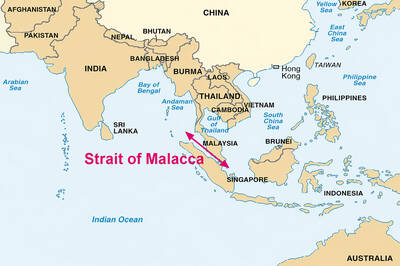
The closure of the Strait of Hormuz has forced policymakers in Asia to face questions over the security of other maritime chokepoints, including the Strait of Malacca, which is the world’s busiest waterway for international trade. WHAT IS THE MALACCA STRAIT? The 900km long Malacca Strait, bounded by Indonesia, Thailand, Malaysia and Singapore, provides the shortest sea route from East Asia to the Middle East and Europe. It carries nearly 22 percent of the world’s maritime trade, according to the Center for Strategic and International Studies (CSIS). This includes oil and gas shipments from the Middle East to the energy-hungry economies of China,
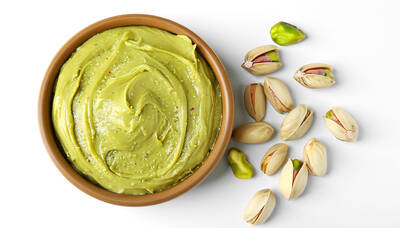
It seems like every year, new foods or drinks start trending and suddenly show up everywhere. A decade ago, avocado __1__ restaurant menus, while oat milk became the must-have addition to your coffee in cafes around five years back. The latest trend to hit this list is the pistachio. This flavorful green nut now features in everything from chocolate bars to Indian curries. While pistachios have long played a central role in certain regional cuisines, their recent global __2__ can be traced to Dubai. There, a specialty chocolate shop went __3__ on TikTok for one of its chocolate bars
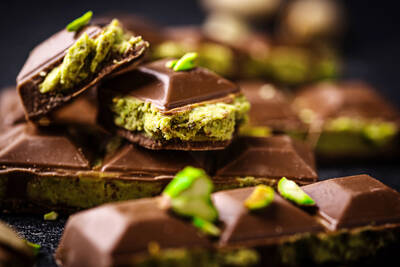
One reason pistachios have taken the food world by storm compared to other nuts is their soft, green color. When ground down into a cream or butter, the green hue __6__ nicely with golden pastries or dark-brown chocolate, making it perfect for Instagram photos and TikTok videos. Their labor-intensive cultivation and __7__ also contribute to their image as a premium ingredient. Thus, buying a pistachio-based product often feels like a __8__ treat. Pistachios also stand out for their distinct flavor and health __9__. They have a subtle, sweet, earthy flavor that goes well with both sweet desserts and


 RSS
RSS